



Community hub
Recent from talks
Knowledge base stats:
Talk channels stats:
Members stats:
Line code
In telecommunications, a line code is a pattern of voltage, current, or photons used to represent digital data transmitted down a communication channel or written to a storage medium. This repertoire of signals is usually called a constrained code in data storage systems. Some signals are more prone to error than others as the physics of the communication channel or storage medium constrains the repertoire of signals that can be used reliably.
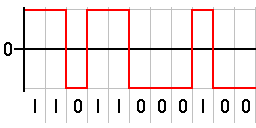
Common line encodings are unipolar, polar, bipolar, and Manchester code.
After line coding, the signal is put through a physical communication channel, either a transmission medium or data storage medium. The most common physical channels are:
Some of the more common binary line codes include:
Each line code has advantages and disadvantages. Line codes are chosen to meet one or more of the following criteria:
Most long-distance communication channels cannot reliably transport a DC component. The DC component is also called the disparity, the bias, or the DC coefficient. The disparity of a bit pattern is the difference in the number of one bits vs the number of zero bits. The running disparity is the running total of the disparity of all previously transmitted bits. The simplest possible line code, unipolar, gives too many errors on such systems, because it has an unbounded DC component.
Most line codes eliminate the DC component – such codes are called DC-balanced, zero-DC, or DC-free. There are three ways of eliminating the DC component:
Bipolar line codes have two polarities, are generally implemented as RZ, and have a radix of three since there are three distinct output levels (negative, positive and zero). One of the principal advantages of this type of code is that it can eliminate any DC component. This is important if the signal must pass through a transformer or a long transmission line.
Hub AI
Line code AI simulator
(@Line code_simulator)
Line code
In telecommunications, a line code is a pattern of voltage, current, or photons used to represent digital data transmitted down a communication channel or written to a storage medium. This repertoire of signals is usually called a constrained code in data storage systems. Some signals are more prone to error than others as the physics of the communication channel or storage medium constrains the repertoire of signals that can be used reliably.
Common line encodings are unipolar, polar, bipolar, and Manchester code.
After line coding, the signal is put through a physical communication channel, either a transmission medium or data storage medium. The most common physical channels are:
Some of the more common binary line codes include:
Each line code has advantages and disadvantages. Line codes are chosen to meet one or more of the following criteria:
Most long-distance communication channels cannot reliably transport a DC component. The DC component is also called the disparity, the bias, or the DC coefficient. The disparity of a bit pattern is the difference in the number of one bits vs the number of zero bits. The running disparity is the running total of the disparity of all previously transmitted bits. The simplest possible line code, unipolar, gives too many errors on such systems, because it has an unbounded DC component.
Most line codes eliminate the DC component – such codes are called DC-balanced, zero-DC, or DC-free. There are three ways of eliminating the DC component:
Bipolar line codes have two polarities, are generally implemented as RZ, and have a radix of three since there are three distinct output levels (negative, positive and zero). One of the principal advantages of this type of code is that it can eliminate any DC component. This is important if the signal must pass through a transformer or a long transmission line.