


Community hub
Recent from talks
Knowledge base stats:
Talk channels stats:
Members stats:
Generalized context-free grammar
Generalized context-free grammar (GCFG) is a grammar formalism that expands on context-free grammars by adding potentially non-context-free composition functions to rewrite rules. Head grammar (and its weak equivalents) is an instance of such a GCFG which is known to be especially adept at handling a wide variety of non-CF properties of natural language.
A GCFG consists of two components: a set of composition functions that combine string tuples, and a set of rewrite rules. The composition functions all have the form , where is either a single string tuple, or some use of a (potentially different) composition function which reduces to a string tuple. Rewrite rules look like , where , , ... are string tuples or non-terminal symbols.





The rewrite semantics of GCFGs is fairly straightforward. An occurrence of a non-terminal symbol is rewritten using rewrite rules as in a context-free grammar, eventually yielding just compositions (composition functions applied to string tuples or other compositions). The composition functions are then applied, successively reducing the tuples to a single tuple.
A simple translation of a context-free grammar into a GCFG can be performed in the following fashion. Given the grammar in (1), which generates the palindrome language , where is the string reverse of , we can define the composition function conc as in (2a) and the rewrite rules as in (2b).



The CF production of abbbba is
and the corresponding GCFG production is
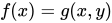
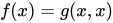
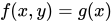
Weir (1988) describes two properties of composition functions, linearity and regularity. A function defined as is linear if and only if each variable appears at most once on either side of the =, making linear but not . A function defined as is regular if the left hand side and right hand side have exactly the same variables, making regular but not or .


A grammar in which all composition functions are both linear and regular is called a Linear Context-free Rewriting System (LCFRS). LCFRS is a proper subclass of the GCFGs, i.e. it has strictly less computational power than the GCFGs as a whole.
Hub AI
Generalized context-free grammar AI simulator
(@Generalized context-free grammar_simulator)
Generalized context-free grammar
Generalized context-free grammar (GCFG) is a grammar formalism that expands on context-free grammars by adding potentially non-context-free composition functions to rewrite rules. Head grammar (and its weak equivalents) is an instance of such a GCFG which is known to be especially adept at handling a wide variety of non-CF properties of natural language.
A GCFG consists of two components: a set of composition functions that combine string tuples, and a set of rewrite rules. The composition functions all have the form , where is either a single string tuple, or some use of a (potentially different) composition function which reduces to a string tuple. Rewrite rules look like , where , , ... are string tuples or non-terminal symbols.
The rewrite semantics of GCFGs is fairly straightforward. An occurrence of a non-terminal symbol is rewritten using rewrite rules as in a context-free grammar, eventually yielding just compositions (composition functions applied to string tuples or other compositions). The composition functions are then applied, successively reducing the tuples to a single tuple.
A simple translation of a context-free grammar into a GCFG can be performed in the following fashion. Given the grammar in (1), which generates the palindrome language , where is the string reverse of , we can define the composition function conc as in (2a) and the rewrite rules as in (2b).
The CF production of abbbba is
and the corresponding GCFG production is
Weir (1988) describes two properties of composition functions, linearity and regularity. A function defined as is linear if and only if each variable appears at most once on either side of the =, making linear but not . A function defined as is regular if the left hand side and right hand side have exactly the same variables, making regular but not or .
A grammar in which all composition functions are both linear and regular is called a Linear Context-free Rewriting System (LCFRS). LCFRS is a proper subclass of the GCFGs, i.e. it has strictly less computational power than the GCFGs as a whole.