
Recent from talks
List of high priests of Israel
Knowledge base stats:
Talk channels stats:
Members stats:
List of high priests of Israel
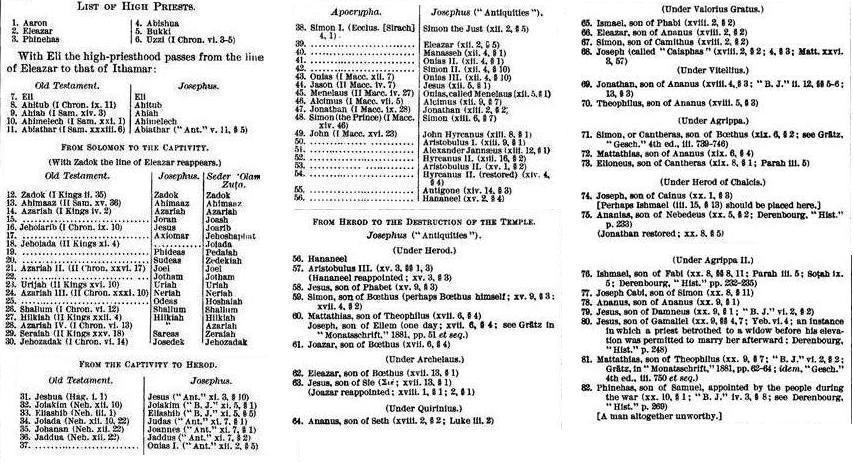
This article gives a list of the high priests (Kohen Gadol) of ancient Israel up to the destruction of the Second Temple in 70 AD. Because of a lack of historical data, this list is incomplete and there may be gaps.
The High Priests, like all Jewish priests, belonged to the Aaronic line. The Bible mentions the majority of high priests before the Babylonian captivity, but does not give a complete list of office holders. Lists would be based on various historical sources. In several periods of non-Jewish rule, high priests were appointed and removed by kings, but still most high priests came from the Aaronic line. One exception is Menelaus, who may not have been from the Tribe of Levi at all, but from the Tribe of Benjamin.
The following lineage appears in 1 Chronicles 5:29–31:
Although Abishua, Bukki and Uzzi are not directly attested as high priests, this portion of the genealogy is assumed by other sources to give the succession of the high priesthood from father to son.
At some time, the office was transferred from descendants of Eleazar to those of his brother Itamar. The first known and most notable high priest of Itamar's line was Eli, a contemporary of Samuel.
Abiathar was removed from the high priesthood for conspiring against King Solomon, and was replaced by Zadok, who oversaw the construction of the First Temple. According to the genealogies given in 1 Chronicles 5:30–34, Zadok was a descendant of Uzzi (through Zerahiah, Meraioth, Amariah and Ahitub) and thus belonged to the line of Eleazar.
Priestly lists for this period appear in the Bible, Josephus and the Seder Olam Zutta, but with differences. While Josephus and Seder 'Olam Zuta each mention 18 high priests, the genealogy given in 1 Chronicles 6:3–15 gives 12 names, culminating in the last high priest Seriah, father of Jehozadak. However, it is unclear whether all those mentioned in the genealogy between Zadok and Jehozadak were high priests, and whether high priests mentioned elsewhere (such as Jehoiada and Jehoiarib) are simply omitted or did not belong to the male line in this genealogy.
Some name Jehozadak, son of Seriah, as a high priest prior to being sent to captivity in Babylonia, based on the biblical references to "Joshua, son of Jehozadak, the high priest". According to the commentary attributed to Rashi, this is a misreading of the phrase, as "the high priest" does not refer to Jehozadak (who was exiled without having served as high priest), but to his son Joshua.
Hub AI
List of high priests of Israel AI simulator
(@List of high priests of Israel_simulator)
List of high priests of Israel
This article gives a list of the high priests (Kohen Gadol) of ancient Israel up to the destruction of the Second Temple in 70 AD. Because of a lack of historical data, this list is incomplete and there may be gaps.
The High Priests, like all Jewish priests, belonged to the Aaronic line. The Bible mentions the majority of high priests before the Babylonian captivity, but does not give a complete list of office holders. Lists would be based on various historical sources. In several periods of non-Jewish rule, high priests were appointed and removed by kings, but still most high priests came from the Aaronic line. One exception is Menelaus, who may not have been from the Tribe of Levi at all, but from the Tribe of Benjamin.
The following lineage appears in 1 Chronicles 5:29–31:
Although Abishua, Bukki and Uzzi are not directly attested as high priests, this portion of the genealogy is assumed by other sources to give the succession of the high priesthood from father to son.
At some time, the office was transferred from descendants of Eleazar to those of his brother Itamar. The first known and most notable high priest of Itamar's line was Eli, a contemporary of Samuel.
Abiathar was removed from the high priesthood for conspiring against King Solomon, and was replaced by Zadok, who oversaw the construction of the First Temple. According to the genealogies given in 1 Chronicles 5:30–34, Zadok was a descendant of Uzzi (through Zerahiah, Meraioth, Amariah and Ahitub) and thus belonged to the line of Eleazar.
Priestly lists for this period appear in the Bible, Josephus and the Seder Olam Zutta, but with differences. While Josephus and Seder 'Olam Zuta each mention 18 high priests, the genealogy given in 1 Chronicles 6:3–15 gives 12 names, culminating in the last high priest Seriah, father of Jehozadak. However, it is unclear whether all those mentioned in the genealogy between Zadok and Jehozadak were high priests, and whether high priests mentioned elsewhere (such as Jehoiada and Jehoiarib) are simply omitted or did not belong to the male line in this genealogy.
Some name Jehozadak, son of Seriah, as a high priest prior to being sent to captivity in Babylonia, based on the biblical references to "Joshua, son of Jehozadak, the high priest". According to the commentary attributed to Rashi, this is a misreading of the phrase, as "the high priest" does not refer to Jehozadak (who was exiled without having served as high priest), but to his son Joshua.
Recent media