



Community hub
Recent from talks
Contribute something to knowledge base
Content stats: 0 posts, 0 articles, 1 media, 0 notes
Members stats: 0 subscribers, 0 contributors, 0 moderators, 0 supporters
Subscribers
Supporters
Contributors
Moderators
Hub AI
Nerve block AI simulator
(@Nerve block_simulator)
Hub AI
Nerve block AI simulator
(@Nerve block_simulator)
Nerve block
Nerve block or regional nerve blockade is any deliberate interruption of signals traveling along a nerve, often for the purpose of pain relief. Local anesthetic nerve block (sometimes referred to as simply "nerve block") is a short-term block, usually lasting hours or days, involving the injection of an anesthetic, a corticosteroid, and other agents onto or near a nerve. Neurolytic block, the deliberate temporary degeneration of nerve fibers through the application of chemicals, heat, or freezing, produces a block that may persist for weeks, months, or indefinitely. Neurectomy, the cutting through or removal of a nerve or a section of a nerve, usually produces a permanent block. Because neurectomy of a sensory nerve is often followed, months later, by the emergence of new, more intense pain, sensory nerve neurectomy is rarely performed.
The concept of nerve block sometimes includes central nerve block, which includes epidural and spinal anaesthesia.
Local anesthetic nerve block (local anesthetic regional nerve blockade, or often simply nerve block) is a short-term nerve block involving the injection of local anesthetic as close to the nerve as possible for pain relief. The local anesthetic bathes the nerve and numbs the area of the body that is supplied by that nerve. The goal of the nerve block is to prevent pain by blocking the transmission of pain signals from the affected area. Local anesthetic is often combined with other drugs to potentiate or prolong the analgesia produced by the nerve block. These adjuvants may include epinephrine (or more specific alpha-adrenergic agonists), corticosteroids, opioids, or ketamine. These blocks can be either single treatments, multiple injections over a period of time, or continuous infusions. A continuous peripheral nerve block can be introduced into a limb undergoing surgery – for example, a femoral nerve block to prevent pain in knee replacement.
Regional blocks can be used for procedural anesthesia, post-operative analgesia, and treatment of acute pain in the emergency room. Consequently they can be an alternative to general anesthesia as well as oral pain medications. An advantage over oral pain medications is that regional blocks can provide complete relief of pain along a nerve distribution. This can lead to a reduction in the amount of opiates needed. Advantages over general anesthesia include faster recovery and less need for monitoring.
Nerve blocks can be used for the diagnosis of surgically treatable chronic pain, such as nerve compression syndrome. Advances in surgical techniques such as minimally invasive surgery have made virtually all peripheral nerves surgically accessible since the invention of open surgery. Any nerve that can be blocked can now be treated with a nerve decompression. Imaging such as MRI has poor correlation with clinical diagnosis of nerve entrapment as well as intraoperative findings of decompression surgeries and so diagnostic blocks are used for surgical planning.
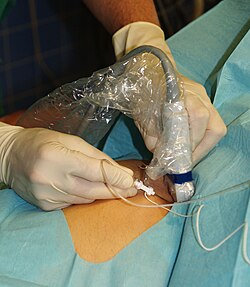
Local anesthetic nerve blocks are sterile procedures usually performed in an outpatient facility or hospital. The procedure can be performed with the help of ultrasound, fluoroscopy, CT, or MRI/MRN to guide the practitioner in the placement of the needle. The various imaging modalities differ in their availability, cost, spatial resolution, soft tissue resolution, bone resolution, radiation exposure, accuracy, real-time imaging capabilities, and ability to visualize small or deep nerves.
Landmark-guided (or "blind") nerve blocks use palpable anatomical landmarks and a working knowledge of the superficial and deep anatomy to determine where to place the needle. Although a peripheral nerve stimulator can be used to facilitate placement of the block, it is designed to elicit a motor response rather than creating a paresthesia, making it less effective for identifying purely sensory nerves. Landmark-guided injections have largely been replaced with image guidance due to increased accuracy, but there are some nerves for which landmark-guidance still has comparable accuracy, such as the pudendal nerve.
Fluoroscopy is an imaging technique that uses X-rays to obtain real-time moving planar images of the interior of an object. In this sense, fluoroscopy is a continuous x-ray. Fluoroscopy is broadly similar to landmark-guided injections except that the landmarks are based on radiographic anatomy. However, there is poor soft tissue contrast, meaning that nerves cannot be clearly visualized. Nerves that are situated by bony landmarks can be good candidates, such as epidural steroid injections, which target the spinal nerves.
Nerve block
Nerve block or regional nerve blockade is any deliberate interruption of signals traveling along a nerve, often for the purpose of pain relief. Local anesthetic nerve block (sometimes referred to as simply "nerve block") is a short-term block, usually lasting hours or days, involving the injection of an anesthetic, a corticosteroid, and other agents onto or near a nerve. Neurolytic block, the deliberate temporary degeneration of nerve fibers through the application of chemicals, heat, or freezing, produces a block that may persist for weeks, months, or indefinitely. Neurectomy, the cutting through or removal of a nerve or a section of a nerve, usually produces a permanent block. Because neurectomy of a sensory nerve is often followed, months later, by the emergence of new, more intense pain, sensory nerve neurectomy is rarely performed.
The concept of nerve block sometimes includes central nerve block, which includes epidural and spinal anaesthesia.
Local anesthetic nerve block (local anesthetic regional nerve blockade, or often simply nerve block) is a short-term nerve block involving the injection of local anesthetic as close to the nerve as possible for pain relief. The local anesthetic bathes the nerve and numbs the area of the body that is supplied by that nerve. The goal of the nerve block is to prevent pain by blocking the transmission of pain signals from the affected area. Local anesthetic is often combined with other drugs to potentiate or prolong the analgesia produced by the nerve block. These adjuvants may include epinephrine (or more specific alpha-adrenergic agonists), corticosteroids, opioids, or ketamine. These blocks can be either single treatments, multiple injections over a period of time, or continuous infusions. A continuous peripheral nerve block can be introduced into a limb undergoing surgery – for example, a femoral nerve block to prevent pain in knee replacement.
Regional blocks can be used for procedural anesthesia, post-operative analgesia, and treatment of acute pain in the emergency room. Consequently they can be an alternative to general anesthesia as well as oral pain medications. An advantage over oral pain medications is that regional blocks can provide complete relief of pain along a nerve distribution. This can lead to a reduction in the amount of opiates needed. Advantages over general anesthesia include faster recovery and less need for monitoring.
Nerve blocks can be used for the diagnosis of surgically treatable chronic pain, such as nerve compression syndrome. Advances in surgical techniques such as minimally invasive surgery have made virtually all peripheral nerves surgically accessible since the invention of open surgery. Any nerve that can be blocked can now be treated with a nerve decompression. Imaging such as MRI has poor correlation with clinical diagnosis of nerve entrapment as well as intraoperative findings of decompression surgeries and so diagnostic blocks are used for surgical planning.
Local anesthetic nerve blocks are sterile procedures usually performed in an outpatient facility or hospital. The procedure can be performed with the help of ultrasound, fluoroscopy, CT, or MRI/MRN to guide the practitioner in the placement of the needle. The various imaging modalities differ in their availability, cost, spatial resolution, soft tissue resolution, bone resolution, radiation exposure, accuracy, real-time imaging capabilities, and ability to visualize small or deep nerves.
Landmark-guided (or "blind") nerve blocks use palpable anatomical landmarks and a working knowledge of the superficial and deep anatomy to determine where to place the needle. Although a peripheral nerve stimulator can be used to facilitate placement of the block, it is designed to elicit a motor response rather than creating a paresthesia, making it less effective for identifying purely sensory nerves. Landmark-guided injections have largely been replaced with image guidance due to increased accuracy, but there are some nerves for which landmark-guidance still has comparable accuracy, such as the pudendal nerve.
Fluoroscopy is an imaging technique that uses X-rays to obtain real-time moving planar images of the interior of an object. In this sense, fluoroscopy is a continuous x-ray. Fluoroscopy is broadly similar to landmark-guided injections except that the landmarks are based on radiographic anatomy. However, there is poor soft tissue contrast, meaning that nerves cannot be clearly visualized. Nerves that are situated by bony landmarks can be good candidates, such as epidural steroid injections, which target the spinal nerves.
Recent media
Recent media