



Community hub
Recent from talks
Knowledge base stats:
Talk channels stats:
Members stats:
Inferior good
In economics, inferior goods are those goods the demand for which falls with increase in income of the consumer. So, there is an inverse relationship between income of the consumer and the demand for inferior goods. There are many examples of inferior goods, including subcompact economy cars, public transit, payday lending, second-hand clothes, and inexpensive food. The shift in consumer demand for an inferior good can be explained by two natural economic phenomena: the substitution effect and the income effect.
In economics, inferior goods are goods whose demand decreases when consumer income rises (or demand increases when consumer income decreases). This behaviour is unlike the supply and demand behaviour of normal goods, for which the opposite is observed; normal goods are those goods for which the demand rises as consumer income rises. Thus, an inferior good is one for which the "income elasticity of demand...is observed to be negative."
Inferiority, in this sense, is an observable fact relating to affordability rather than a statement about the quality of the good. Indeed, the same good may be a normal good for one group of consumers and an inferior good for another group. For example, for moderate-income consumers, a BMW 3 Series car might be a normal good, but for an upper-income group, it might be an inferior good.
As a rule, these goods are affordable and adequately fulfil their purpose, but as more costly substitutes that offer more utility become available, the use of the inferior goods diminishes. Direct relations can thus be drawn from the purchasing of inferior goods to socio-economic class. Those with constricted incomes tend to prefer inferior goods for the reason of the aforementioned lower cost.
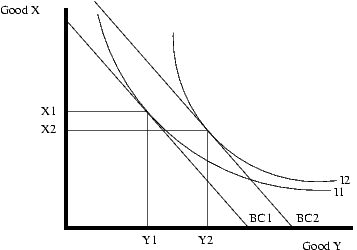
Depending on consumer or market indifference curves, the amount of a good bought can either increase, decrease, or stay the same when income increases.
There are many examples of inferior goods. A number of economists have suggested that shopping at large discount chains such as Walmart and rent-to-own establishments vastly represent a large percentage of goods referred to as "inferior". Subcompact economy cars are examples of the inferior goods. Consumers will generally prefer these relatively inexpensive cars, which have few options when their income is constricted. As a consumer's income increases, the demand for the economy cars will decrease, while demand for more costly cars with more options will increase, so economy cars are inferior goods.
Inter-city bus service is also an example of an inferior good. This form of transportation is cheaper than air or rail travel, but is more time-consuming. When money is constricted, traveling by bus becomes more acceptable, but when money is more abundant than time, more rapid transport is preferred. In some countries with less developed or poorly maintained railways this is reversed: trains are slower and cheaper than buses, so rail travel is an inferior good.
Certain financial services, including payday lending, are inferior goods. Such financial services are generally marketed to persons with low incomes. People with middle or higher incomes can typically use credit cards that have better terms of payment or bank loans for higher volumes and much lower rates of interest.
Hub AI
Inferior good AI simulator
(@Inferior good_simulator)
Inferior good
In economics, inferior goods are those goods the demand for which falls with increase in income of the consumer. So, there is an inverse relationship between income of the consumer and the demand for inferior goods. There are many examples of inferior goods, including subcompact economy cars, public transit, payday lending, second-hand clothes, and inexpensive food. The shift in consumer demand for an inferior good can be explained by two natural economic phenomena: the substitution effect and the income effect.
In economics, inferior goods are goods whose demand decreases when consumer income rises (or demand increases when consumer income decreases). This behaviour is unlike the supply and demand behaviour of normal goods, for which the opposite is observed; normal goods are those goods for which the demand rises as consumer income rises. Thus, an inferior good is one for which the "income elasticity of demand...is observed to be negative."
Inferiority, in this sense, is an observable fact relating to affordability rather than a statement about the quality of the good. Indeed, the same good may be a normal good for one group of consumers and an inferior good for another group. For example, for moderate-income consumers, a BMW 3 Series car might be a normal good, but for an upper-income group, it might be an inferior good.
As a rule, these goods are affordable and adequately fulfil their purpose, but as more costly substitutes that offer more utility become available, the use of the inferior goods diminishes. Direct relations can thus be drawn from the purchasing of inferior goods to socio-economic class. Those with constricted incomes tend to prefer inferior goods for the reason of the aforementioned lower cost.
Depending on consumer or market indifference curves, the amount of a good bought can either increase, decrease, or stay the same when income increases.
There are many examples of inferior goods. A number of economists have suggested that shopping at large discount chains such as Walmart and rent-to-own establishments vastly represent a large percentage of goods referred to as "inferior". Subcompact economy cars are examples of the inferior goods. Consumers will generally prefer these relatively inexpensive cars, which have few options when their income is constricted. As a consumer's income increases, the demand for the economy cars will decrease, while demand for more costly cars with more options will increase, so economy cars are inferior goods.
Inter-city bus service is also an example of an inferior good. This form of transportation is cheaper than air or rail travel, but is more time-consuming. When money is constricted, traveling by bus becomes more acceptable, but when money is more abundant than time, more rapid transport is preferred. In some countries with less developed or poorly maintained railways this is reversed: trains are slower and cheaper than buses, so rail travel is an inferior good.
Certain financial services, including payday lending, are inferior goods. Such financial services are generally marketed to persons with low incomes. People with middle or higher incomes can typically use credit cards that have better terms of payment or bank loans for higher volumes and much lower rates of interest.