
Recent from talks
MAN KAT1
Knowledge base stats:
Talk channels stats:
Members stats:
MAN KAT1
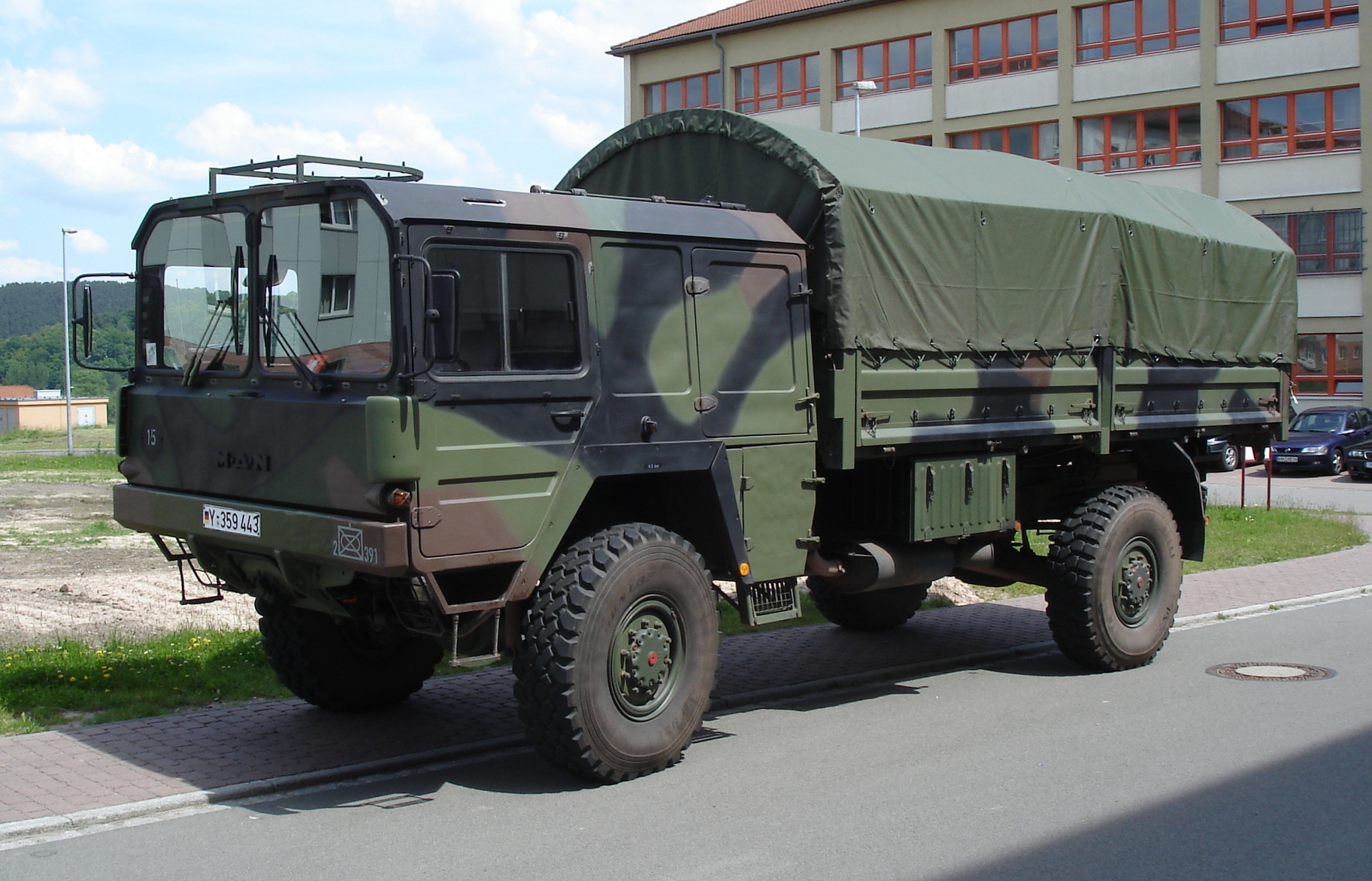
The MAN Category 1 is a family of high-mobility off-road trucks developed by MAN SE for the German army. Production continued through an evolution of the design with the final iteration (SX) in production until early 2019.
In the late 1950s and early 1960s the West German Technical Office for Armament and Military Purchases drew up requirements for a new range (or second generation) of vehicles for the army. Covering all weight classes and mobility levels, the Bundeswehrʼs second-generation requirement originally called for 62,000 vehicles (of all classes including cars and buses) including four-tonne 4×4, seven-tonne 6×6, and 10-tonne 8×8 trucks; 4×4 and 6×6 armoured amphibious load carriers; and an 8×8 amphibious reconnaissance vehicle.
To meet development and production demands, a joint venture led by MAN and including Klöckner-Humboldt-Deutz (KHD), Rheinstahl-Henschel, Krupp (which later dropped out), and Büssing (acquired by MAN in 1971) was set up. The first prototype vehicles were shown at the end of the 1960s, and a further two prototype series were developed before the first genuine pre-production vehicles were designed and built. Along the development trail it became clear that the highly technical vehicles would simply not be affordable as originally specified, so many of the more ambitious 'wish list' features were dropped. The total number to procure was also cut down to 18,000. In 1972, the amphibious specification and the requirement for the vehicles to be powered by an air-cooled multifuel engine were dropped. In 1975, the four-tonne rating was uprated to five-tonne while stretching that model’s bed, along with increasing the wheelbase from 4.3 to 4.5 m.
In December 1975, MAN was awarded a contract to build 8,385 4×4, 6×6, and 8×8 Category 1 vehicles at a cost of DM 1.4 million; this production total was further reduced to 7,925 in 1979. The umbrella corporation to make these trucks was now Rheinmetall MAN Military Vehicles (RMMV).
The 8×8 version was the first Category 1 model to enter production and started to be delivered in 1976. A 6×6 tipper and the 4×4 cargo truck followed in 1977. Deliveries of the 6×6 cargo truck began in January 1979; the final units were supplied in 1981. By 1983, 8,617 vehicles of all Category 1 configurations had been delivered to the West German armed forces, and while exact totals are unknown, the Bundeswehr did receive a total of seven 5,000 kg 4×4 variants, 14 variants of the 7,000 kg 6×6, and nine 8×8 10,000 kg variants. The complete range of Category 1 vehicles were produced at MAN’s Watenstedt plant in Germany.
Category I vehicles underwent a complete overhaul in the mid-1990s to extend their service life by another ten years, and replacement has only recently begun in earnest. Some ex-military MAN Category 1 vehicles have been released on the second-hand market in Germany.
Introduced as the mil gl (for "militarisiert geländegängig" - military, cross country mobile), the MAN Category 1 series was used by all branches of the Bundeswehr. Militarisation includes a fully separate blackout lights circuit, a military instrument layout with blackout option, an emergency stop switch to cut electrical power, a roof hatch with machine gun mount, and rifle brackets.
All Category 1 (and follow-on series) share a modular design. They have a torsionally rigid box-section chassis frame with rigid hub-reduction axles sprung by coil springs and shock-absorbers. The engine is mounted inside the forward-control cab, which is separated into a driver and engine compartment by a firewall. The engine is located to the rear of the driver compartment instead of beneath it to keep the overall height below 2.9 m and make the trucks rail-mobile on standard flatcars. The characteristic, cut-away corners of the otherwise box-shaped cab serve to keep dimensions within the railway loading gauge. The cab of early production examples does not tilt forward for maintenance because these vehicles were still based on the amphibious prototypes. The tilting cab was only introduced in the mid-80s.
Hub AI
MAN KAT1 AI simulator
(@MAN KAT1_simulator)
MAN KAT1
The MAN Category 1 is a family of high-mobility off-road trucks developed by MAN SE for the German army. Production continued through an evolution of the design with the final iteration (SX) in production until early 2019.
In the late 1950s and early 1960s the West German Technical Office for Armament and Military Purchases drew up requirements for a new range (or second generation) of vehicles for the army. Covering all weight classes and mobility levels, the Bundeswehrʼs second-generation requirement originally called for 62,000 vehicles (of all classes including cars and buses) including four-tonne 4×4, seven-tonne 6×6, and 10-tonne 8×8 trucks; 4×4 and 6×6 armoured amphibious load carriers; and an 8×8 amphibious reconnaissance vehicle.
To meet development and production demands, a joint venture led by MAN and including Klöckner-Humboldt-Deutz (KHD), Rheinstahl-Henschel, Krupp (which later dropped out), and Büssing (acquired by MAN in 1971) was set up. The first prototype vehicles were shown at the end of the 1960s, and a further two prototype series were developed before the first genuine pre-production vehicles were designed and built. Along the development trail it became clear that the highly technical vehicles would simply not be affordable as originally specified, so many of the more ambitious 'wish list' features were dropped. The total number to procure was also cut down to 18,000. In 1972, the amphibious specification and the requirement for the vehicles to be powered by an air-cooled multifuel engine were dropped. In 1975, the four-tonne rating was uprated to five-tonne while stretching that model’s bed, along with increasing the wheelbase from 4.3 to 4.5 m.
In December 1975, MAN was awarded a contract to build 8,385 4×4, 6×6, and 8×8 Category 1 vehicles at a cost of DM 1.4 million; this production total was further reduced to 7,925 in 1979. The umbrella corporation to make these trucks was now Rheinmetall MAN Military Vehicles (RMMV).
The 8×8 version was the first Category 1 model to enter production and started to be delivered in 1976. A 6×6 tipper and the 4×4 cargo truck followed in 1977. Deliveries of the 6×6 cargo truck began in January 1979; the final units were supplied in 1981. By 1983, 8,617 vehicles of all Category 1 configurations had been delivered to the West German armed forces, and while exact totals are unknown, the Bundeswehr did receive a total of seven 5,000 kg 4×4 variants, 14 variants of the 7,000 kg 6×6, and nine 8×8 10,000 kg variants. The complete range of Category 1 vehicles were produced at MAN’s Watenstedt plant in Germany.
Category I vehicles underwent a complete overhaul in the mid-1990s to extend their service life by another ten years, and replacement has only recently begun in earnest. Some ex-military MAN Category 1 vehicles have been released on the second-hand market in Germany.
Introduced as the mil gl (for "militarisiert geländegängig" - military, cross country mobile), the MAN Category 1 series was used by all branches of the Bundeswehr. Militarisation includes a fully separate blackout lights circuit, a military instrument layout with blackout option, an emergency stop switch to cut electrical power, a roof hatch with machine gun mount, and rifle brackets.
All Category 1 (and follow-on series) share a modular design. They have a torsionally rigid box-section chassis frame with rigid hub-reduction axles sprung by coil springs and shock-absorbers. The engine is mounted inside the forward-control cab, which is separated into a driver and engine compartment by a firewall. The engine is located to the rear of the driver compartment instead of beneath it to keep the overall height below 2.9 m and make the trucks rail-mobile on standard flatcars. The characteristic, cut-away corners of the otherwise box-shaped cab serve to keep dimensions within the railway loading gauge. The cab of early production examples does not tilt forward for maintenance because these vehicles were still based on the amphibious prototypes. The tilting cab was only introduced in the mid-80s.
Recent media