


Community hub
Recent from talks
Contribute something to knowledge base
Content stats: 0 posts, 0 articles, 1 media, 0 notes
Members stats: 0 subscribers, 0 contributors, 0 moderators, 0 supporters
Subscribers
Supporters
Contributors
Moderators
Hub AI
M1903 Springfield AI simulator
(@M1903 Springfield_simulator)
Hub AI
M1903 Springfield AI simulator
(@M1903 Springfield_simulator)
M1903 Springfield
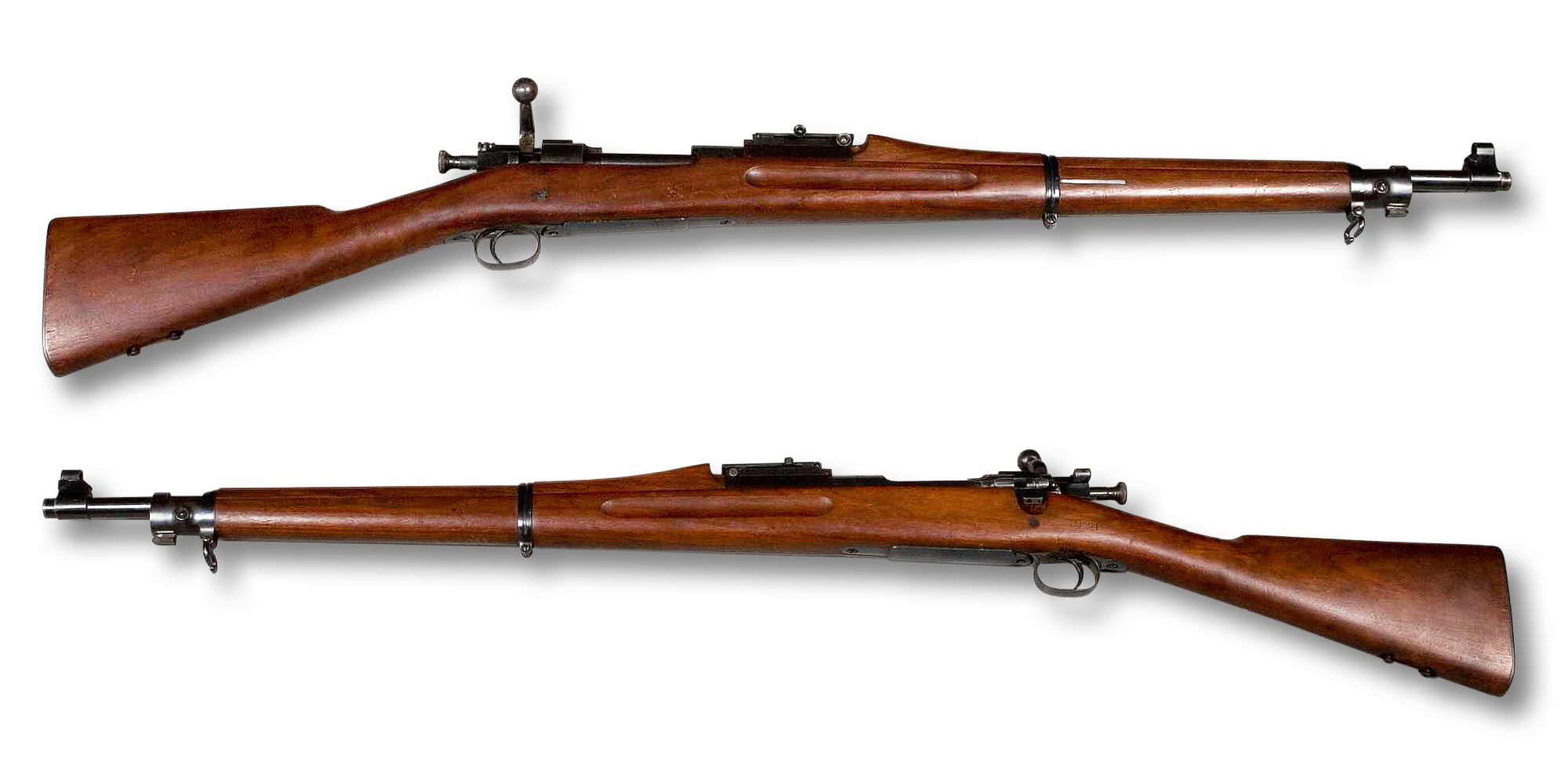
The M1903 Springfield, officially the U.S. Rifle, Caliber .30, M1903, is an American five-round, non-removable, staggered-row box magazine-fed, bolt-action, repeating service rifle, used primarily during the first half of the 20th century.
The M1903 was first used in combat during the Philippine-American War and was officially adopted by the United States as the standard infantry rifle on 19 June 1903. It saw service in World War I and was replaced by the faster-firing semi-automatic eight-round M1 Garand starting in 1936. However, the M1903 remained a standard-issue infantry rifle during World War II, since the U.S. entered the war without sufficient M1 rifles to arm all troops. It also was used as a sniper rifle during World War II, the Korean War and the Vietnam War. It remains popular as a civilian firearm, collector's piece, a competitive shooting rifle and as a military drill rifle.
During the 1898 war with Spain, the Mauser M1893 used by the Spanish Army gained a deadly reputation, particularly from the Battle of San Juan Hill, where 750 Spanish regulars significantly delayed the advance of 15,000 US troops armed with outclassed Springfield Krag–Jørgensen bolt-action rifles and older single-shot Springfield model 1873 trapdoor rifles. The Spanish soldiers inflicted 1,400 casualties on the US in a matter of minutes. Likewise, earlier in the day, a Spanish force of 540 regulars armed with the same Mauser rifles, under Spanish general Vara Del Rey, held off General Henry Ware Lawton's Second Division of 6,653 American soldiers and an independent brigade of 1,800 men for ten hours in the nearby town of El Caney, keeping that division from assisting in the attack on the San Juan Heights. A US Army board of investigation was commissioned as a direct result of both battles. They recommended replacement of the Krag.
The 1903 adoption of the M1903 was preceded by nearly 30 years of struggle and politics, using lessons learned from the recently adopted Krag–Jørgensen and contemporary German Mauser Gewehr 98 bolt-action rifles. The design itself is largely based on the Mauser M1893 and its successive models up to the Gewehr 98 rifle. The M1903's forward receiver ring diameter is 1.305 in (33.15 mm), slightly over the 33 mm (1.30 in) ring diameter of the older "small ring" Mauser models and less than the "large ring" 35.8 mm (1.41 in) Gewehr 98s. The US military licensed many of the Mauser Company's and other German patents, including the spitzer bullet, later modified into the .30-06 Springfield. The M1903 not only replaced the various versions of the U.S. Army's Krag, but also the Lee M1895 and M1885 Remington–Lee used by the United States Navy and the United States Marine Corps, as well as all remaining single-shot trapdoor rifles. While the Krag had been issued with barrel lengths of both 30-inch rifle and 22-inch carbine models, the Springfield was issued only as a short 24-inch-barrel rifle in keeping with current trends in Switzerland and Great Britain to eliminate the need for both long rifles and carbines.
The two main problems usually cited with the Krag were its slow-to-load magazine and its inability to handle higher chamber pressures for high-velocity rounds. The United States Army attempted to introduce a higher-velocity cartridge in 1899 for the existing Krags, but its single locking lug on the bolt could not withstand the extra chamber pressure. Though a stripper-clip or charger loading modification to the Krag was designed, it was clear to Army authorities that a new rifle was required. After the U.S. military's experience with the Mauser rifle in the 1898 Spanish–American War, authorities decided to adopt a stronger Mauser-derived bolt-action design equipped with a charger- or stripper clip-loaded box magazine.
In 1882, the bolt action Remington Lee rifle design of 1879, with its newly invented detachable box magazine, was purchased in limited numbers by the U.S. Navy. Several hundred M1882 Lee Navy models (M1882 Remington-Lee) were also subjected to trials by the U.S. Army during the 1880s, though the rifle was not formally adopted. The Navy adopted the M1885, and later different style Lee M1895 (a 6 mm straight pull bolt), which saw service in the Boxer Rebellion. In Army service, both the M1885 and M1895 6 mm Lee were used in the Spanish–American War, along with the .30-40 Krag and the .45-70. The Lee rifle's detachable box magazine was invented by James Paris Lee, and was very influential on later rifle designs. Other advancements had made it clear that the Army needed a replacement. In 1892, the U.S. military held a series of rifle trials, resulting in the adoption of the .30-40 Krag–Jørgensen rifle. The Krag officially entered U.S. service in 1894, only to be replaced nine years later by the M1903.
Thousands of Spanish Mauser M1893 rifles, surrendered by Spanish troops in Cuba, were returned to the US and extensively studied at Springfield Armory, where it was decided that the Mauser was the superior design.
A prototype rifle was produced in 1900; it was very similar to rifle No. 5, the final Mauser M92 prototype in the U.S. Army rifle trials of 1892. This design was rejected, and a new design combining features of the M1898 Krag rifle and the Spanish Mauser M1893 was developed.
M1903 Springfield
The M1903 Springfield, officially the U.S. Rifle, Caliber .30, M1903, is an American five-round, non-removable, staggered-row box magazine-fed, bolt-action, repeating service rifle, used primarily during the first half of the 20th century.
The M1903 was first used in combat during the Philippine-American War and was officially adopted by the United States as the standard infantry rifle on 19 June 1903. It saw service in World War I and was replaced by the faster-firing semi-automatic eight-round M1 Garand starting in 1936. However, the M1903 remained a standard-issue infantry rifle during World War II, since the U.S. entered the war without sufficient M1 rifles to arm all troops. It also was used as a sniper rifle during World War II, the Korean War and the Vietnam War. It remains popular as a civilian firearm, collector's piece, a competitive shooting rifle and as a military drill rifle.
During the 1898 war with Spain, the Mauser M1893 used by the Spanish Army gained a deadly reputation, particularly from the Battle of San Juan Hill, where 750 Spanish regulars significantly delayed the advance of 15,000 US troops armed with outclassed Springfield Krag–Jørgensen bolt-action rifles and older single-shot Springfield model 1873 trapdoor rifles. The Spanish soldiers inflicted 1,400 casualties on the US in a matter of minutes. Likewise, earlier in the day, a Spanish force of 540 regulars armed with the same Mauser rifles, under Spanish general Vara Del Rey, held off General Henry Ware Lawton's Second Division of 6,653 American soldiers and an independent brigade of 1,800 men for ten hours in the nearby town of El Caney, keeping that division from assisting in the attack on the San Juan Heights. A US Army board of investigation was commissioned as a direct result of both battles. They recommended replacement of the Krag.
The 1903 adoption of the M1903 was preceded by nearly 30 years of struggle and politics, using lessons learned from the recently adopted Krag–Jørgensen and contemporary German Mauser Gewehr 98 bolt-action rifles. The design itself is largely based on the Mauser M1893 and its successive models up to the Gewehr 98 rifle. The M1903's forward receiver ring diameter is 1.305 in (33.15 mm), slightly over the 33 mm (1.30 in) ring diameter of the older "small ring" Mauser models and less than the "large ring" 35.8 mm (1.41 in) Gewehr 98s. The US military licensed many of the Mauser Company's and other German patents, including the spitzer bullet, later modified into the .30-06 Springfield. The M1903 not only replaced the various versions of the U.S. Army's Krag, but also the Lee M1895 and M1885 Remington–Lee used by the United States Navy and the United States Marine Corps, as well as all remaining single-shot trapdoor rifles. While the Krag had been issued with barrel lengths of both 30-inch rifle and 22-inch carbine models, the Springfield was issued only as a short 24-inch-barrel rifle in keeping with current trends in Switzerland and Great Britain to eliminate the need for both long rifles and carbines.
The two main problems usually cited with the Krag were its slow-to-load magazine and its inability to handle higher chamber pressures for high-velocity rounds. The United States Army attempted to introduce a higher-velocity cartridge in 1899 for the existing Krags, but its single locking lug on the bolt could not withstand the extra chamber pressure. Though a stripper-clip or charger loading modification to the Krag was designed, it was clear to Army authorities that a new rifle was required. After the U.S. military's experience with the Mauser rifle in the 1898 Spanish–American War, authorities decided to adopt a stronger Mauser-derived bolt-action design equipped with a charger- or stripper clip-loaded box magazine.
In 1882, the bolt action Remington Lee rifle design of 1879, with its newly invented detachable box magazine, was purchased in limited numbers by the U.S. Navy. Several hundred M1882 Lee Navy models (M1882 Remington-Lee) were also subjected to trials by the U.S. Army during the 1880s, though the rifle was not formally adopted. The Navy adopted the M1885, and later different style Lee M1895 (a 6 mm straight pull bolt), which saw service in the Boxer Rebellion. In Army service, both the M1885 and M1895 6 mm Lee were used in the Spanish–American War, along with the .30-40 Krag and the .45-70. The Lee rifle's detachable box magazine was invented by James Paris Lee, and was very influential on later rifle designs. Other advancements had made it clear that the Army needed a replacement. In 1892, the U.S. military held a series of rifle trials, resulting in the adoption of the .30-40 Krag–Jørgensen rifle. The Krag officially entered U.S. service in 1894, only to be replaced nine years later by the M1903.
Thousands of Spanish Mauser M1893 rifles, surrendered by Spanish troops in Cuba, were returned to the US and extensively studied at Springfield Armory, where it was decided that the Mauser was the superior design.
A prototype rifle was produced in 1900; it was very similar to rifle No. 5, the final Mauser M92 prototype in the U.S. Army rifle trials of 1892. This design was rejected, and a new design combining features of the M1898 Krag rifle and the Spanish Mauser M1893 was developed.
Recent media
Recent media