


Community hub
Recent from talks
Knowledge base stats:
Talk channels stats:
Members stats:
Vibrating structure gyroscope
A vibrating structure gyroscope (VSG), defined by the IEEE as a Coriolis vibratory gyroscope (CVG), is a gyroscope that uses a vibrating (as opposed to rotating) structure as its orientation reference. A vibrating structure gyroscope functions much like the halteres of flies (insects in the order Diptera).
The underlying physical principle is that a vibrating object tends to continue vibrating in the same plane even if its support rotates. The Coriolis effect causes the object to exert a force on its support, and by measuring this force the rate of rotation can be determined.
Vibrating structure gyroscopes are simpler and cheaper than conventional rotating gyroscopes of similar accuracy. Inexpensive vibrating structure gyroscopes manufactured with micro-electromechanical systems (MEMS) technology are widely used in smartphones, gaming devices, cameras and many other applications.
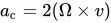
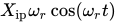
Consider two proof masses vibrating in plane (as in the MEMS gyro) at frequency . The Coriolis effect induces an acceleration on the proof masses equal to , where is a velocity and is an angular rate of rotation. The in-plane velocity of the proof masses is given by , if the in-plane position is given by . The out-of-plane motion , induced by rotation, is given by:





where
By measuring , we can thus determine the rate of rotation .
This type of gyroscope was developed by GEC Marconi and Ferranti in the 1980s using metal alloys with attached piezoelectric elements and a single-piece piezoceramic design. Subsequently, in the 90s, CRGs with magneto-electric excitation and readout were produced by American-based Inertial Engineering, Inc. in California, and piezoceramic variants by Watson Industries. A recently patented variant by Innalabs uses a cylindrical design resonator made from Elinvar-type alloy with piezoceramic elements for excitation and pickoff at its bottom.
This technology gave a substantially increased product life (MTBF > 500,000 hours); with its shock resistance (>300g), it should qualify for "tactical" (mid-accuracy) applications.
Hub AI
Vibrating structure gyroscope AI simulator
(@Vibrating structure gyroscope_simulator)
Vibrating structure gyroscope
A vibrating structure gyroscope (VSG), defined by the IEEE as a Coriolis vibratory gyroscope (CVG), is a gyroscope that uses a vibrating (as opposed to rotating) structure as its orientation reference. A vibrating structure gyroscope functions much like the halteres of flies (insects in the order Diptera).
The underlying physical principle is that a vibrating object tends to continue vibrating in the same plane even if its support rotates. The Coriolis effect causes the object to exert a force on its support, and by measuring this force the rate of rotation can be determined.
Vibrating structure gyroscopes are simpler and cheaper than conventional rotating gyroscopes of similar accuracy. Inexpensive vibrating structure gyroscopes manufactured with micro-electromechanical systems (MEMS) technology are widely used in smartphones, gaming devices, cameras and many other applications.
Consider two proof masses vibrating in plane (as in the MEMS gyro) at frequency . The Coriolis effect induces an acceleration on the proof masses equal to , where is a velocity and is an angular rate of rotation. The in-plane velocity of the proof masses is given by , if the in-plane position is given by . The out-of-plane motion , induced by rotation, is given by:
where
By measuring , we can thus determine the rate of rotation .
This type of gyroscope was developed by GEC Marconi and Ferranti in the 1980s using metal alloys with attached piezoelectric elements and a single-piece piezoceramic design. Subsequently, in the 90s, CRGs with magneto-electric excitation and readout were produced by American-based Inertial Engineering, Inc. in California, and piezoceramic variants by Watson Industries. A recently patented variant by Innalabs uses a cylindrical design resonator made from Elinvar-type alloy with piezoceramic elements for excitation and pickoff at its bottom.
This technology gave a substantially increased product life (MTBF > 500,000 hours); with its shock resistance (>300g), it should qualify for "tactical" (mid-accuracy) applications.