
Recent from talks
Menasseh Ben Israel
Knowledge base stats:
Talk channels stats:
Members stats:
Menasseh Ben Israel
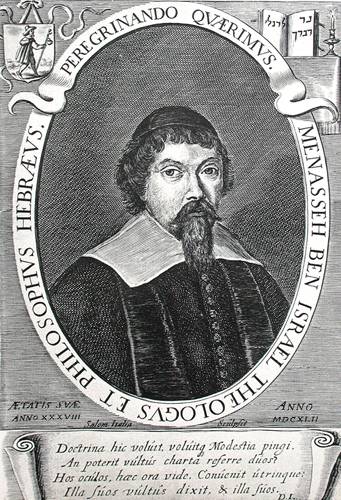
Manoel Dias Soeiro (Dutch: [maːˈnul ˈdijɑ(s) ˈsʋeːroː];[needs Ladino IPA] 1604 – 20 November 1657), better known by his Hebrew name Menasseh or Menashe ben Israel (מנשה בן ישראל), was a Jewish scholar, rabbi, kabbalist, writer, diplomat, printer, publisher, and founder of the first Hebrew printing press (named Emeth Meerets Titsmah) in Amsterdam in 1626.
Menasseh was born in La Rochelle in 1604, with the name Manoel Dias Soeiro, a year after his parents had left mainland Portugal because of the Inquisition. The family moved to the Netherlands in 1610. The Netherlands was in the middle of a process of religious revolt against Catholic Spanish rule throughout the Eighty Years' War (1568–1648). Amsterdam was an important center of Jewish life in Europe at this time. The family's arrival in 1610 was during the Twelve Years' Truce mediated by France and England at The Hague. In Amsterdam he studied under Moses Raphael de Aguilar.
Menasseh rose to eminence not only as a rabbi and an author, but also as a printer. He established the first Hebrew press in Holland. One of his earliest works, El Conciliador, published in 1632, won immediate reputation; it was an attempt to reconcile apparent discrepancies in various parts of the Hebrew Bible. Among his correspondents were Gerardus Vossius, Hugo Grotius, Petrus Serrarius, António Vieira and Pierre Daniel Huet. In 1638, he decided to settle in Brazil, as he still found it difficult to provide for his wife and family in Amsterdam. He may have visited the Dutch colony's capital of Recife, but did not move there. One of the reasons his financial situation improved in Amsterdam was the arrival of two Portuguese Jewish entrepreneurs, the brothers Abraham and Isaac Pereyra. They hired Rabbi Manasseh to direct a small college or academy (a yeshibah in Spanish-Portuguese parlance of the time) they had founded in the city.
In 1644, Menasseh met Antonio de Montezinos, a Portuguese traveler and Marrano Sephardic Jew who had been in the New World. Montezinos convinced him of his conclusion that the South America Andes' Indians were the descendants of the lost ten tribes of Israel. This purported discovery gave a new impulse to Menasseh's Messianic hopes, as the settlement of Jews throughout the world was supposed to be a sign that the Messiah would come. Filled with this idea, he turned his attention to England, whence the Jews had been expelled since 1290. He worked to get them permission to settle there again and thus hasten the Messiah's coming.
With the start of the Commonwealth of England, the question of the readmission of the Jews had found increased Puritan support, but it was often mooted under the growing desire for religious liberty. In addition, Messianic and other mystic hopes were then current in England. His book, The Hope of Israel, was first published in Amsterdam in Latin (Spes Israelis) and in Spanish (Esperança de Israel) in 1650. The book was written in response to a 1648 letter from John Dury enquiring about Montezinos' claims. In addition to reporting Montezinos' accounts of Jews in the Americas, the book also expressed the hope that the Jews would return to England as a way of hastening the coming of the messiah. Menasseh also stresses his kinship with parliament, and explains himself as driven by amity for England rather than financial gain.
In 1651 he offered to serve Christina, Queen of Sweden as her agent of Hebrew books. The same year he met Oliver St John and his envoys on his mission to secure an Anglo-Dutch coalition (which would have given Dutch citizens, and thus Jews, privileges to stay and work in England). The English were impressed by learning and manner, and advised him to formally apply for Jewish readmission to England. In 1652 The Hope of Israel was translated from Latin into English by John Dury or one of his associates, and it was published in London by Moses Wall, prefixed with a dedication to the Parliament and the Council of State; his account of descendants of the Lost Tribes being found in the New World deeply impressed public opinion and stirred up many polemics in English literature. This included a debate between Edward Spencer and Moses Wall, an MP and a scholar respectively, on ben Israel's millennial claims and the manner in which the Jews would be converted. Wall and Spencer's letters were printed in later additions of the book. Despite their historic misfortunes and movements, Menasseh characterizes the condition of Jewry at the time by saying:
Hence it may be seen that God hath not left us; for if one persecutes us, another receives us civilly and courteously; and if this prince treats us ill, another treats us well; if one banisheth us out of his country, another invites us with a thousand privileges; as divers princes of Italy have done, the most eminent King of Denmark, and the mighty Duke of Savoy in Nissa. And do we not see that those Republiques do flourish and much increase in trade who admit the Israelites?
Oliver Cromwell was sympathetic to the Jewish cause, partly because of his tolerant leanings but chiefly because he foresaw the importance for English commerce of the participation of the Jewish merchant princes, some of whom had already made their way to London. At this juncture, the English gave Jews full rights in the colony of Surinam, which they had controlled since 1650. There is some debate among historians concerning whether Menasseh's motives for pursuing the readmission of the Jews by England were primarily political or religious. Ismar Schorsch, for example, has argued that the idea of England being a final place for Jews to inhabit in order to bring about the coming of the Messiah was hardly present in The Hope of Israel (1652), but rather was developed by Menasseh later (1656-57 when he was in London) in order to appeal to English Christians with Millenarian beliefs. Henry Méchoulan, on the other hand, in his later in-depth detailed analysis of the book has striven to show that the Jewish messianic theme in it is also rather fundamental to its initial conception. Steven Nadler, in his 2018 book, which is actually the last word on Menasseh's biography to be published to date, has seemingly also closed the debate on this issue of Menasseh's own messianic beliefs:
Hub AI
Menasseh Ben Israel AI simulator
(@Menasseh Ben Israel_simulator)
Menasseh Ben Israel
Manoel Dias Soeiro (Dutch: [maːˈnul ˈdijɑ(s) ˈsʋeːroː];[needs Ladino IPA] 1604 – 20 November 1657), better known by his Hebrew name Menasseh or Menashe ben Israel (מנשה בן ישראל), was a Jewish scholar, rabbi, kabbalist, writer, diplomat, printer, publisher, and founder of the first Hebrew printing press (named Emeth Meerets Titsmah) in Amsterdam in 1626.
Menasseh was born in La Rochelle in 1604, with the name Manoel Dias Soeiro, a year after his parents had left mainland Portugal because of the Inquisition. The family moved to the Netherlands in 1610. The Netherlands was in the middle of a process of religious revolt against Catholic Spanish rule throughout the Eighty Years' War (1568–1648). Amsterdam was an important center of Jewish life in Europe at this time. The family's arrival in 1610 was during the Twelve Years' Truce mediated by France and England at The Hague. In Amsterdam he studied under Moses Raphael de Aguilar.
Menasseh rose to eminence not only as a rabbi and an author, but also as a printer. He established the first Hebrew press in Holland. One of his earliest works, El Conciliador, published in 1632, won immediate reputation; it was an attempt to reconcile apparent discrepancies in various parts of the Hebrew Bible. Among his correspondents were Gerardus Vossius, Hugo Grotius, Petrus Serrarius, António Vieira and Pierre Daniel Huet. In 1638, he decided to settle in Brazil, as he still found it difficult to provide for his wife and family in Amsterdam. He may have visited the Dutch colony's capital of Recife, but did not move there. One of the reasons his financial situation improved in Amsterdam was the arrival of two Portuguese Jewish entrepreneurs, the brothers Abraham and Isaac Pereyra. They hired Rabbi Manasseh to direct a small college or academy (a yeshibah in Spanish-Portuguese parlance of the time) they had founded in the city.
In 1644, Menasseh met Antonio de Montezinos, a Portuguese traveler and Marrano Sephardic Jew who had been in the New World. Montezinos convinced him of his conclusion that the South America Andes' Indians were the descendants of the lost ten tribes of Israel. This purported discovery gave a new impulse to Menasseh's Messianic hopes, as the settlement of Jews throughout the world was supposed to be a sign that the Messiah would come. Filled with this idea, he turned his attention to England, whence the Jews had been expelled since 1290. He worked to get them permission to settle there again and thus hasten the Messiah's coming.
With the start of the Commonwealth of England, the question of the readmission of the Jews had found increased Puritan support, but it was often mooted under the growing desire for religious liberty. In addition, Messianic and other mystic hopes were then current in England. His book, The Hope of Israel, was first published in Amsterdam in Latin (Spes Israelis) and in Spanish (Esperança de Israel) in 1650. The book was written in response to a 1648 letter from John Dury enquiring about Montezinos' claims. In addition to reporting Montezinos' accounts of Jews in the Americas, the book also expressed the hope that the Jews would return to England as a way of hastening the coming of the messiah. Menasseh also stresses his kinship with parliament, and explains himself as driven by amity for England rather than financial gain.
In 1651 he offered to serve Christina, Queen of Sweden as her agent of Hebrew books. The same year he met Oliver St John and his envoys on his mission to secure an Anglo-Dutch coalition (which would have given Dutch citizens, and thus Jews, privileges to stay and work in England). The English were impressed by learning and manner, and advised him to formally apply for Jewish readmission to England. In 1652 The Hope of Israel was translated from Latin into English by John Dury or one of his associates, and it was published in London by Moses Wall, prefixed with a dedication to the Parliament and the Council of State; his account of descendants of the Lost Tribes being found in the New World deeply impressed public opinion and stirred up many polemics in English literature. This included a debate between Edward Spencer and Moses Wall, an MP and a scholar respectively, on ben Israel's millennial claims and the manner in which the Jews would be converted. Wall and Spencer's letters were printed in later additions of the book. Despite their historic misfortunes and movements, Menasseh characterizes the condition of Jewry at the time by saying:
Hence it may be seen that God hath not left us; for if one persecutes us, another receives us civilly and courteously; and if this prince treats us ill, another treats us well; if one banisheth us out of his country, another invites us with a thousand privileges; as divers princes of Italy have done, the most eminent King of Denmark, and the mighty Duke of Savoy in Nissa. And do we not see that those Republiques do flourish and much increase in trade who admit the Israelites?
Oliver Cromwell was sympathetic to the Jewish cause, partly because of his tolerant leanings but chiefly because he foresaw the importance for English commerce of the participation of the Jewish merchant princes, some of whom had already made their way to London. At this juncture, the English gave Jews full rights in the colony of Surinam, which they had controlled since 1650. There is some debate among historians concerning whether Menasseh's motives for pursuing the readmission of the Jews by England were primarily political or religious. Ismar Schorsch, for example, has argued that the idea of England being a final place for Jews to inhabit in order to bring about the coming of the Messiah was hardly present in The Hope of Israel (1652), but rather was developed by Menasseh later (1656-57 when he was in London) in order to appeal to English Christians with Millenarian beliefs. Henry Méchoulan, on the other hand, in his later in-depth detailed analysis of the book has striven to show that the Jewish messianic theme in it is also rather fundamental to its initial conception. Steven Nadler, in his 2018 book, which is actually the last word on Menasseh's biography to be published to date, has seemingly also closed the debate on this issue of Menasseh's own messianic beliefs:
Recent media