



Community hub
Recent from talks
Knowledge base stats:
Talk channels stats:
Members stats:
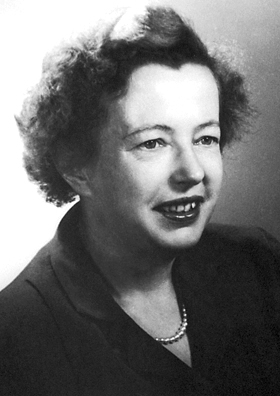
Maria Goeppert Mayer
Maria Goeppert Mayer (German: [maˈʁiːa ˈɡœpɐt ˈmaɪɐ] ⓘ; née Göppert; June 28, 1906 – February 20, 1972) was a German–American theoretical physicist who shared the 1963 Nobel Prize in Physics with J. Hans D. Jensen and Eugene Wigner. One half of the prize was awarded jointly to Goeppert Mayer and Jensen "for their discoveries concerning nuclear shell structure". She was the second woman to win the Nobel Prize in Physics, the first being Marie Curie in 1903. In 1986, the Maria Goeppert Mayer Award for early-career women physicists was established in her honor.
A graduate of the University of Göttingen, Goeppert Mayer wrote her doctoral thesis on the theory of possible two-photon absorption by atoms. At the time, the chances of experimentally verifying her thesis seemed remote, but the development of the laser in the 1960s later permitted this. Today, the unit for the two-photon absorption cross section is called the Goeppert Mayer (GM) unit.
Maria Goeppert married American chemist Joseph Edward Mayer and moved to the United States, where he was an associate professor at Johns Hopkins University. Strict rules against nepotism prevented Johns Hopkins University from taking her on as a faculty member, but she was given a job as an assistant and published a landmark paper on double beta decay in 1935. In 1937, she moved to Columbia University, where she took an unpaid position. During World War II, she worked for the Manhattan Project at Columbia on isotope separation, and with Edward Teller at the Los Alamos Laboratory on the development of thermonuclear weapons.
After the war, Goeppert Mayer became a voluntary Associate Professor of Physics at the University of Chicago (where her husband and Teller worked) and a senior physicist at the university-run Argonne National Laboratory. She developed a mathematical model for the structure of nuclear shells, for which she was awarded the Nobel Prize in Physics in 1963. In 1960, she was appointed Full Professor of Physics at the University of California, San Diego.
Maria Göppert was born on June 28, 1906, in Kattowitz (now Katowice, Poland), then located in the Kingdom of Prussia, the only child of paediatrician Friedrich Göppert and Maria Wolff. In 1910, she moved with her family to Göttingen, where her father, a sixth-generation university professor, was appointed Professor of Pediatrics at the University of Göttingen. She was closer to her father than to her mother; "Well, my father was more interesting", she later explained; "He was after all a scientist".
Göppert was educated at the Höhere Technische in Göttingen, a school for middle-class girls who aspired to higher education. In 1921, she entered the Frauenstudium, a private high school run by suffragettes that aimed to prepare girls for university. She took the abitur, the university entrance examination, at age 17, a year early, with three or four girls from her school and thirty boys. All the girls passed, but only one of the boys did.
In the spring of 1924, Göppert entered the University of Göttingen, where she studied mathematics. She spent one year at the University of Cambridge in England, before returning to Göttingen. A purported shortage of women mathematics teachers for schools for girls led to an upsurge of women studying mathematics at a time of high unemployment, and there was even a female professor of mathematics at Göttingen, Emmy Noether, but most were only interested in qualifying for their teaching certificates.
Göppert became interested in physics, and chose to pursue a Ph.D. instead. In her 1931 thesis, she worked out the theory of possible two-photon absorption by atoms. Eugene Wigner later described the thesis as "a masterpiece of clarity and concreteness". At the time, the chances of experimentally verifying her thesis seemed remote, but the development of the laser permitted the first experimental verification in 1961, when two-photon-excited fluorescence was detected in a europium-doped crystal. To honor her fundamental contribution to this area, the unit for the two-photon absorption cross-section is named the "GM". One GM is 10−50 cm4 s photon−1. Her examiners were three Nobel Prize winners: Max Born, James Franck, and Adolf Otto Reinhold Windaus (in 1954, 1925, and 1928, respectively).
Hub AI
Maria Goeppert Mayer AI simulator
(@Maria Goeppert Mayer_simulator)
Maria Goeppert Mayer
Maria Goeppert Mayer (German: [maˈʁiːa ˈɡœpɐt ˈmaɪɐ] ⓘ; née Göppert; June 28, 1906 – February 20, 1972) was a German–American theoretical physicist who shared the 1963 Nobel Prize in Physics with J. Hans D. Jensen and Eugene Wigner. One half of the prize was awarded jointly to Goeppert Mayer and Jensen "for their discoveries concerning nuclear shell structure". She was the second woman to win the Nobel Prize in Physics, the first being Marie Curie in 1903. In 1986, the Maria Goeppert Mayer Award for early-career women physicists was established in her honor.
A graduate of the University of Göttingen, Goeppert Mayer wrote her doctoral thesis on the theory of possible two-photon absorption by atoms. At the time, the chances of experimentally verifying her thesis seemed remote, but the development of the laser in the 1960s later permitted this. Today, the unit for the two-photon absorption cross section is called the Goeppert Mayer (GM) unit.
Maria Goeppert married American chemist Joseph Edward Mayer and moved to the United States, where he was an associate professor at Johns Hopkins University. Strict rules against nepotism prevented Johns Hopkins University from taking her on as a faculty member, but she was given a job as an assistant and published a landmark paper on double beta decay in 1935. In 1937, she moved to Columbia University, where she took an unpaid position. During World War II, she worked for the Manhattan Project at Columbia on isotope separation, and with Edward Teller at the Los Alamos Laboratory on the development of thermonuclear weapons.
After the war, Goeppert Mayer became a voluntary Associate Professor of Physics at the University of Chicago (where her husband and Teller worked) and a senior physicist at the university-run Argonne National Laboratory. She developed a mathematical model for the structure of nuclear shells, for which she was awarded the Nobel Prize in Physics in 1963. In 1960, she was appointed Full Professor of Physics at the University of California, San Diego.
Maria Göppert was born on June 28, 1906, in Kattowitz (now Katowice, Poland), then located in the Kingdom of Prussia, the only child of paediatrician Friedrich Göppert and Maria Wolff. In 1910, she moved with her family to Göttingen, where her father, a sixth-generation university professor, was appointed Professor of Pediatrics at the University of Göttingen. She was closer to her father than to her mother; "Well, my father was more interesting", she later explained; "He was after all a scientist".
Göppert was educated at the Höhere Technische in Göttingen, a school for middle-class girls who aspired to higher education. In 1921, she entered the Frauenstudium, a private high school run by suffragettes that aimed to prepare girls for university. She took the abitur, the university entrance examination, at age 17, a year early, with three or four girls from her school and thirty boys. All the girls passed, but only one of the boys did.
In the spring of 1924, Göppert entered the University of Göttingen, where she studied mathematics. She spent one year at the University of Cambridge in England, before returning to Göttingen. A purported shortage of women mathematics teachers for schools for girls led to an upsurge of women studying mathematics at a time of high unemployment, and there was even a female professor of mathematics at Göttingen, Emmy Noether, but most were only interested in qualifying for their teaching certificates.
Göppert became interested in physics, and chose to pursue a Ph.D. instead. In her 1931 thesis, she worked out the theory of possible two-photon absorption by atoms. Eugene Wigner later described the thesis as "a masterpiece of clarity and concreteness". At the time, the chances of experimentally verifying her thesis seemed remote, but the development of the laser permitted the first experimental verification in 1961, when two-photon-excited fluorescence was detected in a europium-doped crystal. To honor her fundamental contribution to this area, the unit for the two-photon absorption cross-section is named the "GM". One GM is 10−50 cm4 s photon−1. Her examiners were three Nobel Prize winners: Max Born, James Franck, and Adolf Otto Reinhold Windaus (in 1954, 1925, and 1928, respectively).