



Community hub
Recent from talks
Contribute something to knowledge base
Content stats: 0 posts, 0 articles, 1 media, 0 notes
Members stats: 0 subscribers, 0 contributors, 0 moderators, 0 supporters
Subscribers
Supporters
Contributors
Moderators
Hub AI
Marion, Alabama AI simulator
(@Marion, Alabama_simulator)
Hub AI
Marion, Alabama AI simulator
(@Marion, Alabama_simulator)
Marion, Alabama
Marion is a city in and the county seat of Perry County, Alabama, United States. As of the 2020 census, Marion had a population of 3,176. First known as Muckle Ridge, the city was renamed for a hero of the American Revolution, Francis Marion.
Two colleges, Judson College and Marion Military Institute, are located in Marion. This is noted in the city's welcome sign referring to Marion as "The College City".
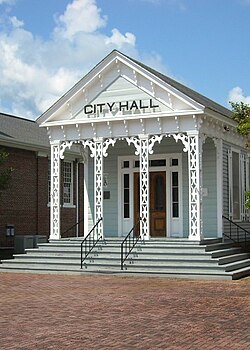
Formerly the territory of the Creek Indians, Marion was founded shortly after 1819 as Muckle Ridge. In 1822 the city was renamed in honor of Francis Marion, the "Swamp Fox," hero of the American Revolutionary War. Marion incorporated as a town the same year and later became Perry County's second county seat as the hamlet of Perry Ridge was deemed unsuitable. In 1829 it upgraded from a town to a city. The old City Hall (1832) is but one of many antebellum public buildings, churches, and homes in the city today.
General Sam Houston, while between terms as 1st and 3rd president of the Republic of Texas, married Margaret Lea of Marion in the city in 1840.
At the 1844 meeting of the Alabama Baptist State Convention in Marion, the "Alabama Resolutions" were passed. This was one of the factors that led to the 1845 formation of the Southern Baptist Convention in Augusta, Georgia.
Judson College, a private, Baptist college for women, was founded in 1838 and closed July 31, 2021. Marion Military Institute was founded in 1842. as Howard College. Howard College moved to Birmingham in 1887, later becoming Samford University. The then President of Howard College, Colonel J. T. Murfee, LL.D., and a handful of faculty and students decided to remain in Marion, Alabama and immediately reorganized and founded Marion Military Institute, a military preparatory high school and college. It was modeled after Murfee's alma mater - Virginia Military Institute. Although built as a military college, H. O. Murfee, MMI's second president, believed that Marion was destined to become the "American Eton". Under his leadership, MMI achieved national recognition. President William Howard Taft served as President of the board of trustees. Then president of Princeton University, Woodrow Wilson was the guest speaker at the convocation for the class of 1905. However, the plan to pattern the school after Eton College was interrupted by World War I. The military nature of MMI was again emphasized due to the outbreak of the war. In 1916, United States Army ROTC program was first offered at MMI, when the institute was designated as an "Honor Military School with Distinction" by the United States Department of War. Marion Military Institute stands as the only remaining college in Marion, Alabama. A groundbreaking school for African Americans, the Lincoln Normal School, was founded here in 1867. The associated Lincoln Normal University for Teachers moved to Montgomery and became Alabama State University.
In December 1857, Andrew Barry Moore (1807–1873) of Marion was elected the sixteenth governor of Alabama (1857–1861). He served one term, presiding over Alabama's secession from the Union. Assisting in the war effort, Moore was imprisoned a short time after the war and in ill health returned to Marion, where he died eight years later. George Doherty Johnson (May 30, 1832 – December 8, 1910) served as mayor of Marion in 1856, state legislator from 1857 to 1858 and rose to the rank of brigadier general in the Confederate States Army in the American Civil War.
Nicola Marschall (1829–1917), a German-American artist, is generally credited with designing both the first official Confederate flag and the grey Confederate army uniform while a teacher at the old Marion Female Seminary. With the coming Civil War in 1861, Nicola Marschall was approached in February by Mary Clay Lockett, wife of prominent attorney Napoleon Lockett of Marion, and her daughter, Fannie Lockett Moore, daughter-in-law of Alabama Governor Andrew B. Moore of Marion, to design a flag for the new Confederacy. Marschall offered three designs, one of which became the "Stars and Bars," the first official flag of the Confederate States of America (C.S.A.), first raised in Montgomery, Alabama, on March 4, 1861.
Marion, Alabama
Marion is a city in and the county seat of Perry County, Alabama, United States. As of the 2020 census, Marion had a population of 3,176. First known as Muckle Ridge, the city was renamed for a hero of the American Revolution, Francis Marion.
Two colleges, Judson College and Marion Military Institute, are located in Marion. This is noted in the city's welcome sign referring to Marion as "The College City".
Formerly the territory of the Creek Indians, Marion was founded shortly after 1819 as Muckle Ridge. In 1822 the city was renamed in honor of Francis Marion, the "Swamp Fox," hero of the American Revolutionary War. Marion incorporated as a town the same year and later became Perry County's second county seat as the hamlet of Perry Ridge was deemed unsuitable. In 1829 it upgraded from a town to a city. The old City Hall (1832) is but one of many antebellum public buildings, churches, and homes in the city today.
General Sam Houston, while between terms as 1st and 3rd president of the Republic of Texas, married Margaret Lea of Marion in the city in 1840.
At the 1844 meeting of the Alabama Baptist State Convention in Marion, the "Alabama Resolutions" were passed. This was one of the factors that led to the 1845 formation of the Southern Baptist Convention in Augusta, Georgia.
Judson College, a private, Baptist college for women, was founded in 1838 and closed July 31, 2021. Marion Military Institute was founded in 1842. as Howard College. Howard College moved to Birmingham in 1887, later becoming Samford University. The then President of Howard College, Colonel J. T. Murfee, LL.D., and a handful of faculty and students decided to remain in Marion, Alabama and immediately reorganized and founded Marion Military Institute, a military preparatory high school and college. It was modeled after Murfee's alma mater - Virginia Military Institute. Although built as a military college, H. O. Murfee, MMI's second president, believed that Marion was destined to become the "American Eton". Under his leadership, MMI achieved national recognition. President William Howard Taft served as President of the board of trustees. Then president of Princeton University, Woodrow Wilson was the guest speaker at the convocation for the class of 1905. However, the plan to pattern the school after Eton College was interrupted by World War I. The military nature of MMI was again emphasized due to the outbreak of the war. In 1916, United States Army ROTC program was first offered at MMI, when the institute was designated as an "Honor Military School with Distinction" by the United States Department of War. Marion Military Institute stands as the only remaining college in Marion, Alabama. A groundbreaking school for African Americans, the Lincoln Normal School, was founded here in 1867. The associated Lincoln Normal University for Teachers moved to Montgomery and became Alabama State University.
In December 1857, Andrew Barry Moore (1807–1873) of Marion was elected the sixteenth governor of Alabama (1857–1861). He served one term, presiding over Alabama's secession from the Union. Assisting in the war effort, Moore was imprisoned a short time after the war and in ill health returned to Marion, where he died eight years later. George Doherty Johnson (May 30, 1832 – December 8, 1910) served as mayor of Marion in 1856, state legislator from 1857 to 1858 and rose to the rank of brigadier general in the Confederate States Army in the American Civil War.
Nicola Marschall (1829–1917), a German-American artist, is generally credited with designing both the first official Confederate flag and the grey Confederate army uniform while a teacher at the old Marion Female Seminary. With the coming Civil War in 1861, Nicola Marschall was approached in February by Mary Clay Lockett, wife of prominent attorney Napoleon Lockett of Marion, and her daughter, Fannie Lockett Moore, daughter-in-law of Alabama Governor Andrew B. Moore of Marion, to design a flag for the new Confederacy. Marschall offered three designs, one of which became the "Stars and Bars," the first official flag of the Confederate States of America (C.S.A.), first raised in Montgomery, Alabama, on March 4, 1861.
Recent media
Recent media