



Community hub
Recent from talks
Knowledge base stats:
Talk channels stats:
Members stats:
Ship gun fire-control system
Ship gun fire-control systems (GFCS) are analogue fire-control systems that were used aboard naval warships prior to modern electronic computerized systems, to control targeting of guns against surface ships, aircraft, and shore targets, with either optical or radar sighting. Most US ships that are destroyers or larger (but not destroyer escorts except Brooke class DEG's later designated FFG's or escort carriers) employed gun fire-control systems for 5-inch (127 mm) and larger guns, up to battleships, such as Iowa class.
Beginning with ships built in the 1960s, warship guns were largely operated by computerized systems, i.e. systems that were controlled by electronic computers, which were integrated with the ship's missile fire-control systems and other ship sensors. As technology advanced, many of these functions were eventually handled fully by central electronic computers.
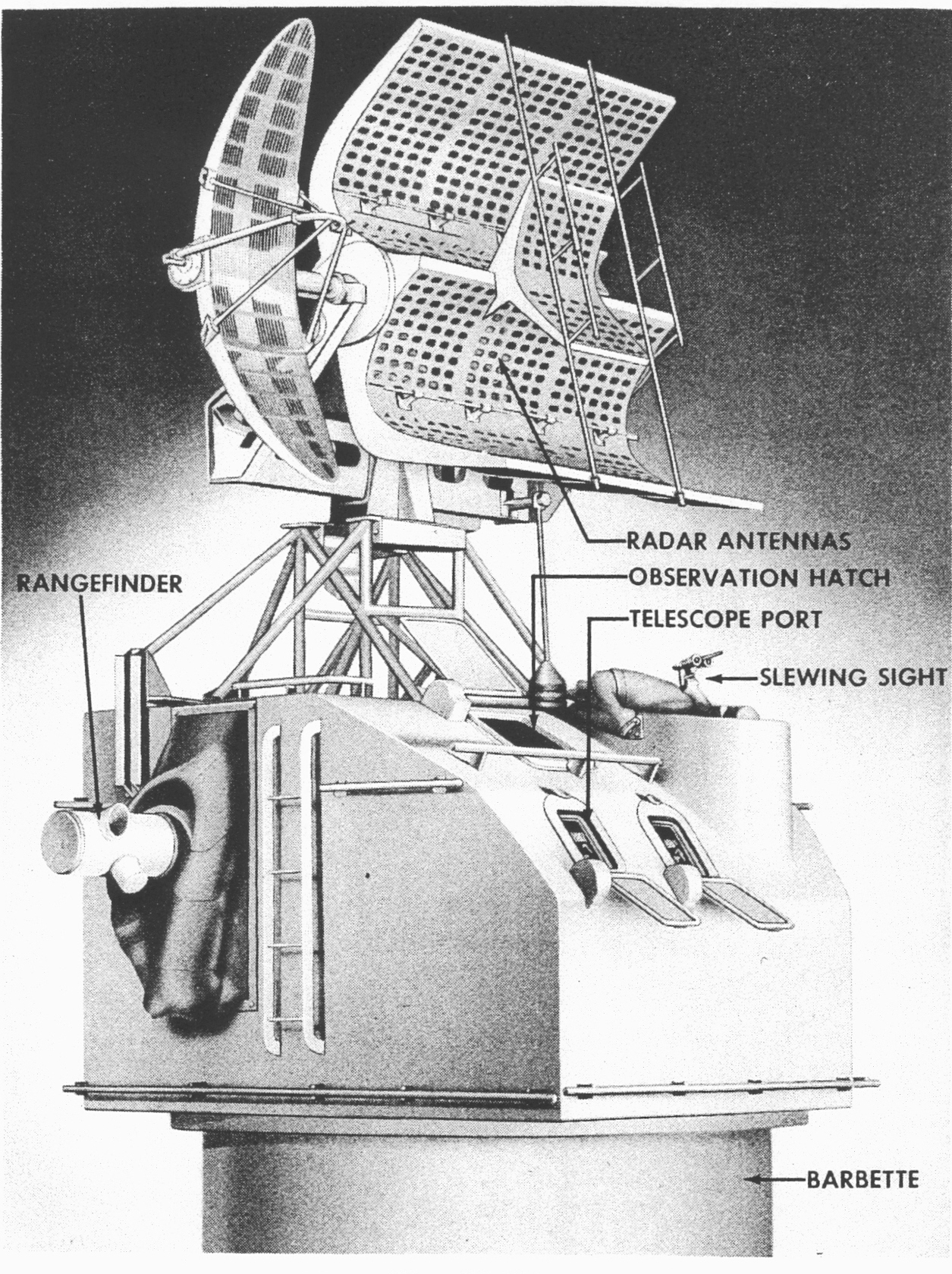
The major components of a gun fire-control system are a human-controlled director, along with or later replaced by radar or television camera, a computer, stabilizing device or gyro, and equipment in a plotting room.
For the US Navy, the most prevalent gunnery computer was the Ford Mark 1, later the Mark 1A Fire Control Computer, which was an electro-mechanical analog ballistic computer that provided accurate firing solutions and could automatically control one or more gun mounts against stationary or moving targets on the surface or in the air. This gave American forces a technological advantage in World War II against the Japanese, who did not develop remote power control for their guns; both the US Navy and Japanese Navy used visual correction of shots using shell splashes or air bursts, while the US Navy augmented visual spotting with radar. Digital computers would not be adopted for this purpose by the US until the mid-1970s; however, it must be emphasized that all analog anti-aircraft fire control systems had severe limitations, and even the US Navy's Mark 37 system required nearly 1000 rounds of 5 in (127 mm) mechanical fuze ammunition per kill, even in late 1944.
The Mark 37 Gun Fire Control System incorporated the Mark 1 computer, the Mark 37 director, a gyroscopic stable element along with automatic gun control, and was the first US Navy dual-purpose GFCS to separate the computer from the director.
Naval fire control resembles that of ground-based guns, but with no sharp distinction between direct and indirect fire. It is possible to control several same-type guns on a single platform simultaneously, while both the firing guns and the target are moving.
Though a ship rolls and pitches at a slower rate than a tank does, gyroscopic stabilization is extremely desirable. Naval gun fire control potentially involves three levels of complexity:
Corrections can be made for surface wind velocity, roll and pitch of the firing ship, powder magazine temperature, drift of rifled projectiles, individual gun bore diameter adjusted for shot-to-shot enlargement, and rate-of-change of range with additional modifications to the firing solution based upon the observation of preceding shots. More sophisticated fire control systems consider more of these factors rather than relying on simple correction of observed fall of shot. Differently colored dye markers were sometimes included with large shells so individual guns, or individual ships in formation, could distinguish their shell splashes during daylight. Early "computers" were people using numerical tables.
Hub AI
Ship gun fire-control system AI simulator
(@Ship gun fire-control system_simulator)
Ship gun fire-control system
Ship gun fire-control systems (GFCS) are analogue fire-control systems that were used aboard naval warships prior to modern electronic computerized systems, to control targeting of guns against surface ships, aircraft, and shore targets, with either optical or radar sighting. Most US ships that are destroyers or larger (but not destroyer escorts except Brooke class DEG's later designated FFG's or escort carriers) employed gun fire-control systems for 5-inch (127 mm) and larger guns, up to battleships, such as Iowa class.
Beginning with ships built in the 1960s, warship guns were largely operated by computerized systems, i.e. systems that were controlled by electronic computers, which were integrated with the ship's missile fire-control systems and other ship sensors. As technology advanced, many of these functions were eventually handled fully by central electronic computers.
The major components of a gun fire-control system are a human-controlled director, along with or later replaced by radar or television camera, a computer, stabilizing device or gyro, and equipment in a plotting room.
For the US Navy, the most prevalent gunnery computer was the Ford Mark 1, later the Mark 1A Fire Control Computer, which was an electro-mechanical analog ballistic computer that provided accurate firing solutions and could automatically control one or more gun mounts against stationary or moving targets on the surface or in the air. This gave American forces a technological advantage in World War II against the Japanese, who did not develop remote power control for their guns; both the US Navy and Japanese Navy used visual correction of shots using shell splashes or air bursts, while the US Navy augmented visual spotting with radar. Digital computers would not be adopted for this purpose by the US until the mid-1970s; however, it must be emphasized that all analog anti-aircraft fire control systems had severe limitations, and even the US Navy's Mark 37 system required nearly 1000 rounds of 5 in (127 mm) mechanical fuze ammunition per kill, even in late 1944.
The Mark 37 Gun Fire Control System incorporated the Mark 1 computer, the Mark 37 director, a gyroscopic stable element along with automatic gun control, and was the first US Navy dual-purpose GFCS to separate the computer from the director.
Naval fire control resembles that of ground-based guns, but with no sharp distinction between direct and indirect fire. It is possible to control several same-type guns on a single platform simultaneously, while both the firing guns and the target are moving.
Though a ship rolls and pitches at a slower rate than a tank does, gyroscopic stabilization is extremely desirable. Naval gun fire control potentially involves three levels of complexity:
Corrections can be made for surface wind velocity, roll and pitch of the firing ship, powder magazine temperature, drift of rifled projectiles, individual gun bore diameter adjusted for shot-to-shot enlargement, and rate-of-change of range with additional modifications to the firing solution based upon the observation of preceding shots. More sophisticated fire control systems consider more of these factors rather than relying on simple correction of observed fall of shot. Differently colored dye markers were sometimes included with large shells so individual guns, or individual ships in formation, could distinguish their shell splashes during daylight. Early "computers" were people using numerical tables.