



Community hub
Recent from talks
Contribute something to knowledge base
Content stats: 0 posts, 0 articles, 1 media, 0 notes
Members stats: 0 subscribers, 0 contributors, 0 moderators, 0 supporters
Subscribers
Supporters
Contributors
Moderators
Hub AI
Martel, Lot AI simulator
(@Martel, Lot_simulator)
Hub AI
Martel, Lot AI simulator
(@Martel, Lot_simulator)
Martel, Lot
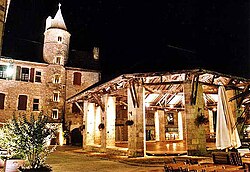
Martel is a commune in the Lot department in southwestern France. It is a small medieval town in a region well known for its walnuts and truffles. It is a member of Les Plus Beaux Villages de France (The Most Beautiful Villages of France) Association.
The town's name means "hammer", and three of these are to be seen on the town's coat of arms. Charles Martel, who earned the nickname "hammer" after his victory in the Battle of Tours in 732, is said to have founded the town. It is more likely to have been established as an urban centre by Rodulphe, first Viscount of Turenne, without a castle or abbey. Henry the Young King died here in 1183. He had sought refuge there after revolting against his father, Henry II of England, and ransacking local monasteries including Rocamadour. He died after confessing his sins, on a bed of hot ashes and a heavy crucifix on his chest.
In 1219, the town received its charter and was a fiefdom of the Viscounts of Turenne. It was exempt from paying taxes to the king of France and issued its own coin. By 1250 it was run by consuls controlled by the Turennes and in turn paid homage to the Kings of France.
With the outbreak of the Hundred Years' War, and the region's status, as either French or English territory having not been clearly established by the Treaty of Paris (1259) and the Treaty of Amiens (1279), the town had to protect itself during the former and was besieged and held out against the English in 1356. It came under English control via the Treaty of Brétigny of 1360 and returned to the French side on 27 August 1374 when it was retaken by Bertrand du Guesclin.
During the French Wars of Religion, the town remained Catholic despite the Viscount being protestant, but the town and church were sacked in 1562 by the protestants.
On 8 May 1738, the Viscount of Turenne, needing money to pay off debts, sold the viscountcy to Louis XV, and Martel and its inhabitants now had to pay their taxes to the king and lost all other privileges it had been given by the viscountcy.
Martel is located about 15 km (9 mi) east of Souillac and 15 km (9 mi) north of the River Dordogne. To the north lies the commune of Cazillac, to the northeast Strenquels, to the east Saint-Denis-lès-Martel, to the southeast Floirac, to the south Montvalent, to the southwest Creysse, to the west Baladou and to the northwest Cuzance.
The countryside is rural with rolling hills, pastureland and the cultivation of walnuts. North of the town lies the elevated limestone plateau of Causse de Martel, much of which is covered with oak and beech woodland.
Martel, Lot
Martel is a commune in the Lot department in southwestern France. It is a small medieval town in a region well known for its walnuts and truffles. It is a member of Les Plus Beaux Villages de France (The Most Beautiful Villages of France) Association.
The town's name means "hammer", and three of these are to be seen on the town's coat of arms. Charles Martel, who earned the nickname "hammer" after his victory in the Battle of Tours in 732, is said to have founded the town. It is more likely to have been established as an urban centre by Rodulphe, first Viscount of Turenne, without a castle or abbey. Henry the Young King died here in 1183. He had sought refuge there after revolting against his father, Henry II of England, and ransacking local monasteries including Rocamadour. He died after confessing his sins, on a bed of hot ashes and a heavy crucifix on his chest.
In 1219, the town received its charter and was a fiefdom of the Viscounts of Turenne. It was exempt from paying taxes to the king of France and issued its own coin. By 1250 it was run by consuls controlled by the Turennes and in turn paid homage to the Kings of France.
With the outbreak of the Hundred Years' War, and the region's status, as either French or English territory having not been clearly established by the Treaty of Paris (1259) and the Treaty of Amiens (1279), the town had to protect itself during the former and was besieged and held out against the English in 1356. It came under English control via the Treaty of Brétigny of 1360 and returned to the French side on 27 August 1374 when it was retaken by Bertrand du Guesclin.
During the French Wars of Religion, the town remained Catholic despite the Viscount being protestant, but the town and church were sacked in 1562 by the protestants.
On 8 May 1738, the Viscount of Turenne, needing money to pay off debts, sold the viscountcy to Louis XV, and Martel and its inhabitants now had to pay their taxes to the king and lost all other privileges it had been given by the viscountcy.
Martel is located about 15 km (9 mi) east of Souillac and 15 km (9 mi) north of the River Dordogne. To the north lies the commune of Cazillac, to the northeast Strenquels, to the east Saint-Denis-lès-Martel, to the southeast Floirac, to the south Montvalent, to the southwest Creysse, to the west Baladou and to the northwest Cuzance.
The countryside is rural with rolling hills, pastureland and the cultivation of walnuts. North of the town lies the elevated limestone plateau of Causse de Martel, much of which is covered with oak and beech woodland.
Recent media
Recent media