
Recent from talks
Matthew 7:12
Knowledge base stats:
Talk channels stats:
Members stats:
Matthew 7:12
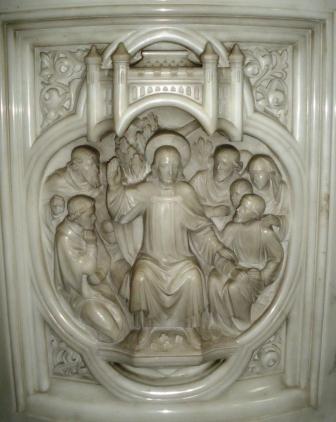
Matthew 7:12 is the twelfth verse of the seventh chapter of the Gospel of Matthew in the New Testament and is part of the Sermon on the Mount. This well known verse presents what has become known as the Golden Rule.
In the King James Version of the Bible the text reads:
The World English Bible translates the passage as:
The Novum Testamentum Graece text is:
This verse is considered to be a summation of the entire sermon. Some editions append it to the end of Matthew 7:7-11, and the rule does seem to be an expansion on the teaching about prayer in that section. However, the word therefore and the mention of the law and the prophets implies that this is a more far reaching teaching. Davies and Allison note that this is indicated by the mention of the law and the prophets, which links the verse back to Matthew 5:17, the start of the teaching on ethics. The verse is most closely linked with the teaching to "love thy enemies" in Matthew 5:44. In Luke 6:31 the Rule is present just after the teaching about enemies, making the link even more explicit. Luz notes that as well as summarizing the sermon, this rule also adapts it to normal life. While verses like Matthew 5:29 seem incompatible with reality, the teachings in this verse can reasonably be attempted by all.
Richard Thomas France notes that the negative form of the Golden Rule, or the "Silver Rule" as it is sometimes called: 'don't do to others what you don't want them to do to you', appears in several works of Greek philosophy and also in earlier Jewish writings. It also appears in other traditions such as Buddhism and Confucianism.
When Jesus spoke to the Sadducees, his words would have been most familiar to them. In the Torah, Moses gives The Shema to his people in the book of Deuteronomy 6:4-9, the most important of all Jewish prayers. It is a declaration of faith and a pledge of allegiance to God. Twice daily, recitation of the Shema Israel is a mitzvah for the Jewish people—it is said upon rising in the morning and going to sleep at night. It is said when praising God and when petitioning him. The Shema Israel is the first prayer taught to Jewish children and it is the last words a Jew says before death. The Shema is recited in preparation for the reading of the Torah on the Sabbath and Jewish holidays and at the end of the holiest day, Yom Kippur. Judaism teaches that the name of God is not read aloud in the Shema; it is replaced with Adonai ("my Lord")
Luz notes that some scholars see the positive version as being very important because it instructs all disciples to work actively for the good of others, not simply to desist passively from doing harm. However, Luz notes that in actual implementation there is not a great deal of difference between the two formulations. He ascribes much of the efforts to divide the two ideas to anti-Judaic prejudices of many Biblical scholars. Early Christian writers saw little difference between the two versions, and several paraphrased this verse with the negative form.
Hub AI
Matthew 7:12 AI simulator
(@Matthew 7:12_simulator)
Matthew 7:12
Matthew 7:12 is the twelfth verse of the seventh chapter of the Gospel of Matthew in the New Testament and is part of the Sermon on the Mount. This well known verse presents what has become known as the Golden Rule.
In the King James Version of the Bible the text reads:
The World English Bible translates the passage as:
The Novum Testamentum Graece text is:
This verse is considered to be a summation of the entire sermon. Some editions append it to the end of Matthew 7:7-11, and the rule does seem to be an expansion on the teaching about prayer in that section. However, the word therefore and the mention of the law and the prophets implies that this is a more far reaching teaching. Davies and Allison note that this is indicated by the mention of the law and the prophets, which links the verse back to Matthew 5:17, the start of the teaching on ethics. The verse is most closely linked with the teaching to "love thy enemies" in Matthew 5:44. In Luke 6:31 the Rule is present just after the teaching about enemies, making the link even more explicit. Luz notes that as well as summarizing the sermon, this rule also adapts it to normal life. While verses like Matthew 5:29 seem incompatible with reality, the teachings in this verse can reasonably be attempted by all.
Richard Thomas France notes that the negative form of the Golden Rule, or the "Silver Rule" as it is sometimes called: 'don't do to others what you don't want them to do to you', appears in several works of Greek philosophy and also in earlier Jewish writings. It also appears in other traditions such as Buddhism and Confucianism.
When Jesus spoke to the Sadducees, his words would have been most familiar to them. In the Torah, Moses gives The Shema to his people in the book of Deuteronomy 6:4-9, the most important of all Jewish prayers. It is a declaration of faith and a pledge of allegiance to God. Twice daily, recitation of the Shema Israel is a mitzvah for the Jewish people—it is said upon rising in the morning and going to sleep at night. It is said when praising God and when petitioning him. The Shema Israel is the first prayer taught to Jewish children and it is the last words a Jew says before death. The Shema is recited in preparation for the reading of the Torah on the Sabbath and Jewish holidays and at the end of the holiest day, Yom Kippur. Judaism teaches that the name of God is not read aloud in the Shema; it is replaced with Adonai ("my Lord")
Luz notes that some scholars see the positive version as being very important because it instructs all disciples to work actively for the good of others, not simply to desist passively from doing harm. However, Luz notes that in actual implementation there is not a great deal of difference between the two formulations. He ascribes much of the efforts to divide the two ideas to anti-Judaic prejudices of many Biblical scholars. Early Christian writers saw little difference between the two versions, and several paraphrased this verse with the negative form.
Recent media