



Community hub
Recent from talks
Contribute something to knowledge base
Content stats: 0 posts, 0 articles, 1 media, 0 notes
Members stats: 0 subscribers, 0 contributors, 0 moderators, 0 supporters
Subscribers
Supporters
Contributors
Moderators
Hub AI
Machine press AI simulator
(@Machine press_simulator)
Hub AI
Machine press AI simulator
(@Machine press_simulator)
Machine press
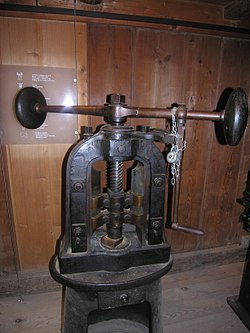
A forming press, commonly shortened to press, is a machine tool that changes the shape of a work-piece by the application of pressure. The operator of a forming press is known as a press-tool setter, often shortened to tool-setter.
Presses can be classified according to
Typically consisting of a simple rectangular frame, often fabricated from C-channel or tubing, containing a bottle jack or hydraulic cylinder to apply pressure via a ram to a work-piece. Often used for general-purpose forming work in the auto mechanic shop, machine shop, garage or basement shops, etc. Typical shop presses are capable of applying between 1 and 30 tons pressure, depending on size and construction. Lighter-duty versions are often called arbor presses.
A shop press is commonly used to press interference fit parts together, such as gears onto shafts or bearings into housings.
A servomechanism press, also known as a servo press or an 'electro-press, is a press driven by an AC servo motor. The torque produced is converted to a linear force via a ball screw. Pressure and position are controlled through a load cell and an encoder. The main advantage of a servo press is its low energy consumption; its only 10-20% of other press machines.
When stamping, it is really about maximizing energy as opposed to how the machine can deliver tonnage. Up until recently, the way to increase tonnage between the die and work-piece on a mechanical press was through bigger machines with bigger motors.
The press style used is in direct correlation to the end product. Press types are straight-side, BG (back geared), geared, gap, OBI (open back inclinable) and OBS (open back stationary). Hydraulic and mechanical presses are classified by the frame the moving elements are mounted on. The most common are the gap-frame, also known as C-frame, and the straight-side press. A straight-side press has vertical columns on either side of the machine and eliminates angular deflection. A C-frame allows easy access to the die area on three sides and require less floor space. A type of gap-frame, the OBI pivots the frame for easier scrap or part discharge. The OBS timed air blasts, devices or conveyor for scrap or part discharge.
Historically, metal was shaped by hand using a hammer. Later, larger hammers were constructed to press more metal at once, or to press thicker materials. Often a smith would employ a helper or apprentice to swing the hammer while the smith concentrated on positioning the work-piece. Drop hammers and trip hammers utilize a mechanism to lift the hammer, which then falls by gravity onto the work.
Machine press
A forming press, commonly shortened to press, is a machine tool that changes the shape of a work-piece by the application of pressure. The operator of a forming press is known as a press-tool setter, often shortened to tool-setter.
Presses can be classified according to
Typically consisting of a simple rectangular frame, often fabricated from C-channel or tubing, containing a bottle jack or hydraulic cylinder to apply pressure via a ram to a work-piece. Often used for general-purpose forming work in the auto mechanic shop, machine shop, garage or basement shops, etc. Typical shop presses are capable of applying between 1 and 30 tons pressure, depending on size and construction. Lighter-duty versions are often called arbor presses.
A shop press is commonly used to press interference fit parts together, such as gears onto shafts or bearings into housings.
A servomechanism press, also known as a servo press or an 'electro-press, is a press driven by an AC servo motor. The torque produced is converted to a linear force via a ball screw. Pressure and position are controlled through a load cell and an encoder. The main advantage of a servo press is its low energy consumption; its only 10-20% of other press machines.
When stamping, it is really about maximizing energy as opposed to how the machine can deliver tonnage. Up until recently, the way to increase tonnage between the die and work-piece on a mechanical press was through bigger machines with bigger motors.
The press style used is in direct correlation to the end product. Press types are straight-side, BG (back geared), geared, gap, OBI (open back inclinable) and OBS (open back stationary). Hydraulic and mechanical presses are classified by the frame the moving elements are mounted on. The most common are the gap-frame, also known as C-frame, and the straight-side press. A straight-side press has vertical columns on either side of the machine and eliminates angular deflection. A C-frame allows easy access to the die area on three sides and require less floor space. A type of gap-frame, the OBI pivots the frame for easier scrap or part discharge. The OBS timed air blasts, devices or conveyor for scrap or part discharge.
Historically, metal was shaped by hand using a hammer. Later, larger hammers were constructed to press more metal at once, or to press thicker materials. Often a smith would employ a helper or apprentice to swing the hammer while the smith concentrated on positioning the work-piece. Drop hammers and trip hammers utilize a mechanism to lift the hammer, which then falls by gravity onto the work.
Recent media
Recent media