
Recent from talks
Merchant aircraft carrier
Knowledge base stats:
Talk channels stats:
Members stats:
Merchant aircraft carrier
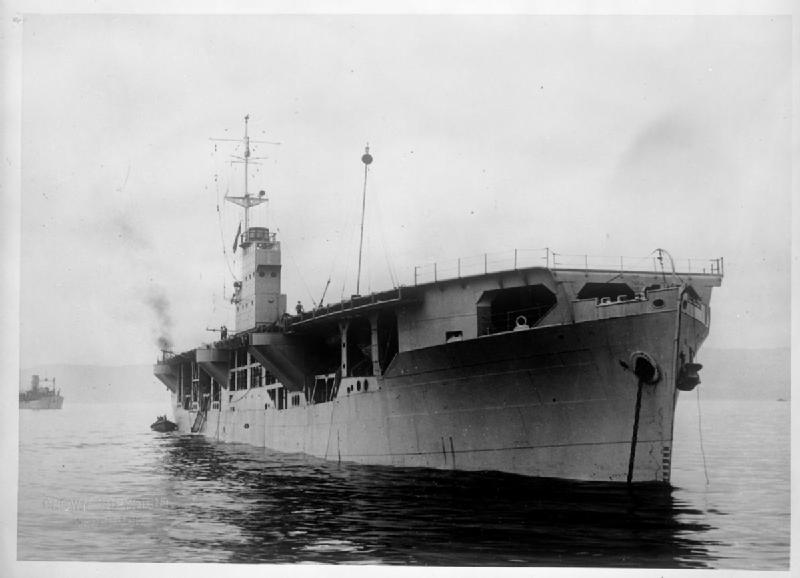
A merchant aircraft carrier (also known as a MAC ship, the Admiralty's official 'short name') was a limited-purpose aircraft carrier operated under British and Dutch civilian registry during World War II. MAC ships were adapted by adding a flight deck to a bulk grain ship or oil tanker enabling it to operate anti-submarine aircraft in support of Allied convoys during the Battle of the Atlantic.
Despite their quasi-military function, MAC ships retained their mercantile status, continued to carry cargo and operated under civilian command. MAC ships entered service from May 1943 when they began to supplement and supplant escort carriers, and remained operational until the end of the war in Europe.
In 1940, Captain M. S. Slattery RN, Director of Air Matériel at the Admiralty, proposed a scheme for converting merchant ships into aircraft carriers as a follow-up to the CAM ship project. Slattery proposed fitting a flight deck equipped with two arrestor wires and a safety barrier onto an existing merchant ship hull. The resulting 'auxiliary fighter carrier' would be capable of operating six Hurricane fighters while retaining its cargo-carrying ability. The stumbling block for Slattery's proposal turned out to be objections from the Ministry of Supply that combining the merchant and aircraft carrier roles would be too complicated. While this would turn out to be over-stated, it seems to have had the effect of diverting attention from the idea of hybrid merchant-warships towards the alternative of converting merchant ships into fully-fledged warships designated 'auxiliary aircraft carriers', the first of which, converted from the captured German cargo ship Hannover, entered service as Empire Audacity (later HMS Audacity) in June 1941.
The hybrid concept re-emerged early in 1942 when, in the face of mounting losses from U-boat attacks, it became apparent that escort carriers being built in the US could not be delivered quickly enough in the numbers required. Various people have been credited with re-inventing the idea, including Captain B. B. Schofield RN, Director Trade Division, and John Lamb, Marine Technical Manager of the Anglo-Saxon Petroleum Company. Sir James Lithgow, Controller of Merchant Shipbuilding and Repair and joint-owner of Lithgows Ltd, the Clyde-based shipbuilders, also helped overcome Admiralty reservations about MAC ships. Lithgow is said to have sketched a rough design for one on the back of an envelope and offered to convert two ships about to be built at his family's shipyard on condition that "I am not interfered with by the Admiralty". While the timing of Lithgow's possibly apocryphal intervention is uncertain, his deputy, Sir Amos Ayre, the Director of Merchant Shipbuilding, was certainly discussing the requirements for MAC ships by May 1942. Ayre himself credits Sir Douglas Thomson of Ben Line and the Ministry of War Transport with having first suggested the idea.
There was some initial resistance to the MAC ship concept, in particular through concerns about operating aircraft from short, relatively slow ships. The Admiralty considered that a flight deck length of 460 feet (140 m) was needed for safe take-offs and landings and a speed of 15 knots (28 km/h; 17 mph). to provide a sufficient margin over convoy speeds and they were especially doubtful that tankers, with their low freeboards and volatile cargoes, could be utilised. As the U-boat situation worsened, however, such concerns were out-weighed by the urgent need to provide convoy air support, and once it was accepted that the grain ship variant at least could be made to work, the Admiralty became more enthusiastic about the project.
By September 1942, the Admiralty was asking for "about 50" MAC ships to be made available, to allow one to be included in every North Atlantic convoy and in October the requirement was set at 52. This ambitious target had been scaled back to 40 by the time the MAC ship project was formally endorsed by the War Cabinet in October 1942, but it was apparent that even this reduced number could not be produced sufficiently quickly without American help. The US was therefore asked to begin construction of 30 MAC ships to be delivered during the first half of 1943, but a Navy Department committee specially formed to consider the request turned it down because of concerns about the experimental nature of the ships. In the event, all the MAC ships were built and/or converted in British shipyards.
The first two MAC ships were ordered in June 1942 from the Burntisland Shipbuilding Company on the Firth of Forth and William Denny & Brothers of Dumbarton. These ships, which were not strictly conversions but brand-new grain ships that had not yet been laid down, would eventually enter service as Empire MacAlpine and Empire MacAndrew respectively. Empire MacAlpine was launched on 23 December 1942 and completed more-or-less on schedule on 21 April 1943. Five more new-build grain ships, Empire MacAndrew, Empire MacRae, Empire MacCallum, Empire MacKendrick and Empire MacDermott followed at approximately two-month intervals, with Empire MacDermott entering service in March 1944.
By late September 1942 it was finally agreed that tanker-MAC ships could be operated safely subject to various limitations about the cargoes they would be allowed to carry. Four new-build tankers were scheduled for conversion but work on these did not start until May 1943. Empire MacKay entered service in October 1943, followed at intervals by Empire MacCabe, Empire MacMahon and Empire MacColl in November 1943. Additional hulls were still needed, however, and it was decided that existing tankers would have to be withdrawn from trade. The most efficient way to approach the task of converting these was to select ships of similar design and, at the beginning of 1943, the Anglo-Saxon Petroleum Company, which had actively promoted the MAC ship concept, offered up its entire fleet of British-registered 'Triple Twelve' tankers (sometimes referred to as the Rapana class) for government charter.
Hub AI
Merchant aircraft carrier AI simulator
(@Merchant aircraft carrier_simulator)
Merchant aircraft carrier
A merchant aircraft carrier (also known as a MAC ship, the Admiralty's official 'short name') was a limited-purpose aircraft carrier operated under British and Dutch civilian registry during World War II. MAC ships were adapted by adding a flight deck to a bulk grain ship or oil tanker enabling it to operate anti-submarine aircraft in support of Allied convoys during the Battle of the Atlantic.
Despite their quasi-military function, MAC ships retained their mercantile status, continued to carry cargo and operated under civilian command. MAC ships entered service from May 1943 when they began to supplement and supplant escort carriers, and remained operational until the end of the war in Europe.
In 1940, Captain M. S. Slattery RN, Director of Air Matériel at the Admiralty, proposed a scheme for converting merchant ships into aircraft carriers as a follow-up to the CAM ship project. Slattery proposed fitting a flight deck equipped with two arrestor wires and a safety barrier onto an existing merchant ship hull. The resulting 'auxiliary fighter carrier' would be capable of operating six Hurricane fighters while retaining its cargo-carrying ability. The stumbling block for Slattery's proposal turned out to be objections from the Ministry of Supply that combining the merchant and aircraft carrier roles would be too complicated. While this would turn out to be over-stated, it seems to have had the effect of diverting attention from the idea of hybrid merchant-warships towards the alternative of converting merchant ships into fully-fledged warships designated 'auxiliary aircraft carriers', the first of which, converted from the captured German cargo ship Hannover, entered service as Empire Audacity (later HMS Audacity) in June 1941.
The hybrid concept re-emerged early in 1942 when, in the face of mounting losses from U-boat attacks, it became apparent that escort carriers being built in the US could not be delivered quickly enough in the numbers required. Various people have been credited with re-inventing the idea, including Captain B. B. Schofield RN, Director Trade Division, and John Lamb, Marine Technical Manager of the Anglo-Saxon Petroleum Company. Sir James Lithgow, Controller of Merchant Shipbuilding and Repair and joint-owner of Lithgows Ltd, the Clyde-based shipbuilders, also helped overcome Admiralty reservations about MAC ships. Lithgow is said to have sketched a rough design for one on the back of an envelope and offered to convert two ships about to be built at his family's shipyard on condition that "I am not interfered with by the Admiralty". While the timing of Lithgow's possibly apocryphal intervention is uncertain, his deputy, Sir Amos Ayre, the Director of Merchant Shipbuilding, was certainly discussing the requirements for MAC ships by May 1942. Ayre himself credits Sir Douglas Thomson of Ben Line and the Ministry of War Transport with having first suggested the idea.
There was some initial resistance to the MAC ship concept, in particular through concerns about operating aircraft from short, relatively slow ships. The Admiralty considered that a flight deck length of 460 feet (140 m) was needed for safe take-offs and landings and a speed of 15 knots (28 km/h; 17 mph). to provide a sufficient margin over convoy speeds and they were especially doubtful that tankers, with their low freeboards and volatile cargoes, could be utilised. As the U-boat situation worsened, however, such concerns were out-weighed by the urgent need to provide convoy air support, and once it was accepted that the grain ship variant at least could be made to work, the Admiralty became more enthusiastic about the project.
By September 1942, the Admiralty was asking for "about 50" MAC ships to be made available, to allow one to be included in every North Atlantic convoy and in October the requirement was set at 52. This ambitious target had been scaled back to 40 by the time the MAC ship project was formally endorsed by the War Cabinet in October 1942, but it was apparent that even this reduced number could not be produced sufficiently quickly without American help. The US was therefore asked to begin construction of 30 MAC ships to be delivered during the first half of 1943, but a Navy Department committee specially formed to consider the request turned it down because of concerns about the experimental nature of the ships. In the event, all the MAC ships were built and/or converted in British shipyards.
The first two MAC ships were ordered in June 1942 from the Burntisland Shipbuilding Company on the Firth of Forth and William Denny & Brothers of Dumbarton. These ships, which were not strictly conversions but brand-new grain ships that had not yet been laid down, would eventually enter service as Empire MacAlpine and Empire MacAndrew respectively. Empire MacAlpine was launched on 23 December 1942 and completed more-or-less on schedule on 21 April 1943. Five more new-build grain ships, Empire MacAndrew, Empire MacRae, Empire MacCallum, Empire MacKendrick and Empire MacDermott followed at approximately two-month intervals, with Empire MacDermott entering service in March 1944.
By late September 1942 it was finally agreed that tanker-MAC ships could be operated safely subject to various limitations about the cargoes they would be allowed to carry. Four new-build tankers were scheduled for conversion but work on these did not start until May 1943. Empire MacKay entered service in October 1943, followed at intervals by Empire MacCabe, Empire MacMahon and Empire MacColl in November 1943. Additional hulls were still needed, however, and it was decided that existing tankers would have to be withdrawn from trade. The most efficient way to approach the task of converting these was to select ships of similar design and, at the beginning of 1943, the Anglo-Saxon Petroleum Company, which had actively promoted the MAC ship concept, offered up its entire fleet of British-registered 'Triple Twelve' tankers (sometimes referred to as the Rapana class) for government charter.
Recent media