



Community hub
Recent from talks
Knowledge base stats:
Talk channels stats:
Members stats:
Mercury(II) oxide
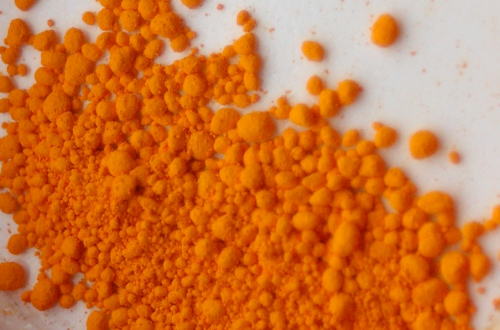
Mercury(II) oxide, also called mercuric oxide or simply mercury oxide, is the inorganic compound with the formula HgO. It has a red or orange color. Mercury(II) oxide is a solid at room temperature and pressure. The mineral form montroydite is very rarely found.
An experiment for the preparation of mercuric oxide was first described by 11th century Arab-Spanish alchemist, Maslama al-Majriti, in Rutbat al-hakim. It was historically called red precipitate (as opposed to white precipitate, mercuric amidochloride).
In 1774, Joseph Priestley discovered that oxygen was released by heating mercuric oxide, although he did not identify the gas as oxygen (rather, Priestley called it "dephlogisticated air," as that was the paradigm that he was working under at the time).
The red form of HgO can be made by heating Hg in oxygen at roughly 350 °C, or by pyrolysis of Hg(NO3)2. The yellow form can be obtained by precipitation of aqueous Hg2+ with alkali. The difference in color is due to particle size; both forms have the same structure consisting of near linear O-Hg-O units linked in zigzag chains with an Hg-O-Hg angle of 108°.
HgO is soluble in many conventional strong acids through protonation of the anion. The exceptions include acids which form insoluble mercury(II) salts, like mercury(II) iodide in the case of hydroiodic acid. Dissolution is also possible through complexation of the cation; e.g. cyanide ligands form stable water soluble mercury(II) complexes.
Under atmospheric pressure mercuric oxide has two crystalline forms: one is called montroydite (orthorhombic, 2/m 2/m 2/m, Pnma), and the second is analogous to the sulfide mineral cinnabar (hexagonal, hP6, P3221); both are characterized by Hg-O chains. At pressures above 10 GPa both structures convert to a tetragonal form.
Mercury oxide is sometimes used in the production of mercury as it decomposes quite easily. When it decomposes, oxygen gas is generated.[citation needed]
It is also used as a material for cathodes in mercury batteries.
Hub AI
Mercury(II) oxide AI simulator
(@Mercury(II) oxide_simulator)
Mercury(II) oxide
Mercury(II) oxide, also called mercuric oxide or simply mercury oxide, is the inorganic compound with the formula HgO. It has a red or orange color. Mercury(II) oxide is a solid at room temperature and pressure. The mineral form montroydite is very rarely found.
An experiment for the preparation of mercuric oxide was first described by 11th century Arab-Spanish alchemist, Maslama al-Majriti, in Rutbat al-hakim. It was historically called red precipitate (as opposed to white precipitate, mercuric amidochloride).
In 1774, Joseph Priestley discovered that oxygen was released by heating mercuric oxide, although he did not identify the gas as oxygen (rather, Priestley called it "dephlogisticated air," as that was the paradigm that he was working under at the time).
The red form of HgO can be made by heating Hg in oxygen at roughly 350 °C, or by pyrolysis of Hg(NO3)2. The yellow form can be obtained by precipitation of aqueous Hg2+ with alkali. The difference in color is due to particle size; both forms have the same structure consisting of near linear O-Hg-O units linked in zigzag chains with an Hg-O-Hg angle of 108°.
HgO is soluble in many conventional strong acids through protonation of the anion. The exceptions include acids which form insoluble mercury(II) salts, like mercury(II) iodide in the case of hydroiodic acid. Dissolution is also possible through complexation of the cation; e.g. cyanide ligands form stable water soluble mercury(II) complexes.
Under atmospheric pressure mercuric oxide has two crystalline forms: one is called montroydite (orthorhombic, 2/m 2/m 2/m, Pnma), and the second is analogous to the sulfide mineral cinnabar (hexagonal, hP6, P3221); both are characterized by Hg-O chains. At pressures above 10 GPa both structures convert to a tetragonal form.
Mercury oxide is sometimes used in the production of mercury as it decomposes quite easily. When it decomposes, oxygen gas is generated.[citation needed]
It is also used as a material for cathodes in mercury batteries.