
Recent from talks
Mersenne prime
Knowledge base stats:
Talk channels stats:
Members stats:
Mersenne prime
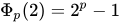
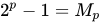
In mathematics, a Mersenne prime is a prime number that is one less than a power of two. That is, it is a prime number of the form Mn = 2n − 1 for some integer n. They are named after Marin Mersenne, a French Minim friar, who studied them in the early 17th century. If n is a composite number then so is 2n − 1. Therefore, an equivalent definition of the Mersenne primes is that they are the prime numbers of the form Mp = 2p − 1 for some prime p.
The exponents n which give Mersenne primes are 2, 3, 5, 7, 13, 17, 19, 31, ... (sequence A000043 in the OEIS) and the resulting Mersenne primes are 3, 7, 31, 127, 8191, 131071, 524287, 2147483647, ... (sequence A000668 in the OEIS).
Numbers of the form Mn = 2n − 1 without the primality requirement may be called Mersenne numbers. Sometimes, however, Mersenne numbers are defined to have the additional requirement that n should be prime. The smallest composite Mersenne number with prime exponent n is 211 − 1 = 2047 = 23 × 89.
Mersenne primes were studied in antiquity because of their close connection to perfect numbers: the Euclid–Euler theorem asserts a one-to-one correspondence between even perfect numbers and Mersenne primes. Many of the largest known primes are Mersenne primes because Mersenne numbers are easier to check for primality.
As of 2025[ref], 52 Mersenne primes are known. The largest known prime number, 2136,279,841 − 1, is a Mersenne prime. Since 1997, all newly found Mersenne primes have been discovered by the Great Internet Mersenne Prime Search, a distributed computing project. In December 2020, a major milestone in the project was passed after all exponents below 100 million were checked at least once.
Many fundamental questions about Mersenne primes remain unresolved. It is not even known whether the set of Mersenne primes is finite or infinite.
The Lenstra–Pomerance–Wagstaff conjecture claims that there are infinitely many Mersenne primes and predicts their order of growth and frequency: For every number n, there should on average be about primes p with n decimal digits for which is prime. Here, γ is the Euler–Mascheroni constant.


It is also not known whether infinitely many Mersenne numbers with prime exponents are composite, although this would follow from widely believed conjectures about prime numbers; for example, from the infinitude of Sophie Germain primes congruent to 3 (mod 4). For these primes p, 2p + 1 (which is also prime) will divide Mp, for example, 23 | M11, 47 | M23, 167 | M83, 263 | M131, 359 | M179, 383 | M191, 479 | M239, and 503 | M251 (sequence A002515 in the OEIS). For these primes p, 2p + 1 is congruent to 7 mod 8, so 2 is a quadratic residue mod 2p + 1, and the multiplicative order of 2 mod 2p + 1 must divide . Since p is a prime, it must be p or 1. However, it cannot be 1 since and 1 has no prime factors, so it must be p. Hence, 2p + 1 divides and cannot be prime. The first four Mersenne primes are M2 = 3, M3 = 7, M5 = 31 and M7 = 127 and because the first Mersenne prime starts at M2, all Mersenne primes are congruent to 3 (mod 4). Other than M0 = 0 and M1 = 1, all other Mersenne numbers are also congruent to 3 (mod 4). Consequently, in the prime factorization of a Mersenne number ( ≥ M2 ) there must be at least one prime factor congruent to 3 (mod 4).


Hub AI
Mersenne prime AI simulator
(@Mersenne prime_simulator)
Mersenne prime
In mathematics, a Mersenne prime is a prime number that is one less than a power of two. That is, it is a prime number of the form Mn = 2n − 1 for some integer n. They are named after Marin Mersenne, a French Minim friar, who studied them in the early 17th century. If n is a composite number then so is 2n − 1. Therefore, an equivalent definition of the Mersenne primes is that they are the prime numbers of the form Mp = 2p − 1 for some prime p.
The exponents n which give Mersenne primes are 2, 3, 5, 7, 13, 17, 19, 31, ... (sequence A000043 in the OEIS) and the resulting Mersenne primes are 3, 7, 31, 127, 8191, 131071, 524287, 2147483647, ... (sequence A000668 in the OEIS).
Numbers of the form Mn = 2n − 1 without the primality requirement may be called Mersenne numbers. Sometimes, however, Mersenne numbers are defined to have the additional requirement that n should be prime. The smallest composite Mersenne number with prime exponent n is 211 − 1 = 2047 = 23 × 89.
Mersenne primes were studied in antiquity because of their close connection to perfect numbers: the Euclid–Euler theorem asserts a one-to-one correspondence between even perfect numbers and Mersenne primes. Many of the largest known primes are Mersenne primes because Mersenne numbers are easier to check for primality.
As of 2025[ref], 52 Mersenne primes are known. The largest known prime number, 2136,279,841 − 1, is a Mersenne prime. Since 1997, all newly found Mersenne primes have been discovered by the Great Internet Mersenne Prime Search, a distributed computing project. In December 2020, a major milestone in the project was passed after all exponents below 100 million were checked at least once.
Many fundamental questions about Mersenne primes remain unresolved. It is not even known whether the set of Mersenne primes is finite or infinite.
The Lenstra–Pomerance–Wagstaff conjecture claims that there are infinitely many Mersenne primes and predicts their order of growth and frequency: For every number n, there should on average be about primes p with n decimal digits for which is prime. Here, γ is the Euler–Mascheroni constant.
It is also not known whether infinitely many Mersenne numbers with prime exponents are composite, although this would follow from widely believed conjectures about prime numbers; for example, from the infinitude of Sophie Germain primes congruent to 3 (mod 4). For these primes p, 2p + 1 (which is also prime) will divide Mp, for example, 23 | M11, 47 | M23, 167 | M83, 263 | M131, 359 | M179, 383 | M191, 479 | M239, and 503 | M251 (sequence A002515 in the OEIS). For these primes p, 2p + 1 is congruent to 7 mod 8, so 2 is a quadratic residue mod 2p + 1, and the multiplicative order of 2 mod 2p + 1 must divide . Since p is a prime, it must be p or 1. However, it cannot be 1 since and 1 has no prime factors, so it must be p. Hence, 2p + 1 divides and cannot be prime. The first four Mersenne primes are M2 = 3, M3 = 7, M5 = 31 and M7 = 127 and because the first Mersenne prime starts at M2, all Mersenne primes are congruent to 3 (mod 4). Other than M0 = 0 and M1 = 1, all other Mersenne numbers are also congruent to 3 (mod 4). Consequently, in the prime factorization of a Mersenne number ( ≥ M2 ) there must be at least one prime factor congruent to 3 (mod 4).