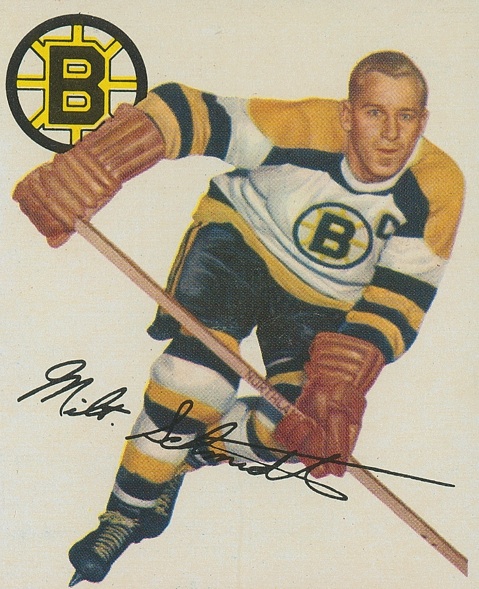

Milt Schmidt
View on Wikipedia
Milton Conrad Schmidt (March 5, 1918 – January 4, 2017) was a Canadian professional ice hockey centre, coach and general manager, mostly for the Boston Bruins of the National Hockey League (NHL), He was a member of the famed "Kraut Line" with teammates Bobby Bauer and Woody Dumart. The trio led the Bruins to two Stanley Cup championships and became the first line to finish first, second and third in NHL scoring, in 1939–40. He was elected to the Hockey Hall of Fame in 1961. In 2017, Schmidt was named one of the '100 Greatest NHL Players' in history.[1]
Key Information


After retiring as a player, Schmidt remained with the Bruins, as head coach for eleven years, then as general manager as the Bruins won two Stanley Cups in 1970 and 1972.
Early years
[edit]Schmidt's early years were spent in Kitchener, where he attended King Edward Public School. In high school, he briefly attended Kitchener-Waterloo Collegiate and Vocational School, but dropped out at age 14 to work to support his family (his father had become too ill to work regularly), and took a job at a shoe factory. He made 18 cents per hour ($3.94 per hour in 2025 dollars[2]) while working there and claimed that he knew the value of the dollar.[3] He continued playing junior hockey with the Kitchener Empires and Kitchener Greenshirts. Schmidt was a childhood friend of fellow Hall of Famers Woody Dumart and Bobby Bauer. At the age of 20, while playing for the Boston Bruins' AHL farm team, the Providence Reds, Schmidt was invited to try out for the St. Louis Cardinals pro baseball team, but knew himself well enough from his youth baseball experience that while he could hit the ball out of the park, he would strike out many more times than hitting home runs.[4]
Playing career
[edit]Playing
[edit]Schmidt played junior hockey with Dumart and Bauer in Kitchener, Ontario, before their rights were all acquired by the Bruins in 1935.[5] After playing a final year of junior hockey in Kitchener, Ontario, and half a year with the Providence Reds, Schmidt was called up to the Bruins during the 1937 season. He quickly proved himself to be a hardnosed centre, a skilled stick handler and smooth playmaker.[6]
Schmidt and his childhood friends Bauer and Dumart were teamed up together in the NHL as well. They formed the Kraut Line and were a strong and dependable line for the Bruins for most of the following fifteen seasons. They were a key ingredient to the Bruins' success as they rampaged to 4 straight regular season titles and a hard-fought Stanley Cup victory in 1939.[6] The following season Schmidt became a star, as he led the league in scoring and guided the Bruins to another first-place finish and the third-most goals in team history to date. That year the Kraut line would make history with Schmidt leading the NHL in points with 52 while Dumart and Bauer finished second and third respectively with 43 each.[7] It was the first time in league history that three linemates finished in the top three spots in NHL scoring.[8]
.jpg)
The 1941 season saw Schmidt spearhead the Bruins to their second Cup win in three years with 38 points and a postseason high 11 points in 11 playoff games. However, the powerhouse Brown and Gold were decimated by World War II the following year as Schmidt, Bauer, and Dumart were all the first players to enlist in the Canadian military, and superstar American goaltender Frank Brimsek enlisted with the United States Coast Guard. In their final game with the bruins before deployment the Kraut Line recorded eight points in a dominating victory over the Montreal Canadiens. Following the contest, players from both teams fêted the trio, hoisting them up on their shoulders and parading them around the ice. While training in Ottawa, The Kraut line found success playing for the Ottawa RCAF Flyers of the Quebec Senior Hockey League winning the Ottawa City Hockey League championship and the Allan Cup before heading overseas. Schmidt, Bauer, and Dumart ultimately missed three productive NHL seasons due to their service in the War. Schmidt and Dumart would serve as a member of a Bomber squadron and Bauer would serve as a radio technician.
Schmidt returned for the beginning of the 1946 season reuniting with the Kraut line. He resumed his starring ways and finished fourth in league scoring in 1947 with a career high 62 point season (27 goals 35 assists). Named captain in 1951, Schmidt won the Hart Trophy as the league's most valuable player that year having a 61 points with 22 goals and 39 assists.[citation needed] Schmidt would follow this up with a 50-point season the following year and would continue to put up solid numbers for the Bruins until his retirement.
In the later part of his career, Schmidt became friends with journalist Leo Monahan who travelled with the team on overnight train rides. One train ride Schmidt recalled that "Leo was in the berth above me and I was down below. Throughout the night, he told me, he did not move for fear he would do something that would keep me awake".[9]
Schmidt retired as a player partway through the 1954–1955 season to take over head coaching duties, replacing Lynn Patrick.
Coaching
[edit]Schmidt coached the Bruins up to the 1966 season with a year and a half hiatus, leading them to the Stanley Cup Final in 1957 and 1958. He also was Boston's assistant general manager.
After coaching the Bruins for 11 seasons Schmidt was promoted to the general manager position in 1967 just as the league ushered in six new franchises, doubling in size.[6] Schmidt proved to be a great architect in the new era of the NHL, acquiring and drafting several key players to build a Bruins team that won two more Stanley Cups in 1970 and 1972. His biggest deal was a blockbuster as he acquired Phil Esposito, Ken Hodge and Fred Stanfield from the Chicago Black Hawks in exchange for Pit Martin, Gilles Marotte and Jack Norris.
After his long and loyal career in the Bruins organization, Schmidt left the team to become the first General Manager of the expansion Washington Capitals on April 20, 1973.[10] Unfortunately for Schmidt, the Capitals set a benchmark in futility that still stands as an NHL record today, as the new franchise finished the year with a minuscule 21 points with the worst record in the 18-team league (8–67–5).[6]
Career statistics
[edit]Regular season and playoffs
[edit]- Bold indicates led league
| Regular season | Playoffs | |||||||||||||
|---|---|---|---|---|---|---|---|---|---|---|---|---|---|---|
| Season | Team | League | GP | G | A | Pts | PIM | GP | G | A | Pts | PIM | ||
| 1933–34 | Kitchener Empires | OHA-Jr. | 7 | 2 | 4 | 6 | 2 | 4 | 2 | 3 | 5 | 0 | ||
| 1933–34 | Kitchener Greenshirts | OHA-Jr. | 17 | 20 | 6 | 26 | 14 | 3 | 2 | 2 | 4 | 0 | ||
| 1935–36 | Kitchener Greenshirts | OHA-Jr. | 5 | 4 | 3 | 7 | 2 | 4 | 4 | 1 | 5 | 11 | ||
| 1936–37 | Boston Bruins | NHL | 26 | 2 | 8 | 10 | 15 | 3 | 0 | 0 | 0 | 0 | ||
| 1936–37 | Providence Reds | IAHL | 23 | 8 | 1 | 9 | 12 | — | — | — | — | — | ||
| 1937–38 | Boston Bruins | NHL | 44 | 13 | 14 | 27 | 15 | 3 | 0 | 0 | 0 | 0 | ||
| 1938–39 | Boston Bruins | NHL | 41 | 15 | 17 | 32 | 13 | 12 | 3 | 3 | 6 | 2 | ||
| 1939–40 | Boston Bruins | NHL | 48 | 22 | 30 | 52 | 37 | 6 | 0 | 0 | 0 | 4 | ||
| 1940–41 | Boston Bruins | NHL | 45 | 13 | 25 | 38 | 23 | 11 | 5 | 6 | 11 | 9 | ||
| 1941–42 | Boston Bruins | NHL | 36 | 14 | 21 | 35 | 34 | — | — | — | — | — | ||
| 1941–42 | Ottawa RCAF Flyers | OCHL | — | — | — | — | — | 6 | 4 | 7 | 11 | 10 | ||
| 1941–42 | Ottawa RCAF Flyers | Al-Cup | — | — | — | — | — | 13 | 6 | 17 | 23 | 19 | ||
| 1944–45 | Middleton RCAF | Exhib. | — | — | — | — | — | — | — | — | — | — | ||
| 1945–46 | Boston Bruins | NHL | 48 | 13 | 18 | 31 | 21 | 10 | 3 | 5 | 8 | 2 | ||
| 1946–47 | Boston Bruins | NHL | 59 | 27 | 35 | 62 | 40 | 5 | 3 | 1 | 4 | 4 | ||
| 1947–48 | Boston Bruins | NHL | 33 | 9 | 17 | 26 | 28 | 5 | 2 | 5 | 7 | 2 | ||
| 1948–49 | Boston Bruins | NHL | 44 | 10 | 22 | 32 | 25 | 4 | 0 | 2 | 2 | 8 | ||
| 1949–50 | Boston Bruins | NHL | 68 | 19 | 22 | 41 | 41 | — | — | — | — | — | ||
| 1950–51 | Boston Bruins | NHL | 62 | 22 | 39 | 61 | 33 | 6 | 0 | 1 | 1 | 7 | ||
| 1951–52 | Boston Bruins | NHL | 69 | 21 | 29 | 50 | 57 | 7 | 2 | 1 | 3 | 0 | ||
| 1952–53 | Boston Bruins | NHL | 68 | 11 | 23 | 34 | 30 | 10 | 5 | 1 | 6 | 6 | ||
| 1953–54 | Boston Bruins | NHL | 62 | 14 | 18 | 32 | 28 | 4 | 1 | 0 | 1 | 20 | ||
| 1954–55 | Boston Bruins | NHL | 23 | 4 | 8 | 12 | 26 | — | — | — | — | — | ||
| NHL totals | 776 | 229 | 346 | 575 | 466 | 86 | 24 | 25 | 49 | 64 | ||||
Career coaching record
[edit]| Team | Year | Regular season | Post season | |||||
|---|---|---|---|---|---|---|---|---|
| G | W | L | T | Pts | Division Rank | Result | ||
| Boston Bruins | 1954–55 | 40 | 13 | 12 | 15 | (41) | 4th in NHL | Lost in semi-finals |
| 1955–56 | 70 | 23 | 34 | 17 | 59 | 5th in NHL | Missed Playoffs | |
| 1956–57 | 70 | 34 | 24 | 12 | 80 | 3rd in NHL | Lost in Cup Final | |
| 1957–58 | 70 | 27 | 28 | 15 | 69 | 3rd in NHL | Lost in Cup Final | |
| 1958–59 | 70 | 32 | 29 | 9 | 73 | 2nd in NHL | Lost in semi-final | |
| 1959–60 | 70 | 28 | 34 | 8 | 64 | 5th in NHL | Missed Playoffs | |
| 1960–61 | 70 | 15 | 42 | 13 | 43 | 6th in NHL | Missed Playoffs | |
| 1962–63 | 56 | 13 | 31 | 12 | (38) | 6th in NHL | Missed Playoffs | |
| 1963–64 | 70 | 18 | 40 | 12 | 48 | 6th in NHL | Missed Playoffs | |
| 1964–65 | 70 | 21 | 43 | 6 | 43 | 6th in NHL | Missed Playoffs | |
| 1965–66 | 70 | 21 | 43 | 6 | 48 | 5th in NHL | Missed Playoffs | |
| Washington Capitals | 1974–75 | 8 | 2 | 6 | 0 | (4) | 5th in Norris | Missed Playoffs |
| 1975–76 | 36 | 3 | 28 | 5 | (11) | 5th in Norris | (fired) | |
| Total | 770 | 257 | 410 | 127 | ||||

Retirement and death
[edit]Schmidt was married to his wife Marie. Together they had two children, a son named Conrad, and a daughter Nancy.[11] After he retired from hockey management, Schmidt remained involved with the Bruins with the alumni team and the Boards and Blades Club at the Boston Garden.[12]
Schmidt was inducted into the Hockey Hall of Fame in 1961 and his #15 jersey was retired by the Bruins. After he retired from hockey management, Schmidt remained involved with the Bruins through their alumni team and as manager of the Boards and Blades Club at the Boston Garden. On October 6, 2010, the Bruins celebrated Schmidt's 75 years with the team during Milt Schmidt Night. On this night he received 2 commemorative Stanley Cup miniatures to represent the two cups he had brought to the club, plus he raised his number to the rafters inside TD Garden. He was the last surviving member of both the Bruins' 1939 and 1941 Stanley Cup teams. Schmidt was also the last living NHL player to play in the 1930s and the last to have played against the Montreal Maroons (a team that folded in 1938). He is viewed as a legendary figure in Boston and is the only person in franchise history to serve as player to have been a captain, coach, and general manager. Former Bruins President Harry Siden referred to him along with Johnny Buyck as the quintessential Boston Bruins.[13]
In 1975 he was inducted into the Canada Sports Hall of Fame.
In 2002 Schmidt was one of the original honorees at The Sports Museum annual tradition event, being given the hockey legacy award.[14] He was later inducted into the Massachusetts hockey Hall of Fame in 2008.[15]
On October 20, 2016, Schmidt along with Bobby Orr dropped the ceremonial puck at the Boston Bruins' first home game of the season.[16]
Schmidt died after a stroke on January 4, 2017, in a retirement facility in Westwood, Massachusetts;[17] at the age of 98; at the time of his death he was the oldest living former NHL player, and the last living player from the AHL's inaugural season.[18][19][20] Following Schmidt's death, Chick Webster became the oldest living NHL player. Schmidt is buried alongside his wife at the Highland Cemetery in Dover, Massachusetts.
Tribute
[edit]Upon hearing of Schmidt's death, NHL Commissioner Gary Bettman issued the following statement: "It would be a challenge to find anyone who took greater pride in being a Boston Bruin than Milt Schmidt did--be it as a player, an executive or an ambassador over the 80-plus years he served the franchise, the city of Boston and the National Hockey League. Milt's respect for the game was matched by his humility and was mirrored by the great respect with which his opponents, and generations of Bruins players, treated him through the years."[21]
After Schmidt's death The Bruins honored Schmidt's legacy with a pregame tribute prior to game a game on January 5. In addition, two on-ice graphics with Schmidt's retired jersey number 15 were painted behind both nets and remained there for the entire month of January. The Bruins also worn a commemorative patch on their jerseys featuring Schmidt's number 15 for the rest of the 2016–17 season.[22]
Awards and achievements
[edit]- Stanley Cup champion - all with Boston (1939 and 1941 as a player), (1970 and 1972 as general manager)
- NHL Scoring Champion in 1940.
- NHL assists Leader in 1940
- Allen Cup champion 1942
- Named to the NHL First All-Star Team in 1940, 1947 and 1951.
- Played in NHL All-Star Game in 1947, 1948, 1951 and 1952.
- Won the Hart Trophy in 1951.
- Named to the NHL Second All-Star Team in 1952.
- inducted into the Hockey Hall of Fame in 1961
- His #15 jersey number was retired by the Boston Bruins on March 13, 1980.
- Won the Lester Patrick Trophy for contributions to hockey in 1996.
- At the time of his retirement, was fourth in NHL history in points scored and third in assists.
- Was the last active NHL player who played during the 1930s.
- The first former player to win a Stanley Cup with the same franchise as their general manager (1970), an achievement only matched by Serge Savard (1986) and Joe Sakic (2022).[23]
- Inducted into the Canada sports Hall of Fame in 1975.
- In 1998, he was ranked number 27 on The Hockey News' list of the 100 Greatest Hockey Players.
- Inducted into the Massachusetts hockey Hall of Fame in 2008
- In January 2017, Schmidt was part of the first group of players to be named one of the '100 Greatest NHL Players' in history.[1]
- In 2023 he was named One of the Top 100 Best Bruins Players of all Time.[24]
- Named to the Boston Bruins all centennial team.[25]
References
[edit]- ^ a b "100 Greatest NHL Players". National Hockey League. January 1, 2017. Retrieved January 1, 2017.
- ^ 1688 to 1923: Geloso, Vincent, A Price Index for Canada, 1688 to 1850 (December 6, 2016). Afterwards, Canadian inflation numbers based on Statistics Canada tables 18-10-0005-01 (formerly CANSIM 326-0021) "Consumer Price Index, annual average, not seasonally adjusted". Statistics Canada. Retrieved April 17, 2021., table 18-10-0004-13 "Consumer Price Index by product group, monthly, percentage change, not seasonally adjusted, Canada, provinces, Whitehorse, Yellowknife and Iqaluit". Statistics Canada. Retrieved May 8, 2024. and table 18-10-0005-01 "Consumer Price Index, annual average, not seasonally adjusted". Statistics Canada. Retrieved February 14, 2026.
- ^ Hicks, Jeff (November 4, 2006). "Kitchener's Great One". The Record, Kitchener, Ontario. p. A1, A8, A9.
- ^ Bailey, Arnold (September 10, 2008). "Pesky, Schmidt share a Boston bond for life". sportscollectorsdigest.com. Retrieved January 17, 2017.
"It was around 1938 that I was invited to a tryout by the St. Louis Cardinals," Schmidt recalled. "I had been an outfielder, and at bat, I'd either hit the ball out of the park or end up walking back to the dugout (after a strikeout). Unfortunately, I ended up walking back to the dugout more than I ended up running around the bases." Schmidt never followed up on the Cardinals' invitation. "In Boston, we were in a fight for the Stanley Cup, anyway, and I was just too busy with that to give baseball much thought," he said.
- ^ Diamond, Dan, ed. (2000) [1998]. Total Hockey: Second Edition. Total Sports Publishing, Kingston, New York. pp. 655, 698, 802.
- ^ a b c d Скончался член Зала славы НХЛ Милт Шмидт
- ^ Holland, Heidi, ed. (2013). Boston Bruins 2013–14 Guide and Record Book. Boston Bruins Hockey Club. p. 146.
- ^ "Bruins honor Milt Schmidt". National Hockey League. October 28, 2010. Archived from the original on November 17, 2010. Retrieved December 20, 2013.
- ^ Marquard, Bryan (April 2, 2013). "D. Leo Monahan, 86; Boston sports reporter, columnist". The Boston Globe. Boston, Massachusetts.
- ^ "'Express' Enters Indy 500," Daytona Beach (FL) Sunday News-Journal, Sunday, April 22, 1973. Retrieved February 24, 2023.
- ^ "Q&A: Boston Bruins legend Milt Schmidt on point". ABC News. Retrieved August 17, 2025.
- ^ Tolman, Amy (January 4, 2021). "A Tribute To Bruins Legend Milt Schmidt". Black N' Gold Hockey. Retrieved August 17, 2025.
- ^ Writer, Lenny Megliola / News Sports. "Worthy recipient: Bucyk to be honored as NE legend". Milford Daily News. Retrieved August 17, 2025.
- ^ Griffin, Bill. "The Tradition has emerged into treasure of Boston sports scene". Enterprise News. Retrieved August 17, 2025.
- ^ "Massachusetts Hockey Hall of Fame Recipients". www.mahockey.org. Retrieved August 17, 2025.
- ^ Goss, Nicholas (October 20, 2016). "Bruins Legends Bobby Orr, Milt Schmidt Take Part In Special Puck Drop Ceremony". NESN.com. Retrieved October 21, 2016.
- ^ "MILTON CONRAD SCHMIDT Obituary (1918-2017) Boston Globe". Legacy.com.
- ^ "Bruins legend Milt Schmidt dies at 98". Boston Globe.
- ^ jreiser (January 4, 2017). "Milt Schmidt Passes Away at 98". Stanley Cup of Chowder. Retrieved January 4, 2017.
- ^ Shinzawa, Fluto (January 7, 2017). "The state of the NHL leaves much to be desired. Here are 7 fixes to improve it". Boston Globe.
- ^ "Bruins great Milt Schmidt dies at 98". bangordailynews.com. Bangor Daily News. January 4, 2017. Retrieved December 25, 2020.
- ^ "Bruins To Honor Milt Schmidt Prior To Thursday's Game | Boston Bruins". www.nhl.com. January 5, 2017. Retrieved August 17, 2025.
- ^ "What Joe Sakic Means to the Avalanche". July 7, 2022.
- ^ "Bruins Announce "Historic 100" Ahead of All-Centennial Team Reveal | Boston Bruins". www.nhl.com. September 12, 2023. Retrieved April 14, 2025.
- ^ "Bruins Announce All-Centennial Team | Boston Bruins". www.nhl.com. October 13, 2023. Retrieved August 17, 2025.
NESN October 28, 2010
External links
[edit]- Biographical information and career statistics from NHL.com, or Eliteprospects.com, or Hockey-Reference.com, or Legends of Hockey, or The Internet Hockey Database
| International | |
|---|---|
| National | |

Milt Schmidt
View on GrokipediaEarly life
Family and upbringing
Milton Conrad Schmidt was born on March 5, 1918, in Kitchener, Ontario, to German immigrant parents Carl Friedrich Wilhelm Schmidt and Emma Schmidt.[2][8] As the youngest of six children, he grew up in a family with three sisters—Bertha, Martha, and Elsie—and two older brothers, Albert and Carl Jr.[9][8] His father worked as a laborer in a local tannery, while his mother managed the household in their modest working-class home.[10][11] Schmidt's childhood unfolded in Kitchener's tight-knit German-Canadian community, a neighborhood shaped by immigrant families and the city's industrial heritage; the town had recently renamed itself from Berlin amid anti-German sentiment following World War I.[2][10] Surrounded by siblings who shared his enthusiasm for sports—particularly his brothers, both of whom played hockey, with Carl Jr. earning the nickname "Gunboat" as a goaltender for the junior Kitchener Empires—he was exposed early to local pastimes like baseball and ice hockey on outdoor rinks and neighborhood fields.[10] This environment fostered his competitive spirit, as he often joined pickup games that blended the community's cultural traditions with everyday physical activities. Schmidt received his early education in Kitchener's public schools, including King Edward Public School, where he first encountered organized athletics and developed interests beyond hockey, such as baseball, amid the challenges of a blue-collar upbringing.[12][13] At age 14, following his father's illness, he left school to contribute to the family by working in a shoe factory, earning 18 cents an hour while continuing to pursue sports informally.[14] These formative years in Kitchener laid the groundwork for his lifelong passion for athletics, blending familial support with the grit of immigrant life.Junior hockey career
Milt Schmidt's entry into organized hockey occurred in the early 1930s in his hometown of Kitchener, Ontario, where he first played for local junior teams amid strong family encouragement for his athletic pursuits. At the age of 15, he debuted in the Ontario Hockey Association (OHA) junior league with the Kitchener Empires during the 1933–34 season.[2][15] Schmidt quickly progressed to the Kitchener Greenshirts for the 1934–35 OHA junior campaign, where he established himself as a prolific scorer and skilled center, often playing alongside childhood friends Woody Dumart and Bobby Bauer. His offensive prowess was evident in a breakout performance that season, highlighted by his ability to combine speed and physicality on the ice. The following year, 1935–36, he continued developing with the Greenshirts, refining his all-around game before attracting professional interest.[15][16] Schmidt's junior statistics reflect his rapid skill development and scoring impact in the competitive OHA environment:| Season | Team | League | GP | G | A | Pts | PIM |
|---|---|---|---|---|---|---|---|
| 1933–34 | Kitchener Empires | OHA-Jr | 7 | 2 | 4 | 6 | 2 |
| 1934–35 | Kitchener Greenshirts | OHA-Jr | 17 | 20 | 6 | 26 | 14 |
| 1935–36 | Kitchener Greenshirts | OHA-Jr | 5 | 4 | 3 | 7 | 2 |
Professional playing career
Boston Bruins tenure
Milt Schmidt joined the Boston Bruins midway through the 1936-37 NHL season, making his debut on December 8, 1936, after impressing in training camp and being called up from the team's American Hockey League affiliate, the Providence Reds.[17] As a center, he quickly established himself alongside left winger Woody Dumart and right winger Bobby Bauer—childhood friends from Kitchener, Ontario, all of German descent—forming the renowned "Kraut Line," which debuted as a unit on November 6, 1937.[18] The nickname, coined affectionately by a Montreal Canadiens player in 1936 while the trio played for a Boston farm team, reflected their heritage and became a symbol of their seamless integration into the Bruins' lineup.[2] Schmidt's playing style was defined by relentless hustle, physical aggression, and a team-oriented approach, emphasizing hard forechecking and brilliant playmaking that drove the Bruins' offensive firepower.[2] At 6 feet tall and 185 pounds, he combined speed and toughness, often leading rushes with unselfish passes while contributing prolifically to scoring; in the 1939-40 season, the Kraut Line became the first in NHL history to finish 1-2-3 in league points, with Schmidt topping the charts at 52.[2] His physicality made him one of the league's toughest competitors, using body checks and determination to disrupt opponents and create turnovers, which fueled Boston's transition game and elevated the team's overall output during the late 1930s.[2] The Kraut Line's chemistry propelled the Bruins to early successes, including the 1939 Stanley Cup championship, where Boston defeated the Toronto Maple Leafs in the final after a grueling semifinal series against the New York Rangers; Schmidt recorded 3 goals and 3 assists in 12 playoff games.[1] In 1941, the line was instrumental in a dominant sweep of the Detroit Red Wings in the Cup Final, with Schmidt contributing 5 goals and 6 assists across 11 postseason contests, securing Boston's third franchise title.[1] Their intuitive play—rooted in years of junior hockey together—and crowd-pleasing style endeared them to Boston fans, who embraced the trio as local heroes despite the ethnic moniker, turning the line into one of the era's most celebrated units.[4]World War II interruption
In early 1942, Milt Schmidt, along with his longtime Boston Bruins linemates Woody Dumart and Bobby Bauer—collectively known as the "Kraut Line" for their German-Canadian heritage and on-ice synergy—enlisted in the Royal Canadian Air Force to support Canada's war effort during World War II.[4] Their decision came shortly after a standout 8–1 victory over the Montreal Canadiens on February 10, 1942, marking the end of their pre-enlistment NHL play.[19] Assigned initially as a physical education instructor in Canada, Schmidt contributed to morale-boosting activities, including the formation of the Ottawa RCAF Flyers senior hockey team. Joined by Dumart and Bauer, the trio dominated the Ottawa City Hockey League and led the Flyers to a decisive victory in the 1942 Allan Cup final, defeating the Port Arthur Bearcats three games to two to claim Canada's national senior amateur championship.[10] This success highlighted their continued impact on the sport even amid military duties, with Schmidt recording six goals and 17 assists in just 13 playoff games.[20][15] Schmidt's RCAF service extended from February 1942 until the war's end in 1945, encompassing postings across Canada and, later, overseas in northeastern England as a pilot officer following his promotion in the fall of 1943.[10] In this non-combat role, he conducted physical training workouts for pilots and aircrew, including lifesaving drills such as raft inflation and flipping in swimming pools to prepare them for potential ditching in the English Channel or North Sea.[10] These efforts supported the operational readiness of RCAF personnel without involving frontline combat. The interruption forced Schmidt to miss three complete NHL seasons from 1942–43 to 1944–45, leaving the Bruins without their dynamic center and disrupting the team's lineup during a critical period.[21] This hiatus, spanning the prime of his career, ultimately cost him potential scoring records and Stanley Cup opportunities in the league.[2]Postwar achievements and retirement
Schmidt returned to the Boston Bruins for the 1945-46 NHL season after serving in the Royal Canadian Air Force during World War II, appearing in 48 games and contributing 13 goals and 18 assists for 31 points while helping the team reach the playoffs, where he added 8 points in 10 games.[1][2] In the postwar era, Schmidt reached the peak of his playing career, leading the Bruins in scoring in multiple seasons, including a career-high 62 points (27 goals and 35 assists) in 1946-47 and 61 points (22 goals and 39 assists) in 1950-51.[22][1] That latter season, his performance earned him the Hart Memorial Trophy as the NHL's most valuable player.[23] He was also named the Bruins' captain in 1951, a role he held until his retirement.[24] Plagued by injuries in his later years, including a limited 33 games in 1947-48, Schmidt continued to contribute as a veteran leader before retiring midway through the 1954-55 season after 23 games (4 goals and 8 assists).[1][25] Over 16 NHL seasons, all with the Bruins, he amassed 575 points (229 goals and 346 assists) in 776 regular-season games, briefly transitioning to a player-coach role before fully stepping away from playing to focus on coaching.[1][3]Coaching and executive career
Coaching the Boston Bruins
Milt Schmidt began his coaching tenure with the Boston Bruins in the 1954–55 season as a player-coach, guiding the team to a 13–12–15 record in 40 games after taking over on December 25, 1954, following the firing of Lynn Patrick.[5] He transitioned to full-time head coach upon his playing retirement at the end of that season, a move that allowed him to focus entirely on team leadership.[26] Schmidt's coaching career with the Bruins spanned parts of 11 seasons through 1965–66, interrupted by a one-year hiatus in 1961–62 when Phil Watson served as head coach; overall, he compiled a regular-season record of 245 wins, 360 losses, and 121 ties in 726 games.[5] Schmidt's coaching philosophy emphasized physical play and defensive structure, drawing directly from his own renowned style as a hard-checking center during his playing days, which helped instill a tough, resilient identity in the Bruins that influenced the franchise's approach for generations.[26] This focus on conditioning and withstanding physical checks was evident in his demands for players to maintain peak fitness to endure the rigors of NHL competition.[27] Under his guidance, the Bruins achieved notable success in the late 1950s, including back-to-back Stanley Cup Finals appearances; in 1956–57, they finished third with a 34–24–12 record and advanced past the New York Rangers before falling to the Montreal Canadiens, while the 1957–58 season saw a 27–28–15 mark, a semifinals victory over the Rangers in six games, and another Finals loss to Montreal.[5][28] These runs marked the Bruins' first deep playoff forays since 1953, highlighting Schmidt's ability to rally a competitive roster amid the era's six-team league.[29] In player development, Schmidt played a pivotal role in nurturing emerging talents, particularly mentoring forward Johnny Bucyk, whom he praised for all-around ability comparable to top stars of the time and who credited Schmidt's guidance as foundational to his career, stating that the coach continued influencing him long after his tenure.[2] Bucyk broke Schmidt's franchise scoring record in 1961 and became a cornerstone of future Bruins success.[30] However, Schmidt faced significant challenges with an aging roster in the early 1960s, leading to dismal finishes—such as last place in 1960–61 (15–42–13) and 1963–64 (18–40–12)—as veteran players struggled to keep pace with younger, faster opponents in the league.[5] Despite these struggles, his emphasis on disciplined, physical hockey laid groundwork for the team's eventual resurgence, culminating in his shift to general manager after the 1965–66 season.[26]General manager role
Following his tenure as head coach, Milt Schmidt was appointed general manager of the Boston Bruins at the start of the 1967-68 season, becoming the franchise's fourth GM in its history.[3] He served in this role until 1973, overseeing a pivotal rebuilding period that transformed the team from perennial underachievers to Stanley Cup contenders.[31] One of Schmidt's most impactful decisions was the May 15, 1967, trade with the Chicago Black Hawks, acquiring forwards Phil Esposito, Ken Hodge, and Fred Stanfield in exchange for Pit Martin, Gilles Marotte, and Jack Norris—a deal widely regarded as one of the most lopsided in NHL history.[2] This acquisition, combined with the existing foundation of young talent like Bobby Orr (whom Schmidt had helped scout and sign years earlier), ended the Bruins' eight-year playoff drought in 1968 and provided the offensive firepower central to their Stanley Cup victories in 1970 and 1972.[3] Schmidt also focused on bolstering the front office and coaching staff, notably hiring Tom Johnson as an assistant in 1967 before promoting him to head coach in June 1970 following Harry Sinden's resignation after the 1970 Cup win.[32] Under Schmidt's leadership, the Bruins emphasized scouting and development of promising amateur players through the NHL's emerging draft system, selecting talents such as Derek Sanderson in 1964 (prior to his GM role but integrated into the rebuild) and contributing to a roster that blended veterans with emerging stars.[3] His executive tenure laid the groundwork for the team's dominance in the early 1970s, marking a shift from administrative stagnation to strategic personnel decisions that restored the franchise's competitiveness.[33]Career statistics
Regular season and playoff playing stats
Milt Schmidt played 16 seasons in the National Hockey League (NHL), all with the Boston Bruins, accumulating 776 games, 229 goals, 346 assists, and 575 points in the regular season.[1] In the playoffs, he appeared in 86 games, scoring 24 goals and 25 assists for 49 points.[1] These totals reflect his role as a durable center who combined scoring prowess with physical play across an era marked by fewer games and tougher conditions. Schmidt's regular season performance evolved from a promising rookie to a league leader and Hart Trophy winner. His season-by-season statistics are summarized below, highlighting key peaks such as his career-high 27 goals and 62 points in 1946–47, and 22 goals with 39 assists for 61 points in 1950–51, the latter earning him the NHL's most valuable player award.[1][2]| Season | GP | G | A | PTS | PIM |
|---|---|---|---|---|---|
| 1936–37 | 26 | 2 | 8 | 10 | 15 |
| 1937–38 | 44 | 13 | 14 | 27 | 15 |
| 1938–39 | 41 | 15 | 17 | 32 | 13 |
| 1939–40 | 48 | 22 | 30 | 52 | 37 |
| 1940–41 | 45 | 13 | 25 | 38 | 23 |
| 1941–42 | 36 | 14 | 21 | 35 | 34 |
| 1945–46 | 48 | 13 | 18 | 31 | 21 |
| 1946–47 | 59 | 27 | 35 | 62 | 40 |
| 1947–48 | 33 | 9 | 17 | 26 | 28 |
| 1948–49 | 44 | 10 | 22 | 32 | 25 |
| 1949–50 | 68 | 19 | 22 | 41 | 41 |
| 1950–51 | 62 | 22 | 39 | 61 | 33 |
| 1951–52 | 69 | 21 | 29 | 50 | 57 |
| 1952–53 | 68 | 11 | 23 | 34 | 30 |
| 1953–54 | 62 | 14 | 18 | 32 | 28 |
| 1954–55 | 23 | 4 | 8 | 12 | 26 |