Hubbry Logo
Gordie HoweGordie HoweMain
Open search
Gordie Howe
Community hub
Gordie Howe
logo
8 pages, 0 posts
0 subscribers
Be the first to start a discussion here.
Gordie Howe
Gordie Howe
from Wikipedia

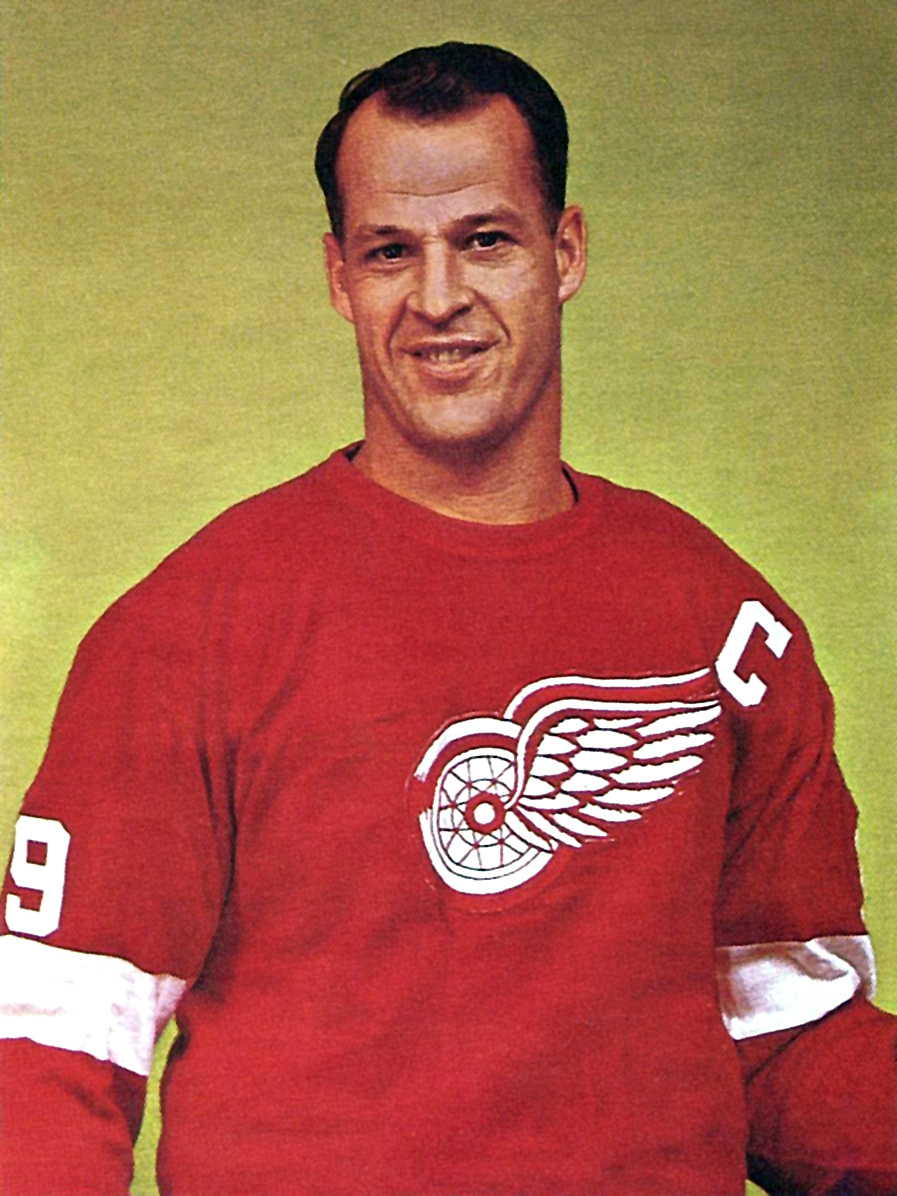
Gordon Howe OC (March 31, 1928 – June 10, 2016) was a Canadian professional ice hockey player. From 1946 to 1980, he played 26 seasons in the National Hockey League (NHL) and six seasons in the World Hockey Association (WHA); his first 25 seasons were spent with the Detroit Red Wings. Nicknamed "Mr. Hockey", Howe is often considered the most complete player ever to play the game and one of the greatest of all time.[2][3] At his retirement, his 801 goals, 1,049 assists, and 1,850 total points were all NHL records that stood until they were broken by Wayne Gretzky, who himself has been a major champion of Howe's legacy. A 23-time NHL All-Star, he shares the NHL record for seasons played with Chris Chelios, and his all-time NHL games played record of 1,767 was only surpassed in 2021 by Patrick Marleau. In 2017, Howe was named one of the "100 Greatest NHL Players".[4]

Key Information

Howe made his NHL debut with the Red Wings in 1946. He won the Art Ross Trophy for leading the league in points each year from 1950–51 to 1953–54, then again in 1956–57 and 1962–63, for a total of six times, which is the second most in NHL history. He led the NHL in goal-scoring four times. He ranked among the top ten in the NHL scoring for 21 consecutive years. He set an NHL record for points in a season (95) in 1953, a record that was broken six years later. He won the Stanley Cup with the Red Wings four times and won six Hart Trophies as the NHL's most valuable player. He also led the NHL in playoff points six times.

Howe retired for the first time in 1971 and was immediately inducted into the Saskatchewan Sports Hall of Fame that same year. He was then inducted into the Hockey Hall of Fame the following year but came back two years later to join his sons Mark and Marty on the Houston Aeros of the WHA. Although in his mid-40s, he scored over 100 points twice in six years, won two straight Avco World Trophies (1974 and 1975), and was named most valuable player in 1974; he scored a total of 174 goals in the WHA. He made a brief return to the NHL in 1979–80, playing one season with the Hartford Whalers, then retired at age 52. His involvement with the WHA was central to their brief pre-NHL merger success, forcing the NHL to recruit European talent and expand to new markets. In totality of two professional leagues, Howe scored 975 regular season goals and was awarded the most valuable player award seven times.[5]

Although Howe was most famous for his scoring prowess, he possessed great physical strength and toughness, and he redefined the ideal qualities of a forward by becoming known for his superior play on both offense and defense.[6] He is the only player to have competed in the NHL in five different decades (1940s through 1980s); he also played a shift in a 1997 game for the Detroit Vipers of the IHL, playing professional hockey for a sixth decade. He became the namesake of the "Gordie Howe hat trick": a goal, an assist, and a fight in the same game, though he only recorded two such games in his career. He was the inaugural recipient of the NHL Lifetime Achievement Award in 2008.

Early life

[edit]

Howe was born in a farmhouse in Floral, Saskatchewan,[7] the son of Katherine (Schultz) and Albert Howe.[8] He was one of nine siblings.[9] When Gordie was nine days old, the Howes moved to Saskatoon,[10] where his father worked as a labourer during the Depression. In the summers, Howe would work construction with his father.[9] Howe was mildly dyslexic growing up but was physically beyond his years at an early age. Already six feet tall in his mid-teens, doctors feared a calcium deficiency and encouraged him to strengthen his spine with chin-ups. He began playing organized hockey at age eight.[9] Howe quit school during the Depression to work in construction, then left Saskatoon at 16 to pursue his hockey career.[10]

Playing careers

[edit]

Howe was an ambidextrous player, one of just a few skaters able to use the straight sticks of his era to shoot either left- or right-handed.[11] As a young teen, he played bantam hockey with the King George Athletic Club in Saskatoon, winning his first championship with them in the 1942 Saskatchewan Provincial Bantam Hockey Finals. He received his first taste of professional hockey at age 15 in 1943 when he was invited by the New York Rangers to their training camp held at "The Amphitheatre" in Winnipeg, Manitoba. He played well enough there that the Rangers wanted Howe to sign a "C" form, which would have given that club his National Hockey League rights, and to play that year at the College of Notre Dame, a Catholic high school in Wilcox, Saskatchewan, that was known for producing good hockey players. However, Howe did not feel that was a good fit for him and wanted to go back home to play hockey with his friends; he declined the Rangers' offer and returned to Saskatoon.[12]

Gordie Howe (2nd from left, back row) on the 1945–46 Omaha Knights (USHL)

In 1944, Howe was noticed by Detroit Red Wings scout Fred Pinkney and was invited to their camp in Windsor, Ontario. He was signed by the Red Wings to a "C" form and assigned to their junior team, the Galt Red Wings. Due to the maximum number of Western players allowed by the league and the Red Wings' preference to develop older players, Howe's playing time with the team was initially limited. However, in 1945, he was promoted to the Omaha Knights of the minor professional United States Hockey League (USHL), where he scored 48 points in 51 games as a 17-year-old. While playing in Omaha, Frank Selke of the Toronto Maple Leafs noticed Howe's rights needed to be properly listed as Red Wings property. Having a good relationship with Detroit head coach Jack Adams, he notified Adams of the clerical error, and Howe was quickly put on the team's protected list.[9]

Detroit Red Wings

[edit]

Howe made his NHL debut on October 16, 1946, playing right wing for the Detroit Red Wings, scoring in his first game at age 18.[13] He wore number 17 as a rookie. However, when Roy Conacher joined the Chicago Black Hawks after the 1946–47 season, Howe was offered Conacher's number 9, which he would wear for the rest of his career. Although he had not requested the change, Howe accepted it when he was informed "9" would entitle him to a lower Pullman berth on road trips. He quickly established himself as a great goalscorer and a gifted playmaker with a willingness to fight. Howe fought so often in his rookie season that head coach Jack Adams told him, "I know you can fight. Now can you show me you can play hockey?"[9] The term "Gordie Howe hat trick" (consisting of a goal, an assist, and a fight) was coined in reference to his penchant for fighting; however, Howe himself only recorded two such hat tricks in his career,[14] on October 10, 1953, and March 21, 1954.[15] Using his great physical strength, he was able to dominate the opposition in a career that spanned six decades (including one game with the Detroit Vipers of the IHL in 1997). In a feat unsurpassed by any hockey player, he finished in the top five in scoring for 20-straight seasons.[16] The first player to score 600 goals, Howe also scored 20 or more goals in 22 consecutive seasons between 1949 and 1971, an NHL record.[17]

Howe made his NHL debut for the Detroit Red Wings in 1946

Howe led Detroit to four Stanley Cup championships and to first place in regular-season play for seven consecutive years (1948–49 to 1954–55), the latter of which remains a feat never equalled in NHL history. During this time, Howe and his linemates—centre Sid Abel and left winger Ted Lindsay—were known collectively as "The Production Line", both for their scoring and as an allusion to Detroit auto factories. The trio dominated the NHL in such a fashion that in 1949–50, they finished one-two-three in NHL scoring.[18] This was despite the fact Howe's career prime was during a defensive era, when scoring was difficult and checking was tight.[19]

However, as he was emerging as one of the top players in the league, Howe sustained the worst injury of his career - his skull was fractured and his cheekbone and nose were broken after his attempt to check the Toronto Maple Leafs captain Ted Kennedy into the boards went awry during the 1950 playoffs. The severity of the fracture was such that he was taken to the hospital for emergency surgery in order to relieve the pressure on his brain.[9] He missed the rest of the playoffs, but his dominant teammates were still able to win the Stanley Cup.

The next season, 1950–51, Howe came back, responding to his severe injuries by playing in every game, by leading the NHL in goals, assists, and total points (86), and by winning the scoring title by 20 points.[20] This was the first year of a four-year period of dominance by Howe which the NHL had never seen before. He won four straight scoring titles and in two of the years (1950–51 and 1952–53) he led the NHL in both goals and assists, which has only been done by five other players in history (a total of 10 times aside from Howe). In three of those years, he led the NHL in goals. In 1952–53, Howe became the first NHL player to score 90 points, finishing the season with 95 points and a career-best 49 goals [2] which just missed tying the league record of 50 goals held by Maurice "Rocket" Richard (albeit in a 50-game season). Prior to Howe, no NHLer had led the NHL in points more than two times in a row. Only three other players have ever matched the feat of winning four straight scoring titles since—Phil Esposito, Jaromír Jágr, and Wayne Gretzky (who won seven in a row). During the 1960-61 season, on November 27, 1960, Howe became the first ever hockey player to record 1,000 points for a career, doing so on an assist versus the Toronto Maple Leafs; the 1,000th point was recorded in his 938th game, and the following season saw him become the first player to play in 1,000 games.[21][22] On November 10, 1963, he became the all-time goal leader with his 545th career goal against Montreal.[23]

As Howe emerged as one of the game's superstars, he was frequently compared to the Montreal Canadiens' Maurice Richard. Both were right wingers who wore #9, were regular challengers for the league scoring title, and could also play roughly if needed. Their first NHL match-up was in 1946, where Richard hit Howe with a hard check and an elbow to the chin. Howe and Richard never got to fight due to Sid Abel intervening. Abel received a broken nose.[24] Howe recalled "They always thought there was bad blood because I hit [Richard] once coming across the line and he spun like a rocket and fell down. He wasn't hurt that much and I started to laugh. But the laughter stopped when there were eight guys on me".[25] Howe also had a rivalry with the Canadiens' centre Jean Béliveau, who wrote in his autobiography that "trying to strong-arm Gordie off the puck in a corner was akin to wrestling with a telephone pole".[26][27] The Red Wings and Canadiens faced off in four Stanley Cup Finals during the 1950s, and again in the 1966 final; Detroit prevailed in 1952, 1954 and 1955, but Montreal triumphed in 1956 and 1966.

The Red Wings also had a fierce rivalry with the Chicago Blackhawks who defeated them in the 1961 Stanley Cup Finals. Chicago's Stan Mikita recalled one time as a rookie when he slashed Howe saying "he was an old man who didn't belong on the ice"; later in the season Howe exacted revenge with a check that gave Mikita a concussion.[28] Bobby Hull recalled the times he and Howe played against each other saying 'I enjoyed every high-sticking minute of it', describing Howe as "strong as a bull and tougher than a night in jail". In the 1968 All-Star Game where Hull and Howe were teammates for the first time, Hull said "it was nice finally having Gordie on my side. He was no fun playing against". Hull and Howe would also be rivals in the World Hockey Association (WHA), as members of the Winnipeg Jets and Houston Aeros, respectively, and would be reunited as teammates on the Hartford Whalers where they finished off their playing careers.[28]

After being consistent contenders through the 1950s and early 1960s, the Red Wings began to slump in the late 1960s. When Howe turned 40 in 1967–68, the NHL expanded from 6 to 12 teams and the number of scoring opportunities grew as the game schedule increased. Howe played the 1968–69 season on a line with Alex Delvecchio and Frank Mahovlich.[2] Mahovlich was a scorer, and Delvecchio was a gifted playmaker. The three were dubbed "The Production Line 3", and at age 40, Howe scored 103 points, surpassing 100 points for the only time in his NHL career by scoring 44 goals and a career-high 59 assists.[2][3]

Howe relaxing at "Gordie Howe Hockeyland" in St. Clair Shores, Michigan, circa 1966

Following his personal best 103-point season, conflict arose with the Red Wings after Howe discovered he was just the third-highest paid player on the team with a $45,000 salary. While team owner Bruce Norris increased Howe's salary to $100,000, he blamed Howe's wife, Colleen, for the demand.[9] Howe remained with the club for two more seasons, but after 25 years, a chronic wrist problem forced him to retire after the 1970–71 season[29] and he took a job in the Red Wings front office. At the beginning of 1972, he was offered the job as first head coach of the New York Islanders, but declined it.[30]

By the end of his NHL career, Howe had won the Hart Memorial Trophy as the NHL's most valuable player six times: 1952, 1953, 1957, 1958, 1960 and 1963—at that time the most of any player, and as of 2025 second only to Gretzky's nine.[31] He also finished second or third in the voting for the Hart a further six times. Howe was named to the NHL's First All-Star Team 12 times and to the Second All-Star Team eight times.

Howe was named an Officer of the Order of Canada in 1971.[32][33] His number 9 jersey was retired by the Red Wings on March 12, 1972.[34]

World Hockey Association

[edit]
Howe in 1974 with the Houston Aeros; in 1974 at the conclusion of the 1973-74 season, he won the league MVP award. At age 46, he became the oldest player to win a pro hockey MVP in history.

One year later, Howe was offered a contract to play with the Houston Aeros of the newly formed World Hockey Association (WHA), which had also signed his sons Mark and Marty to contracts for $5 million for four years, although Gordie's contract called for just one year. Dissatisfied with not having any meaningful influence in the Red Wings' office, he underwent wrist surgery to make a return to hockey possible, and he led his new team to consecutive league championships in 1974 and 1975; he had stated at the time that winning the former with his children playing alongside him "probably" meant more to him than his Stanley Cup wins with Detroit.[35] In 1974, at age 46, Howe won the Gary L. Davidson Trophy, awarded to the WHA's Most Valuable Player (the trophy was renamed the Gordie Howe Trophy the following year); he is the oldest player to win the MVP in NHL/WHA history. He pondered retiring after both the end of the Avco Cup Final of 1974 and 1975 for a front office job but ultimately kept playing.[36] Howe played with the Aeros until 1977, when he and his sons joined the New England Whalers.[3] After Marty's cheekbone was broken by Robbie Ftorek, in the next game Howe used his stick to cross-check Ftorek in the face. Writer Michael Farber recounted "Mark told Gordie, 'Dad, he's [Robbie] my friend, he's an old teammate on Team Canada, he has been a mentor to me,' But none of that mattered. Robbie had mussed up a Howe. Gordie Howe grew up on the prairie. He believed in prairie justice."[27] He became the first grandfather to play professional hockey during the 1978 WHA playoffs at age 50 when his son Mark saw the birth of his first child.[37][38]

1974 Summit Series and WHA All-Star Games

[edit]

Howe was named with sons Mark and Marty to the WHA version of Team Canada for an eight-game series against the Soviet Union. Playing on a line with son Mark and Ralph Backstrom, Howe contributed seven points in seven games at age 46. The Soviets won the series four wins to Canada's one, and with three ties.[39]

In the final season of the WHA, Howe had the opportunity to play with Wayne Gretzky in the 1979 WHA All-Star Games. With a format of a three-game series between the WHA All-Stars and Dynamo Moscow, the WHA All-Stars were coached by Jacques Demers, and Demers asked Howe if it was okay to put him on a line with Gretzky and his son Mark.[40] In game one, the line scored seven points, as the WHA All-Stars won by a score of 4–2.[40] In game two, Gretzky and Mark Howe each scored a goal and Gordie Howe picked up an assist as the WHA won 4–2.[40] The WHA also won Game Three to ensure a clean sweep.[41]

Hartford Whalers

[edit]

When the WHA folded in 1979, the renamed Hartford Whalers joined the NHL. While the Red Wings still held Howe's NHL rights even though he had retired eight years earlier, the Whalers and Red Wings reached a gentleman's agreement in which Detroit agreed not to reclaim him. Howe had experienced dizzy spells in the latter part of the 1978–79 WHA season, and underwent an "extensive battery of tests" before deciding to play the 1979–80 NHL season.[42] By playing in the opening game on October 11, Howe, now 51, passed Doug Harvey to be the oldest person to play in an NHL game. In Howe's final season, he would appear in all 80 games of the schedule and helped his team to make the playoffs by scoring 41 points (15 goals and 26 assists).[2] Late in the season, the Whalers signed Bobby Hull and put Howe, Hull and Dave Keon on the same line. One particular honour came when Wales Conference head coach Scotty Bowman selected Howe, Phil Esposito and Jean Ratelle to the mid-season All-Star Game—which was to take place in Detroit—as a nod to their storied careers before they retired. Howe had played in five decades of All-Star Games and he would skate alongside the second-youngest to ever play in an All-Star Game, 19-year-old Wayne Gretzky. The Joe Louis Arena crowd gave him a standing ovation twice, lasting so long he had to skate to the bench to stop people from cheering. He had one assist in the Wales Conference's 6–3 win.[16] On April 6, 1980, Howe scored his 801st and final goal in the NHL against the Detroit Red Wings at the Hartford Civic Center.[43] Howe played his final game at the age of 52 years and 10 days on April 11, 1980, in Game 3 of the Preliminary Round of the 1980 Stanley Cup playoffs, where Montreal eliminated Hartford 4–3 at the Civic Center.[44]

Retirement

[edit]
Howe's star on Canada's Walk of Fame. He received the honour in 2000.

Howe was named to Canada's Sports Hall of Fame in 1975.[45] In 1998, The Hockey News released their List of Top 100 NHL Players of All Time and listed Howe third overall, behind Wayne Gretzky and Bobby Orr. Of the list, Gretzky and Orr were quoted as regarding Howe as the greatest player.[46][9] In 2000, Howe was inducted into Canada's Walk of Fame.[33]

On April 10, 2007, Howe was honoured with the unveiling of a new bronze statue in Joe Louis Arena, where the West Entrance is named the "Gordie Howe Entrance" in his honour. The statue is 12 feet (3.7 m) tall and weighs about 4,500 pounds (2,000 kg). The statue contains all of Howe's stats and history. Another statue of Howe was erected in downtown Saskatoon, Saskatchewan, on the corner of 20th Street and 1st Ave. He is depicted wearing a Detroit Red Wings sweater.[47] The statue has since been relocated to the SaskTel Centre.[48]

In February 2011, various groups proposed naming the New International Trade Crossing Bridge, a proposed bridge that will connect Detroit and Windsor by linking Highway 401 in Ontario with Interstate 75 and Interstate 94 in Michigan, in honour of Howe.[49] On May 14, 2015, during an event attended by Canadian Prime Minister Stephen Harper, it was officially announced that the bridge would be known as the Gordie Howe International Bridge.[50]

Howe appearing at Gordie Howe Night as part owner of the Vancouver Giants in 2008

Canadian actor Michael Shanks portrayed Howe in the television film Mr. Hockey: The Gordie Howe Story. The film aired April 28, 2013, on CBC Television in Canada, and on the Hallmark Channel in the US on May 5.[51]

After the death of his wife Colleen Howe in 2009, Howe turned his charitable activity towards degenerative diseases such as dementia and Alzheimer's, and founded the Gordie and Colleen Howe Fund for Alzheimer's, in partnership with the University of Toronto's aging and brain health facility at Baycrest Health Sciences.[2]

Personal life and death

[edit]

Howe met his wife, Colleen, at a bowling alley when she was 17 years old, and they were married four years later on April 15, 1953.[9] In the midst of his playing career, Howe appeared as himself on the March 27, 1967 episode of the CBS game show To Tell the Truth. He received two of four possible votes. Although hockey was not as popular as other sports in America in 1967, panellist Peggy Cass was a hockey fan and recognized Howe. She disqualified herself from voting.[52] A middle school in Abbotsford, British Columbia, is named after Gordie and Colleen Howe, and a traffic bridge, campground, and football stadium are named after Gordie Howe in his hometown of Saskatoon, Saskatchewan. An arena is named for Gordie Howe in Traverse City, Michigan, where Howe lived from 1987 to 1999.[53][54] Two of their sons, Marty and Mark, were his teammates on the WHA Houston Aeros and the New England (WHA)/Hartford (NHL) Whalers. Mark had a long NHL career, playing 16 seasons for the Hartford Whalers, the Philadelphia Flyers, and the Red Wings, and was one of the most dominant two-way defencemen of the 1980s. He followed his father by being elected to the Hockey Hall of Fame in 2011.[55] Their third son, Murray, is a radiologist in Toledo, Ohio, while their only daughter, Cathy, lives in Lubbock, Texas.[56][57][58]

Colleen Howe was one of the founders of the Detroit Junior Red Wings and represented both Gordie and Mark financially during their careers.[9] She died in 2009 at age 76 after a long battle with Pick's disease.[59]

Howe's younger brother, Vic Howe, also played in the NHL appearing in 33 games with the New York Rangers between 1950 and 1955. He died at the age of 85 in Moncton, New Brunswick, on January 31, 2015.[60]

Howe lying in state at Joe Louis Arena

Due to dementia, Howe spent most of his time after his wife's death residing with all four of his children on a rotating basis. While staying at his daughter's home, he suffered a major stroke on October 26, 2014.[61][62][63][64][65][66] He died on June 10, 2016, at his son Murray's house in the Toledo suburb of Sylvania, Ohio, at the age of 88. No cause was given.[56][67] Howe's casket was brought to Joe Louis Arena, the then-home of the Detroit Red Wings, for a public visitation on June 14, 2016, that lasted from 9 a.m. to 9 p.m. in honour of the #9 that Howe wore on his jersey.[68] Wayne Gretzky, Scotty Bowman, and Detroit Tigers great Al Kaline acted as pallbearers.[68] Howe's funeral, which was also opened to the public, was held on June 15, 2016, at Detroit's Cathedral of the Most Blessed Sacrament.[69] Howe's cremated remains, along with those of his wife Colleen, were returned to Canada for the last time and interred in Saskatoon in September 2016, at the base of his statue outside of SaskTel Centre.[70]

Legacy

[edit]
Howe in 1989 at the opening of an arena bearing his name in Traverse City, Michigan

Howe's name and nickname, "Mr. Hockey", as well as his late wife's nickname as "Mrs. Hockey", are registered trademarks.[71] Howe was also referred to during his career as Power,[72] Mr. Everything, Mr. All-Star, The Most, The Great Gordie, The King of Hockey, The Legend, The Man, No. 9,[73] and "Mr. Elbows" (for his tough physical play). Howe is widely considered the most complete player in all of hockey history.[2] Once Howe began dominating the NHL, NHL scouts were given new directives to discover players that played the way he did. Howe's strength, scoring ability, and speed exemplified the perfect example of the modern-day role of a power forward and someone who can play the 200-foot game.[74] Howe's brawn and physical play inspired the coining of the "Gordie Howe hat-trick"—a goal, an assist and a fight—which is now a standard part of hockey's vocabulary.[74] Ironically, Howe himself only achieved his namesake hat-trick twice in his long career, both in the early 1950s, because few players dared to fight him after Howe soundly defeated New York Rangers enforcer Lou Fontinato at Madison Square Garden in 1959.[74] (For comparison, the current leader in Gordie Howe hat-tricks, Rick Tocchet, achieved the feat 18 times in his career.[75])

Howe was known for being a well-mannered and trusting person off the ice who never questioned the salary the Detroit Red Wings owners paid him. When it became public knowledge Howe had scored more than 600 goals for the organization before it reluctantly offered to pay him over $40,000, his linemate, Ted Lindsay, began a campaign to establish a player's association to unite for fair wages against the NHL owners. This would be the nucleus of the movement that became the National Hockey League Players' Association.[74]

Howe's time playing with the WHA with his sons allowed the fledgling professional league to gain much-needed legitimacy and the ability to fill stadiums. The increased competition for hockey talent forced the insular NHL to seek players beyond its traditional North American sources and recruit professional European players and to expand into new cities to gain new fans.[74] Wayne Gretzky was one of the players who elected to join the WHA instead of the NHL. Over the years, Howe became good friends with Gretzky, who had idolized him as a young player and who would later break many of Howe's scoring records and milestones.[3][74] While Gretzky surpassed Howe statistically, it was Howe who had first set the standard for consistent, high-level play.[2] Howe's number 9 has been worn as a tribute to him—Gretzky wore number 99 as a direct tribute to Howe since 9 was taken during the early parts of his career.

Another milestone was reached in 1997 when Howe played professional hockey in a sixth decade. He was signed to a one-game contract by the Detroit Vipers of the International Hockey League and at age 69, made a return to the ice for one shift.[9][76] In so doing, he became the only player in hockey history to compete in six different decades at the professional level, having played in the USHL, NHL, WHA and IHL from the 1940s to 1990s.[77]

Howe's No. 9 banner hanging in Joe Louis Arena

Howe's first 20 seasons came during an era when the schedule was only 70 games, scoring was difficult, and checking was tight; he never scored 50 goals in a single season. Howe is currently fourth on the NHL's all-time points list with 1850 total points (801 goals and 1,049 assists) after Wayne Gretzky, Mark Messier and Jaromír Jágr.[2] Howe is still third on the all-time goals list, with only Alexander Ovechkin and Gretzky ahead of him.[2][78] When career regular season goals from both the NHL and the WHA are combined, he ranks first in goals with 975, ahead of Gretzky's 940.[79]

At the time of his retirement, Howe's professional totals, including playoffs, for the NHL and WHA combined, were first. He finished with 2,421 games played, 1,071 goals, 1,518 assists, and 2,589 points. However, Gretzky would later pass him in goals (1,072), assists (2,297) and points (3,369), but not in games played or games played with one team.[80][81] After Howe's death, Gretzky called Howe "the greatest hockey player ever",[2] and said that if it were up to him Howe's No. 9 would be retired for all NHL teams the same as his own No. 99.[82] Howe's record of 1,767 NHL games played was surpassed in April 2021 by Patrick Marleau.[83] However, combining his games played in the WHA, he holds the record for most regular season games played in the major leagues with 2,186.

Gordie Howe Bridge in Saskatoon, was named after Howe in June 2016

Howe played internationally on one occasion, at the 1974 Summit Series.[39]

[edit]

In the 1986 film Ferris Bueller's Day Off, the character Cameron Frye wears Howe's Red Wings jersey throughout most of the film, even though it is set in Chicago.[84] Howe had provided one to the filmmakers personally.[85]

Howe appears in a picture in The Simpsons episode "Bart the Lover". As a prank, Bart Simpson pretends to be a love interest for his teacher, Mrs. Krabappel, named Woodrow (after Woodrow Wilson). When Mrs. Krabappel asks "Woodrow" for a picture of himself, Bart sends her a picture of Howe. At the end of the episode, Howe's career statistics are shown.

In Season 3 of the NBC television crime drama series Good Girls, in an episode entitled "The Eye in Survivor", the character of Ruby (Retta) steals an autographed Stanley Cup Finals game-worn Gordie Howe jersey from a sports bar only to have it appraised and learn that it is counterfeit.

In 2023, a children's book called Gordie's Skate, written by Saskatchewan historian Bill Waiser, was published. The book shares the story of Howe's family acquiring a pair of skates during the Great Depression in Saskatchewan, and how Howe had to share the pair with his sister.[86]

Namesake

[edit]

In 1993, a statue created by Michael Martin of Eston, Saskatchewan, was installed across from Midtown Plaza in Howe's hometown of Saskatoon, and then moved to what is now SaskTel Centre in 2005.[87] Following his death, Howe's ashes along with wife Colleen were interred below the statue.

In May 2015, Canadian Prime Minister Stephen Harper and Michigan Governor Rick Snyder announced that a new international bridge spanning the Detroit River would be named in honour of Howe. The Gordie Howe International Bridge is currently under construction, and is set to open in early 2026.[88][89]

On June 27, 2016, it was announced that a bridge in Saskatoon would be named after Howe.[90] There is also an arena and sports complex in Saskatoon named after Howe.[91][92]

Honours

[edit]

Career statistics

[edit]

Regular season and playoffs

[edit]
The Gordie Howe statue (unveiled in March 2017) in front of the Hockey Hall of Fame

Bolded indicates league leader

Regular season Playoffs
Season Team League GP G A Pts PIM GP G A Pts PIM
1945–46 Omaha Knights USHL 52 22 26 48 53 6 2 1 3 15
1946–47 Detroit Red Wings NHL 58 7 15 22 52 5 0 0 0 18
1947–48 Detroit Red Wings NHL 60 16 28 44 63 10 1 1 2 11
1948–49 Detroit Red Wings NHL 40 12 25 37 57 11 8 3 11 19
1949–50 Detroit Red Wings NHL 70 35 33 68 69 1 0 0 0 7
1950–51 Detroit Red Wings NHL 70 43 43 86 74 6 4 3 7 4
1951–52 Detroit Red Wings NHL 70 47 39 86 78 8 2 5 7 2
1952–53 Detroit Red Wings NHL 70 49 46 95 57 6 2 5 7 2
1953–54 Detroit Red Wings NHL 70 33 48 81 109 12 4 5 9 31
1954–55 Detroit Red Wings NHL 64 29 33 62 68 11 9 11 20 24
1955–56 Detroit Red Wings NHL 70 38 41 79 100 10 3 9 12 8
1956–57 Detroit Red Wings NHL 70 44 45 89 72 5 2 5 7 6
1957–58 Detroit Red Wings NHL 64 33 44 77 40 4 1 1 2 0
1958–59 Detroit Red Wings NHL 70 32 46 78 57
1959–60 Detroit Red Wings NHL 70 28 45 73 46 6 1 5 6 4
1960–61 Detroit Red Wings NHL 64 23 49 72 30 11 4 11 15 10
1961–62 Detroit Red Wings NHL 70 33 44 77 54
1962–63 Detroit Red Wings NHL 70 38 48 86 100 11 7 9 16 22
1963–64 Detroit Red Wings NHL 69 26 47 73 70 14 9 10 19 16
1964–65 Detroit Red Wings NHL 70 29 47 76 104 7 4 2 6 20
1965–66 Detroit Red Wings NHL 70 29 46 75 83 12 4 6 10 12
1966–67 Detroit Red Wings NHL 69 25 40 65 53
1967–68 Detroit Red Wings NHL 74 39 43 82 53
1968–69 Detroit Red Wings NHL 76 44 59 103 58
1969–70 Detroit Red Wings NHL 76 31 40 71 58 4 2 0 2 2
1970–71 Detroit Red Wings NHL 63 23 29 52 38
1973–74 Houston Aeros WHA 70 31 69 100 46 13 3 14 17 34
1974–75 Houston Aeros WHA 75 34 65 99 84 13 8 12 20 20
1975–76 Houston Aeros WHA 78 32 70 102 76 17 4 8 12 31
1976–77 Houston Aeros WHA 62 24 44 68 57 11 5 3 8 11
1977–78 New England Whalers WHA 76 34 62 96 85 14 5 5 10 15
1978–79 New England Whalers WHA 58 19 24 43 51 10 3 1 4 4
1979–80 Hartford Whalers NHL 80 15 26 41 42 3 1 1 2 2
1997–98 Detroit Vipers IHL 1 0 0 0 0
NHL totals 1,767 801 1,049 1,850 1,685 157 68 92 160 220
WHA totals 419 174 334 508 399 78 28 43 71 115
Major League Hockey totals 2,186 975 1,383 2,358 2,084 235 96 135 231 335

International

[edit]
Year Team Event GP G A Pts PIM
1974 Canada SS74 7 3 4 7 2

Awards

[edit]

Records

[edit]
  • Most NHL regular season games played with a single team: 1,687[102]
  • Most NHL and WHA regular season games played: 2,186
  • Most NHL and WHA regular season and playoff games played: 2,421
  • Most NHL and WHA goals regular season 975
  • Most NHL seasons played: 26 (tied with Chris Chelios)[102]
  • Most NHL and WHA seasons played: 32
  • Most NHL regular season goals by a right winger: 801
  • Most NHL regular season points by a father/son combo (with son Mark): 2,592
  • Most consecutive NHL 20-goal seasons: 22 (1949–1971)
  • First player to score over 1000 goals (WHA and NHL, regular season and playoff combined)
  • First player to reach 1,500 games played in NHL history.
  • Most times leading NHL playoffs in scoring (six times)
  • Oldest player to win MVP in NHL/WHA: 46 years old
  • Oldest player to play in NHL: 52 years, 11 days (no other player has played past the age of 48)
  • First in Red Wings history in points, goals and games played, second in assists
  • Most NHL All-Star Game appearances: 23
  • From 1961 until being surpassed by Patrick Marleau in April 2021, Howe held the record for most NHL regular season games played.[102][83]
  • From 1980 until being surpassed by Jaromír Jágr in 2018, Howe held the record for most point points for an NHL player after turning 40 (267)[103][104]

See also

[edit]

References

[edit]
[edit]
Revisions and contributorsEdit on WikipediaRead on Wikipedia
from Grokipedia
Gordie Howe (March 31, 1928 – June 10, 2016) was a Canadian forward widely regarded as one of the greatest players in NHL history, earning the nickname "Mr. Hockey" for his longevity, skill, toughness, and contributions to the sport. Born in the small village of Floral as the eldest of nine children to parents affected by the , Howe developed his skating ability on frozen ponds despite early health challenges like a calcium deficiency that delayed his organized hockey start until age eight. At 15, after a failed tryout with the , he signed with the organization in 1944 and made his NHL debut on October 16, 1946, at age 18. Over 26 NHL seasons, 25 of them with the Red Wings from 1946 to 1971 and one with the Hartford Whalers in 1979–80, Howe amassed NHL records for most games played (1,767) and games with one team (1,687), scoring 801 goals and 1,850 points while becoming the first player to reach 1,000 points. He won four Stanley Cups (1950, 1952, 1954, 1955), six Hart Memorial Trophies as league MVP (1952, 1953, 1957, 1958, 1960, 1963), and six Art Ross Trophies as the NHL's top scorer (1951, 1952, 1953, 1957, 1958, 1963), along with 23 All-Star Game selections and 20 consecutive seasons finishing in the top five in scoring from 1949 to 1969. After retiring from the NHL in 1971, Howe joined the upstart World Hockey Association, playing six seasons with the Houston Aeros and New England/Hartford Whalers, where he scored his 1,000th professional goal in 1977 and became the oldest player to appear in an NHL game at age 52 in 1980 during a brief return with Hartford. Howe was inducted into the in 1972 and received the NHL Lifetime Achievement Award in 2008. In his , he married Joffa in 1953, with whom he had four children including sons Mark and Marty, who later played alongside him in the WHA and NHL; passed away in 2009, and the couple founded the Howe Foundation for charitable causes. Howe died in , from complications of and strokes, leaving a legacy that inspired generations, including , and resulted in numerous arenas and bridges named in his honor.

Early Years

Early Life

Gordie Howe was born on March 31, 1928, in the small farming community of Floral, , the sixth of nine children to parents Albert Howe and (née Schultz) Howe. His family, facing severe economic challenges during the onset of the , relocated to just nine days after his birth in search of steadier work opportunities. In , Albert worked grueling jobs as a in and other manual trades to support the family, while managed the household and cared for the children amid pervasive . Growing up in a large, resource-strapped family, Howe showed early signs of exceptional athleticism despite the era's limitations and health challenges, including a calcium deficiency. At age five, he received his first pair of second-hand skates from a neighbor, sparking his lifelong devotion to hockey. He honed his skills playing on frozen ponds and outdoor rinks in Saskatoon's biting winters, often using makeshift equipment fashioned from scraps, as store-bought gear was unaffordable. Due to his health issues, including the calcium deficiency, Howe did not join his first organized team with local children's groups in until around age eight, where the sport served as a vital community outlet during hard times. His siblings, including his younger brother and future professional player Vic Howe, played a key role in fostering his passion, introducing him to the game and encouraging relentless practice amid the family's modest means. Community figures and neighborhood kids further inspired him, turning hockey into a shared escape and foundation for his development in Saskatchewan's hockey-centric culture.

Junior Career

At age 15 in 1943, Gordie Howe was scouted by the after impressing in Saskatchewan junior hockey, but the team declined to sign him when he insisted on bringing along friends from his hometown. Shortly thereafter, scout Fred Pinkney spotted his potential and signed him to the organization's junior system, assigning him to the Galt Red Wings of the (OHA) for the 1944–45 season. However, due to a league technicality, the OHA rejected his transfer, limiting him to exhibition games only that year. On October 31, 1945, Howe signed his first professional contract as a with the Detroit-affiliated Omaha Knights of the (USHL), marking his entry into minor professional hockey at age 17. In the 1945–46 season, as a , he recorded 22 goals and 26 assists for 48 points in 51 regular-season games, along with 53 penalty minutes, demonstrating strong scoring ability and physical presence on a competitive USHL team that reached the playoffs. His performance helped the Knights advance in the postseason, where he added 2 goals and 1 assist in 6 games. By this time, Howe had grown into an imposing 6-foot, 205-pound forward, a size that contributed to his emerging reputation for toughness and aggressive play, including willingness to engage in fights when necessary. In Omaha, he showcased this blend of skill and grit, solidifying scouts' views of him as NHL-ready. Following the season, he transitioned directly to the NHL with the Red Wings, bypassing further junior play.

Professional Playing Career

Detroit Red Wings

Gordie Howe signed with the as a on October 8, 1946, and made his NHL debut eight days later on October 16 against the at age 18, where he scored a goal and engaged in two fights. In his rookie season of 1946-47, Howe appeared in 58 games, recording 7 goals and 15 assists while adjusting to the professional level under coach , who praised his quickness, toughness, and shot accuracy despite early inconsistencies. By the following year, Howe had solidified his role on the team, contributing to Detroit's emergence as a powerhouse. In 1947, under new coach Tommy Ivan, Howe formed the legendary "Production Line" forward unit with left winger and center , a trio renowned for its offensive dominance and physical play that powered the Red Wings to four championships in the early 1950s. The line's chemistry led to league-leading scoring outputs, including Howe's first in 1950-51 with 86 points, and helped secure titles in 1950, 1952, 1954, and 1955, with Howe contributing 33 playoff points across those victories. Howe's individual excellence during his Detroit tenure was unmatched, earning him six Hart Memorial Trophies as league MVP in the seasons ending 1952, 1953, 1957, 1958, 1960, and 1963, recognizing his all-around impact as the NHL's premier player. He also captured six Art Ross Trophies as the top scorer in 1950-51, 1951-52, 1952-53, 1953-54, 1956-57, and 1962-63, highlighting his consistent offensive prowess amid evolving team dynamics. These accolades underscored his role as the Wings' cornerstone, blending scoring with defensive reliability over 25 seasons. Howe's physical style defined his reputation for toughness, often employing elbows and engaging in fights to protect teammates and maintain ice presence, accumulating 1,685 penalty minutes while enduring injuries like a broken 14 times and over 300 stitches. A notable example occurred on February 1, 1959, when he retaliated against enforcer Lou Fontinato for targeting teammate , delivering a series of punches that broke Fontinato's and left him bloodied, an incident that epitomized Howe's intimidating on-ice . Amid the Red Wings' declining competitiveness in the , Howe faced frustrations, including a 1969 dispute after his career-high 103-point season where he learned he ranked third in team salary behind and , prompting negotiations that highlighted management tensions under Bruce Norris. Trade rumors surfaced periodically during these years, fueled by the team's playoff droughts, though none materialized as retained its icon. On September 8, 1971, at age 43, Howe announced his retirement after 25 seasons, transitioning to a vice-presidential role with the club while holding franchise records of 801 goals and 1,850 points in 1,767 regular-season games.

World Hockey Association

In 1973, at the age of 45, Gordie Howe came out of retirement by signing a one-game contract with the to become a , allowing him to join the Houston Aeros of the (WHA). The Aeros had already signed his sons, Mark and Marty, prompting Howe to reunite with them on the ice, forming the historic "Howe Family Line" as the first father-son duo—and later trio—to play together on the same forward line in professional hockey. This family dynamic not only boosted the Aeros' profile but also highlighted Howe's desire to extend his career alongside his children in the upstart league. Howe quickly adapted to the WHA's more open, high-scoring style, which emphasized speed and offense over the NHL's physical grind, leading the Aeros in scoring during his debut season with 100 points (31 goals and 69 assists) in 70 games. He earned the WHA's award in 1974 and was named to the league's First Team in both 1974 and 1975. Under his leadership, the Aeros captured the Avco World Trophy—the WHA's championship—in 1974 and 1975, defeating the and , respectively, with Howe contributing key playoff performances in both title runs. As a WHA highlight, Howe also represented the league in the against the , scoring three goals and four assists across seven games. Following the 1976–77 season, during which he recorded 68 points in 62 games for the Aeros, Howe and his sons signed with the Whalers as free agents after the Aeros' ownership shifted and the team began to decline. He played his final two WHA seasons with the Whalers in 1977–78 (89 points in 77 games) and 1978–79 (44 points in 58 games), continuing to perform at an elite level into his late 40s before the league's merger with the NHL in 1979.

Hartford Whalers

Following the 1979 merger between the National Hockey League (NHL) and the (WHA), the New England Whalers relocated to Hartford and joined the NHL as the , allowing Gordie Howe to return to the league at age 51 after six seasons in the WHA. In the 1979–80 season, Howe appeared in all 80 regular-season games for the Whalers, skating on the same line as his sons Mark and Marty, and tallied 15 goals and 26 assists for 41 points—his first NHL action since 1971. The Whalers qualified for the playoffs, where Howe added one goal and one assist in three games against the , including his final NHL goal on April 9, 1980, assisted by Mark. Howe's tenure concluded with an emotional farewell in his final regular-season game on April 6, 1980, against the —his original NHL team—where he scored his 801st career in a 5–3 Whalers victory, earning a from the home crowd. During the season, he played his 1,767th NHL game on March 9, 1980, establishing a longevity record that endured until broken by in 1997. The physical demands of competing at 51 were evident, as Howe managed an arthritic left wrist and noticeably slower skating while still delivering competitive play, underscoring his symbolic role in bridging hockey's postwar era to the modern NHL. Postseason, he assumed a brief executive position as director of community relations for the Whalers, maintaining his ties to the franchise. Howe formally retired on June 4, 1980, in a Hartford ceremony that celebrated his 32 professional seasons and positioned him as the final active connection to the NHL's Original Six era, with the Whalers retiring his No. 9 jersey the following year in 1981.

International Competitions

Gordie Howe's international career was limited due to the National Hockey League's longstanding policy prohibiting professional players from participating in events like the Olympics, which were restricted to amateurs, and the absence of major senior-level international tournaments for professionals until the 1970s. This restriction prevented him from representing Canada in earlier competitions, including the Olympic Games or any pre-1970s equivalents. By the time professional participation became feasible with the advent of series against the Soviet Union, Howe was in his late 40s and playing in the rival World Hockey Association (WHA). Howe's most prominent international appearance came at age 46 during the , an eight-game matchup between WHA All-Stars representing and the Soviet national team, held from September 12 to October 14 across and . Selected for his enduring skill and leadership, Howe played alongside his sons Mark and Marty, contributing 3 goals and 4 assists for 7 points in 7 while accumulating just 2 penalty minutes. Notable moments included his first of the series in Game 3, a physical "cup check" on Soviet defenseman Alexander Gusev that exemplified the series' intense rivalry, and several goals against Soviet , underscoring his competitive edge despite the physical toll. Although secured only 1 win and 3 ties against the Soviets' 4 victories, Howe's performance highlighted the talent of WHA professionals and helped foster greater international exposure for North American hockey. Beyond the , Howe participated in several WHA exhibitions against Soviet club and national teams from 1974 to 1976, which served to showcase professional play and build toward events like the inaugural . In these matchups, including games with the Aeros against Soviet selects in late 1974 and additional clashes in 1975–1976, Howe tallied goals and assists while embodying the aggressive style that contrasted with the Soviets' disciplined approach, though specific individual stats from these exhibitions remain less documented than the . These games, often tied to WHA promotional efforts, reinforced Howe's role in bridging club and international play amid ongoing pro-amateur tensions, even as he opted out of the at age 48.

Post-Playing Involvement

Retirement and Comeback

After 25 seasons with the , Gordie Howe announced his on September 8, 1971, at the age of 43, primarily due to a chronic arthritic in his left that had worsened to the point where he often played one-handed and experienced significant pain. The stemmed from a several years earlier, compounded by traumatic that affected his performance and led to soreness in his right arm as well. In the wake of his , Howe accepted a position as a scout and with the Red Wings, though the role provided limited meaningful involvement and left him restless. The brief stint served as a bridge to his full unretirement later that month, motivated by the chance to play alongside his sons, Mark and Marty, who had been drafted by the Houston Aeros of the newly formed (WHA). The WHA's aggressive recruitment included a lucrative family package deal: Howe signed a four-year contract worth $1 million, while his sons each received four-year deals valued at approximately $500,000, far surpassing the modest compensation of his Red Wings front-office position. Howe played six seasons in the WHA from 1973 to 1979, including stints with the Aeros and New England Whalers, before the league's merger with the NHL brought him back to Whalers for the 1979-80 season. At age 52, he retired for the final time on June 4, 1980, following the Whalers' playoff loss to the , reflecting on his unprecedented 32-year professional career that spanned multiple leagues and allowed him to share the ice with his sons for several years. Howe later noted the personal fulfillment of family involvement in his , stating, "It's not an easy task to retire," while acknowledging the physical toll of his longevity but emphasizing his love for the game as key to overcoming age-related challenges.

Executive and Coaching Roles

After retiring as a player in 1980, Gordie Howe assumed the role of director of player development for the , where he focused on mentoring and training younger players to improve their skills and prepare them for professional competition. This position allowed him to leverage his extensive playing experience to contribute to the team's talent pipeline during the early 1980s. By the early 1990s, Howe's involvement with the Whalers evolved into a and advisory capacity, operating under a non-exclusive personal services contract through Howe Enterprises; he assisted on a case-by-case basis from his home in , supporting promotional efforts to boost attendance at the and stabilize the franchise amid financial challenges. His longstanding association with the team, dating back to , was instrumental in the Whalers' absorption into the NHL following the WHA merger and helped sustain the organization through turbulent times, enabling its eventual relocation to , in 1997 to become the . In addition to his front-office duties, Howe engaged in coaching-related activities, including conducting power-skating clinics for young players and providing informal advice to teams involving his sons during their professional careers. He was briefly considered for a head position with the Whalers but ultimately focused on development and advisory roles instead. Howe also contributed to hockey development through endorsements and promotional work, often appearing at events to inspire new generations of players. He promoted the sport via his 2014 , Mr. Hockey: My Story, which detailed his career and emphasized the values of hard work and perseverance in the game. Throughout his later years, he delivered speeches at hockey functions, serving as an who highlighted the importance of accessibility and growth in the sport. On the philanthropic front, Howe supported youth hockey initiatives through the Gordie and Colleen Howe Foundation, which provided scholarships, equipment, and program access to underprivileged children, ensuring more kids could participate in the sport he loved. These efforts included partnerships with organizations like the Youth Hockey Foundation to fund boys' and girls' programs, reflecting his commitment to broadening hockey's reach without overlapping into broader family charities; as of 2025, the foundation continues these initiatives through memorabilia auctions and ongoing donations.

Personal Life

Family and Marriage

Gordie Howe married Colleen Joffa on April 15, 1953, in Detroit, Michigan. Colleen, often called "Mrs. Hockey," played a pivotal role in managing the family's finances and business interests through Power Play International, which she founded to handle contracts, endorsements, and public appearances for Gordie and their sons. She was also a trailblazing advocate for players' rights, notably discovering in 1973 that the World Hockey Association permitted players under 20 to turn professional—a rule the NHL did not allow—and negotiating entry-level deals for her sons Mark and Marty right after high school. The couple had four children: sons Mark, Marty, and Murray; daughter Cathy. Mark and Marty followed in their father's footsteps, becoming professional hockey players in the NHL and WHA. The Howe family relocated multiple times to support Gordie's career, first settling in Detroit during his early years with the Red Wings, then moving to Houston, Texas, in 1973 for his WHA stint with the Aeros, then to the Boston area in 1977 with the New England Whalers, and finally to Hartford, Connecticut, in 1979 when the team relocated and joined the NHL. These moves strengthened family ties, as Gordie played alongside Mark and Marty on the same forward line in Houston from 1973 to 1977, with the New England Whalers from 1977 to 1979, and in Hartford from 1979 to 1980, creating a rare father-son bonding experience on the ice that highlighted their shared passion for the sport. Colleen founded the Howe Foundation in 1993 to support children's charities, focusing on opportunities for underprivileged youth to participate in hockey and enrich their lives through sports. Throughout Gordie's extensive travels for games and exhibitions, the family provided unwavering support, with Colleen and the children often accompanying him or maintaining a stable home base amid the relocations, which helped sustain his remarkable career longevity motivated by familial bonds.

Health Issues and Death

In the years following his retirement, Gordie Howe experienced health challenges linked to his long hockey career, including potential concussions that were not systematically tracked during his playing era. By the 2000s, he began showing signs of , which his family described as initially, though it progressed significantly after the death of his wife, Colleen, in 2009. By 2014, Howe had been diagnosed with advanced stages of , along with chronic and high , rendering him at times. In late 2014, following a severe in October that left him unable to walk or speak clearly, Howe's family pursued experimental at clinics in , , as the treatment was not FDA-approved . The procedure, administered by Novastem, involved injecting neural stem cells into his spinal column and intravenously, with a second round in June 2015. These treatments led to temporary improvements in his mobility, cognition, and overall function, allowing him to walk short distances and engage more actively, though the benefits were short-lived. Howe spent his final years under family care in Sylvania, Ohio, at the home of his son Murray, where he received support from his children amid ongoing health decline. He died peacefully on June 10, 2016, at the age of 88, from complications related to dementia. His funeral on June 15, 2016, at the Cathedral of the Most Blessed Sacrament in Detroit drew hundreds, including NHL Commissioner Gary Bettman, Wayne Gretzky, and Bobby Orr, with family members delivering emotional tributes highlighting his resilience and family devotion; a public visitation at Joe Louis Arena allowed thousands of fans to pay respects.

Legacy

Impact on Hockey

Gordie Howe's enduring nickname "Mr. Hockey" encapsulates his multifaceted persona as a right winger who seamlessly blended elite scoring prowess with unyielding physicality and remarkable longevity in the sport. Over his NHL career, he amassed 801 goals, a record that stood for decades and underscored his offensive dominance. His physical style, characterized by powerful shots, aggressive body checks, and a readiness to engage in fights—earning him a reputation for toughness that left opponents scarred from elbows and fists—set a standard for complete players who could impose their will on both ends of the ice. This blend reached its zenith in his endurance, as he continued competing at the professional level until age 52, defying conventional expectations of athletic decline. Howe's career also marked a pivotal shift in player rights and compensation within professional hockey. Frustrated by the Detroit Red Wings' reluctance to pay him commensurate with his star status—despite annual negotiations where management offered modest raises—this led to improved contracts that highlighted the need for fairer valuation of top talent. His 1973 defection to the (WHA) on a landmark $1 million, four-year deal not only ended his NHL retirement but pressured the league to reevaluate salary structures, ultimately elevating industry standards for player earnings and mobility. Howe's on-ice archetype as a power forward—combining size, skill, and physical intimidation—inspired generations of similar players, including , who admired his greatness and emulated aspects of his goal-scoring tenacity. By revolutionizing the role of the , Howe demonstrated how physical dominance could amplify scoring ability, influencing the evolution of forward play toward a more robust, all-around style. His involvement in the WHA proved instrumental in the league's 1979 merger with the NHL, lending legitimacy to the rival circuit and facilitating the absorption of four teams into the NHL. This expansion created new opportunities for veteran players like himself to return to the NHL at an advanced age, while also enabling family-oriented dynamics, as Howe played alongside sons Mark and Marty in both the WHA's Aeros and the post-merger . Such precedents broadened professional pathways beyond traditional youth timelines. In recent years, Howe's leadership legacy continues to be honored through initiatives like the 2025 CCM Blue Chip Invite's Howie's Hockey MVPs, awards presented to top youth performers across divisions to celebrate excellence and embody his enduring influence on hockey's competitive spirit.

Cultural Influence

Gordie Howe's cultural impact extends beyond the ice through the eponymous "Gordie Howe hat trick," a term coined to describe a player recording a goal, an assist, and a fight in a single game. This phrase encapsulates Howe's versatile playing style, blending offensive prowess with physical intimidation, and has entered hockey lexicon as a benchmark for well-rounded performance. Originating from his reputation for such multifaceted contributions, the term remains widely used by fans, broadcasters, and players to celebrate comprehensive efforts in the sport. Howe has been prominently featured in media portrayals that highlight his and legacy. The 2013 biographical film Mr. Hockey: The Gordie Howe Story, directed by Andy Mikita and starring , chronicles his 1973 comeback with the Houston Aeros in the , emphasizing family dynamics and resilience at age 45. Additionally, NHL Films has produced features showcasing Howe's career , contributing to archival depictions of his dominance and personality in professional hockey. His story has also inspired books and memoirs, including the 1971 And... Howe!, co-authored with his wife , which offers personal anecdotes from his early days to stardom and has influenced hockey by humanizing the sport's icons. These works have enriched fan lore, fostering myths and admiration around Howe's humility, longevity, and family values. Howe's enduring relevance in is evident in contemporary tributes, such as the 2024–25 Upper Deck Synergy series, which includes a Monuments insert (#M-6) commemorating his statues and bronzes across hockey landmarks. This series reflects ongoing fascination with his legacy, keeping his image alive in collectibles that appeal to new generations of fans. Howe's legacy in collectibles is further exemplified by his iconic 1951-52 Parkhurst #66 rookie card, recognized as the only official rookie card of "Mr. Hockey" and a key item in vintage hockey memorabilia.

Namesakes and Tributes

The , connecting , , and , stands as a prominent tribute to Howe's enduring cross-border legacy in hockey, reflecting his long association with the and his Canadian roots. Construction on the $6.4 billion project, which began in 2018, reached 98% completion by late 2025, with an expected opening in early 2026 following final testing, though initial plans targeted fall 2025. The bridge's naming honors Howe's role in bridging communities through the sport, as highlighted by his family during milestone events like the 2024 deck completion ceremony attended by sons Marty and Murray Howe. Several facilities bear Howe's name, including the Gordie Howe in , , his hometown, which opened in 1960 and serves as a multi-sport hub encompassing , football, , and ice arenas. The complex's Gordie Howe Bowl, a key feature upgraded with and lighting in 2014, hosts minor football and other events, symbolizing his early life and contributions to sports. Howe's iconic "Mr. Hockey" nickname, first referenced in print in 1953 and trademarked by him, has extended into formal honors, underscoring his status as the epitome of the sport's toughness, skill, and longevity. The Gordie Howe Trophy, originally the Gary L. Davidson Award for the World Hockey Association's most valuable player from 1973 to 1975, was renamed in his honor starting in the 1975–76 season after Howe won it in at age 46. This award recognizes outstanding individual performance in where Howe played his later professional years alongside his sons. Howe was inducted into the on August 24, 1972, shortly after his initial retirement from the NHL in 1971, with the customary three-year waiting period waived in recognition of his unparalleled career. He joined fellow legend in that class, receiving his induction medal later from the Hartford Whalers upon his 1980 NHL return. In 2000, Howe was honored with induction into for his excellence in sports and athletics, earning a star on the sidewalk that celebrates Canadian icons. In 2025, marking the ninth anniversary of Howe's death on , 2016, reflections on his legacy continued through family-led initiatives and media commemorations, including social media tributes noting the passage of time and his lasting influence. Howe's marked milestones tied to ongoing projects like the international bridge, with sons reflecting on his protective family ethos and the sport's unwritten rules in public discussions. These efforts, alongside the bridge's near-completion, highlight Howe's perpetual impact, rooted in his playing career's blend of scoring prowess and physical dominance that inspired such enduring recognitions.

Career Achievements

Statistics

Gordie Howe's professional hockey statistics encompass 26 seasons in the National Hockey League (NHL) and 6 seasons in the (WHA), demonstrating remarkable longevity and consistency. In the NHL , he appeared in 1,767 games, scoring 801 goals and recording 1,049 assists for 1,850 points. His WHA totals include 419 games played, 174 goals, 334 assists, and 508 points.

NHL Regular Season Statistics

The following table provides a year-by-year breakdown of Howe's NHL regular season performance, primarily with the from 1946–47 to 1970–71 and concluding with the Hartford Whalers in 1979–80.
SeasonAgeTeamGPGAPTSPIM
1946-4718DET587152252
1947-4819DET6016284463
1948-4920DET4012253757
1949-5021DET7035336869
1950-5122DET7043438674
1951-5223DET7047398678
1952-5324DET7049469557
1953-5425DET70334881109
1954-5526DET6429336268
1955-5627DET70384179100
1956-5728DET7044458974
1957-5829DET6433447738
1958-5930DET7032467857
1959-6031DET7028457346
1960-6132DET6423497230
1961-6233DET7033447754
1962-6334DET70384886100
1963-6435DET6926477370
1964-6536DET70294776104
1965-6637DET7029467583
1966-6738DET6925406553
1967-6839DET7439438253
1968-6940DET76445910358
1969-7041DET7631407158
1970-7142DET6323295238
1979-8051HAR8015264142
Total1767801104918501685

WHA Regular Season Statistics

Howe's WHA regular season statistics, split between the Houston Aeros (1973–77) and Whalers (1977–79), are detailed below.
SeasonAgeTeamGPGAPTSPIM
1973-7445HSA70316910046
1974-7546HSA7534659984
1975-7647HSA78327010276
1976-7748HSA6224446857
1977-7849NEW7634629685
1978-7950NEW5819244351
Total419174334508399

Playoff Statistics

Howe participated in 157 NHL playoff games, accumulating 68 goals, 92 assists, and 160 points. In the WHA playoffs, he played 78 games, scoring 28 goals and 43 assists for 71 points. The year-by-year playoff statistics, combining NHL and WHA appearances, are as follows.
SeasonAgeTeamGPGAPTSPIM
1946-4718DET500018
1947-4819DET1011211
1948-4920DET11831119
1949-5021DET10007
1950-5122DET64374
1951-5223DET82572
1952-5324DET62572
1953-5425DET1245931
1954-5526DET119112024
1955-5627DET1039128
1956-5728DET52576
1957-5829DET41120
1959-6031DET61564
1960-6132DET114111510
1962-6334DET11791622
1963-6435DET149101916
1964-6536DET742620
1965-6637DET12461012
1969-7041DET42022
1973-7445HSA133141734
1974-7546HSA138122020
1975-7647HSA17481231
1976-7748HSA1153811
1977-7849NEW14551015
1978-7950NEW103144
1979-8051HAR31122
Total23596135231335

International and All-Star Statistics

Howe represented in the , a matchup between WHA All-Stars and the national team, where he played 7 games, scoring 3 goals and 4 assists for 7 points. He also participated in WHA All-Star events, including the 1979 two-game series against the , contributing to his team's efforts alongside family members Mark and , though specific individual stats for these exhibitions are limited in records.

Awards and Honors

Throughout his NHL career with the , Gordie Howe received numerous individual and team honors, establishing him as one of the league's most dominant players. He won the , awarded to the NHL's , a league-record six times—in 1952, 1953, 1957, 1958, 1960, and 1963—tying him with and for the most in history. Howe also claimed the , given to the league's leading point scorer, six times in 1951, 1952, 1953, 1957, 1958, and 1963, sharing the record with . Additionally, he was selected to 23 NHL Games, the most appearances by any player, spanning from 1947 to 1980. On the team front, Howe contributed to four championships with the Red Wings in 1950, 1952, 1954, and 1955, helping solidify the franchise's dynasty during the Original Six era. In the (WHA), Howe continued his excellence after joining the Houston Aeros in 1973. He led the Aeros to back-to-back Avco World Trophy wins, the league's championship, in 1974 and 1975. That same year, 1974, he earned the Gary L. Davidson Award as the WHA's . Howe was also named to the WHA First All-Star Team twice, in 1974 and 1975. Following his initial NHL retirement in 1971, Howe received several prestigious post-career accolades. He was awarded the in 1967 for outstanding service to hockey in the United States. In 1971, he was appointed an Officer of the for his contributions to the sport and Canadian society. Howe was inducted into the in 1972, his first year of eligibility, recognizing his unparalleled career achievements. That same year, on March 12, 1972, the retired his jersey number 9 in a ceremony at Olympia Stadium.

Records

Upon retiring from the NHL in 1980, Gordie Howe held several major league records, including the most regular-season with 1,767. This mark stood until 2021, when surpassed it with 1,768 games. Howe also owned the career points record with 1,850, broken by on October 15, 1989, with his 1,851st point. Similarly, Howe's 1,049 assists were the all-time high until Gretzky eclipsed it on March 1, 1988. Howe maintained several unbroken NHL records, such as the most 20-goal seasons with 21, spanning from 1948–49 to 1970–71. With the , where he spent the bulk of his career, Howe set franchise records for most goals (786) and points (1,809), achievements that underscore his dominance over 25 seasons with the team. In the (WHA), Howe established benchmarks for longevity and productivity in later career stages. At age 45 during the 1973–74 season, he became the oldest player to record 100 points in a professional season with 100 (31 goals, 69 assists) for the Aeros. He further extended his records as the oldest player to score a goal at age 50 or older, achieving this in 1979–80 with the Hartford Whalers after returning to the NHL. Howe also set WHA standards for points production by a player over 40, amassing over 100 points in two seasons (1973–74 and 1975–76) while in his mid-40s. Howe's scoring spanned six decades, from one goal in the 1940s to 10 goals in the 1980s, a feat unmatched in professional hockey history. This endurance is particularly notable given the era's context: NHL seasons typically featured 70 games compared to the modern 82, with defensive styles and fewer power-play opportunities limiting overall production. Adjusted for these factors, Howe's consistent output highlights his exceptional adaptability across changing competitive landscapes.

References

Add your contribution
Related Hubs
User Avatar
No comments yet.