



Community hub
Recent from talks
Contribute something to knowledge base
Content stats: 0 posts, 0 articles, 1 media, 0 notes
Members stats: 0 subscribers, 0 contributors, 0 moderators, 0 supporters
Subscribers
Supporters
Contributors
Moderators
Hub AI
MOD Boscombe Down AI simulator
(@MOD Boscombe Down_simulator)
Hub AI
MOD Boscombe Down AI simulator
(@MOD Boscombe Down_simulator)
MOD Boscombe Down
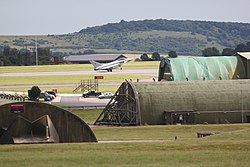
MOD Boscombe Down (ICAO: EGDM) is the home of a military aircraft testing site, on the south-eastern outskirts of the town of Amesbury, Wiltshire, England.
The airfield was built in 1930 as Royal Air Force Boscombe Down, and since 1939, has evaluated aircraft for use by the British Armed Forces. Today, the site has a main runway 3,212 metres (10,538 ft) in length, greater than many other UK airfields and useful for aspects of test flying. It is managed by QinetiQ, the private defence company created as part of the change from the Defence Evaluation and Research Agency in 2001 by the UK Ministry of Defence.
The airfield's evaluation centre is currently home to the Fast Jet Test Squadron, Heavy Aircraft Test Squadron, Rotary Wing Test and Evaluation Squadron, Handling Squadron (which drafts Pilot and other manuals for UK aircraft types), and the Empire Test Pilots' School which was created in 1943 to train squadron pilots in test-related flying. In 2026 it also became home to an anti-jamming test facility.
An aerodrome opened at the Boscombe Down site in October 1917 and operated as a Royal Flying Corps Training Depot Station. Known as Royal Flying Corps Station Red House Farm, it trained aircrews for operational roles in France during the First World War. Between opening and early 1919 the station accommodated No. 6 Training Depot, No. 11 Training Depot and No. 14 Training Depot. When the United States entered the war in April 1917, the Royal Flying Corps began training groundcrew and aircrew of Aviation Section of the US Army at the airfield. During 1918 the 166th Aero Squadron and 188th Aero Squadron were present. At the end of the war in November 1918, the airfield became an aircraft storage unit until 1920 when it closed and the site returned to agricultural use.
In 1930 the site reopened as Royal Air Force Boscombe Down, a bomber station in the Air Defence of Great Britain command, the fore-runner of RAF Fighter Command. The first unit to operate from the new airfield was No. 9 Squadron which started operating the Vickers Virginia heavy bomber on 26 February 1930. A second Virginia unit, No. 10 Squadron, arrived on 1 April 1931 and also operated the Handley Page Heyford.
The following RAF squadrons were based at Boscombe Down between 1930 and 1939:
The Aeroplane and Armament Experimental Establishment (A&AEE) arrived from RAF Martlesham Heath, Suffolk, on 9 September 1939, shortly after the outbreak of the Second World War. The move marked the beginning of A&AEE Boscombe Down and aircraft research and testing at the station, a role which it has retained into the 21st century. About fifty aircraft and military and civilian personnel had arrived by mid-September 1939. The necessary facilities required for the specialist work carried out by the A&AEE were lacking at Boscombe Down, and its expansion resulted in many temporary buildings being constructed at the station in an unplanned manner.
Throughout the war, the airfield continued to have only grass runways and remained within its pre-war boundaries. The first hard-surface runway opened in October 1945 and was followed by two more runways with parallel taxiways to create the present-day layout. The runways extend into Idmiston and Allington parishes.
MOD Boscombe Down
MOD Boscombe Down (ICAO: EGDM) is the home of a military aircraft testing site, on the south-eastern outskirts of the town of Amesbury, Wiltshire, England.
The airfield was built in 1930 as Royal Air Force Boscombe Down, and since 1939, has evaluated aircraft for use by the British Armed Forces. Today, the site has a main runway 3,212 metres (10,538 ft) in length, greater than many other UK airfields and useful for aspects of test flying. It is managed by QinetiQ, the private defence company created as part of the change from the Defence Evaluation and Research Agency in 2001 by the UK Ministry of Defence.
The airfield's evaluation centre is currently home to the Fast Jet Test Squadron, Heavy Aircraft Test Squadron, Rotary Wing Test and Evaluation Squadron, Handling Squadron (which drafts Pilot and other manuals for UK aircraft types), and the Empire Test Pilots' School which was created in 1943 to train squadron pilots in test-related flying. In 2026 it also became home to an anti-jamming test facility.
An aerodrome opened at the Boscombe Down site in October 1917 and operated as a Royal Flying Corps Training Depot Station. Known as Royal Flying Corps Station Red House Farm, it trained aircrews for operational roles in France during the First World War. Between opening and early 1919 the station accommodated No. 6 Training Depot, No. 11 Training Depot and No. 14 Training Depot. When the United States entered the war in April 1917, the Royal Flying Corps began training groundcrew and aircrew of Aviation Section of the US Army at the airfield. During 1918 the 166th Aero Squadron and 188th Aero Squadron were present. At the end of the war in November 1918, the airfield became an aircraft storage unit until 1920 when it closed and the site returned to agricultural use.
In 1930 the site reopened as Royal Air Force Boscombe Down, a bomber station in the Air Defence of Great Britain command, the fore-runner of RAF Fighter Command. The first unit to operate from the new airfield was No. 9 Squadron which started operating the Vickers Virginia heavy bomber on 26 February 1930. A second Virginia unit, No. 10 Squadron, arrived on 1 April 1931 and also operated the Handley Page Heyford.
The following RAF squadrons were based at Boscombe Down between 1930 and 1939:
The Aeroplane and Armament Experimental Establishment (A&AEE) arrived from RAF Martlesham Heath, Suffolk, on 9 September 1939, shortly after the outbreak of the Second World War. The move marked the beginning of A&AEE Boscombe Down and aircraft research and testing at the station, a role which it has retained into the 21st century. About fifty aircraft and military and civilian personnel had arrived by mid-September 1939. The necessary facilities required for the specialist work carried out by the A&AEE were lacking at Boscombe Down, and its expansion resulted in many temporary buildings being constructed at the station in an unplanned manner.
Throughout the war, the airfield continued to have only grass runways and remained within its pre-war boundaries. The first hard-surface runway opened in October 1945 and was followed by two more runways with parallel taxiways to create the present-day layout. The runways extend into Idmiston and Allington parishes.
Recent media
Recent media