Recent from talks
Nothing was collected or created yet.
Mong Kok
View on Wikipedia
| Mong Kok | |||||||||||||||||||||
|---|---|---|---|---|---|---|---|---|---|---|---|---|---|---|---|---|---|---|---|---|---|
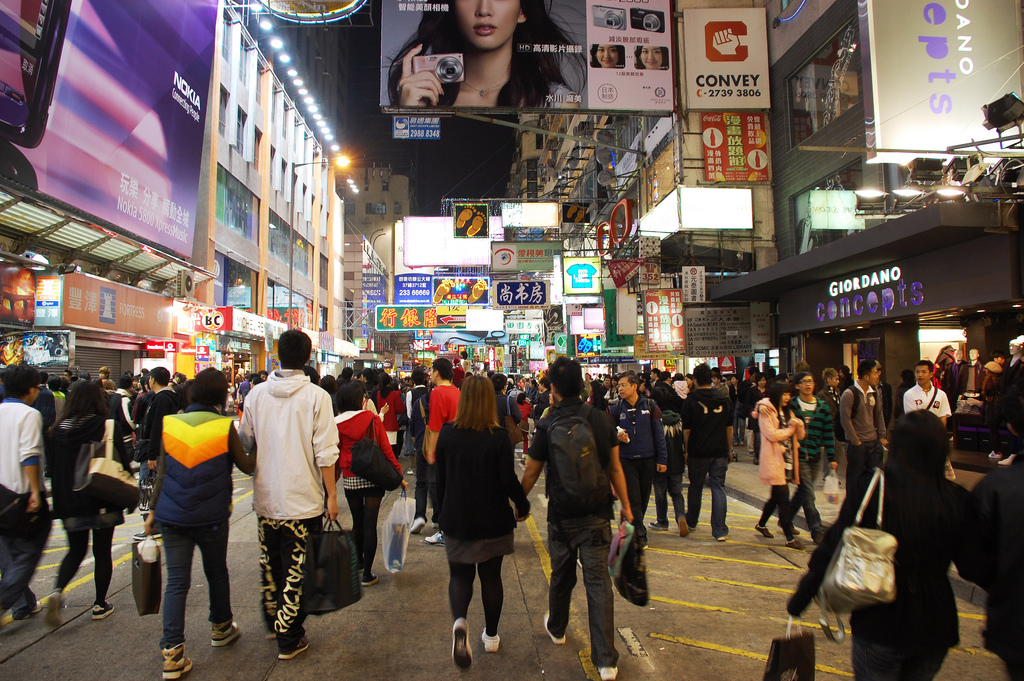
Sai Yeung Choi Street South in Mong Kok | |||||||||||||||||||||
| Chinese | 旺角 | ||||||||||||||||||||
| Literal meaning | flourishing/busy corner | ||||||||||||||||||||
| |||||||||||||||||||||


Mong Kok (Chinese: 旺角), also spelled Mongkok, often abbreviated as MK, is an area in Kowloon, Hong Kong. The Prince Edward subarea occupies the northern part of Mong Kok.
As one of the major shopping areas in Hong Kong, Mong Kok is characterised by a mixture of old and new multi-story buildings, with shops and restaurants at street level, and commercial or residential units above. Major industries in Mong Kok are retail, restaurants (including fast food) and entertainment. It has been described[1] and portrayed in films as an area in which triads run bars, nightclubs, and massage parlours. With its extremely high population density of 130,000/km2 (340,000/sq mi), Mong Kok was described as the busiest district in the world by the Guinness World Records.[2]
Name
[edit]Until 1930, the area was called Mong Kok Tsui (芒角嘴).[3] The current English name is a transliteration of its older Chinese name 望角 (Jyutping: mong6 gok3; IPA: [mɔːŋ˨ kɔːk˧]), or 芒角 (Jyutping: mong4 gok3; IPA: [mɔːŋ˨˩ kɔːk˧]), which is named for its plentiful supply of ferns in the past when it was a coastal region. Its present Chinese name, "旺角" (Jyutping: wong6 gok3; IPA: [wɔːŋ˨ kɔːk˧]), means "prosperous corner" or "crowded corner"; however, the English name did not change.
For a period, the area was also called Argyle (Argyle Street is a thoroughfare in the area), and this name was used for the MTR station when it opened in 1979. The office building Mong Kok Centre, which was named after the area, is known in English as Argyle Centre.
Administration
[edit]Mong Kok is part of Yau Tsim Mong District. It was part of the Mong Kok District before the district was merged in 1994. The area belongs to the Kowloon West geographical constituency of the Legislative Council of Hong Kong.
History
[edit]Displays at the Chinese University of Hong Kong include antique potteries indicating that there might have been settlements in the area as early as the western Han dynasty (206 BC to AD 8 ) to Jin Dynasty (266–420).[4]
The area used to be a Hakka settlement, with about 200 villagers according to Bao'an records in 1819.[5]
The heart of the present-day Mong Kok is along Argyle Street near Sai Yeung Choi Street whilst the proper Mong Kok used to be[when?] to the north, near the present-day Mong Kok East station. Mong Kok was an area of cultivated lands, bounded to the south by Argyle Street, to the west by Coronation Road (a section of present-day Nathan Road), and to the east by hills. To the southeast of Mong Kok is Ho Man Tin and to the west Tai Kok Tsui.
On 10 August 2008, the Cornwall Court fire broke out. More than 200 firefighters were involved in the rescue operation. Four people died, including two firefighters.[6]
Mong Kok received a lot of negative media attention for many acid attacks on Sai Yeung Choi Street from December 2008 through January 2010.
The area was the site of protracted demonstrations during the 2014 Hong Kong protests, including the gau wu campaign, and was also the site of the 2016 Mong Kok civil unrest.
Streets and markets
[edit]This section is written like a travel guide. (January 2017) |


Mong Kok preserves its traditional characteristics with an array of markets, small shops, and food stalls that have disappeared from other areas during the past several decades of economic developments and urban transformation. As such, a few of these streets in Mong Kok have acquired nicknames reflecting their own characteristics. Some interesting sites are:
- Tung Choi Street (通菜街) (also known as 女人街, Ladies' Market) – This market specialises in women's clothing, accessories, and cosmetics, and is open daily from noon to midnight.
- Sai Yeung Choi Street South (西洋菜南街) – A street full of shops selling consumer electronic products, cosmetics, and discount books. The latter are usually located on the lower floors of buildings.
- Yuen Po Street Bird Garden (園圃街雀鳥花園) – Hundreds of songbirds in exquisitely crafted cages can be seen at this market. The garden is open from 10 a.m. to 6 p.m. and is located near Mong Kok Stadium, to the north of Mong Kok East station and east of Prince Edward station.
- The garden was completed in 1997[7] for the relocation of booths selling birds at Hong Lok Street (雀仔街), aka. "Bird Street", which was closed due to urban renewal in June 1998.
- Fa Yuen Street (花園街) (also known as 波鞋街; 'Sneakers Street') – This is a small neighbourhood of small retailers selling sports equipment and clothing. The shops stock a diversity of sports shoes, including many shoes of rare or special editions from different places.
- Flower Market Road (花墟道) – The street and the nearby side streets are packed with florists and street vendors selling flowers and plants. At the end of the street is Yuen Po Street Bird Garden.
- Goldfish Street (金魚街) or Goldfish Market – Centered on a section of Tung Choi Street, north of Bute Street.[8] There are dozens of shops selling tropical freshwater and marine fish, aquariums and accessories. This market opens very early in the morning.
- Tile Street (瓷磚街) – This is a section of Portland Street near Argyle Street and Bute Street with more than 50 retailers selling materials for construction or renovation, such as tiles, wall paper, window frames and bath tubs.
- Photocopy Street (影印街) – A neighbourhood near Yim Po Fong Street and Soy Street is noted for its remarkable number of photocopying shops due to the number of schools in the vicinity. The shops also have ID photo taking service.
- Portland Street (砵蘭街) – A red-light district featuring numerous shops and restaurants.
- Kwong Wa Street (廣華街), between Dundas Street and Yim Po Fong Street, is famous for shops selling airsoft, RC racing, modelling and other hobbying equipment.
- Dundas Street (登打士街) marks the southern end of the shopping area in eastern Mong Kok, where Sai Yeung Choi Street South, Tung Choi Street and Fa Yuen Street terminate. It is named for Henry Dundas, 1st Viscount Melville, former British Home Secretary and Secretary of State for War. It is unclear why the street was bestowed in his honour although, as a former British colony, many of Hong Kong's streets and institutions were named in memory of prominent English historic and political figures. Ho King Shopping Centre and Trendy Zone are major shopping centres on the street. Various kinds of snack food shops concentrate on this street. Kwong Wah Hospital is also situated on the street. Across Nathan Road, the section in the western Mong Kok is relatively quiet and there are many cafés above street level in several buildings.
Some popular shopping plazas located in this dense area include:

- T.O.P (This is Our Place) - Latest fashionable shopping centre for youngers. No high-end shops there but specially characteristic store. An overpass corridor connected to Argyle Centre (旺角中心).
- Sim City (星際城市) - There are shops selling first or second hand cameras and lens, photographic and videographic equipment, gadget, phone accessory, computer accessory.
- Sino Centre (信和中心) – Most shops sell Japanimation figures and merchandising. Other shops sell comic books, VCDs and DVDs related to Japanese cartoons, and regular CD albums.
- Ho King Shopping Centre (好景商場) – Visitors can find computer and video games sold for relatively low prices. The fourth floor of the plaza is infamous for being formerly the biggest base of pornographic CDs and DVDs, and activities have diminished due to police and customs operations. However, some shops have been driven to the office section of the building.
- Grand Century Place (新世紀廣場) – Situated next to Mong Kok East station, visitors can find famous-brand and popular shops.
- Mong Kok Computer Centre (旺角電腦中心) – This three-story computer mall has around 50 to 70 computer shops, selling laptops, software, hardware and computer accessories.
- Langham Place (朗豪坊) – This is a 59-storey complex with a huge shopping mall, a hotel, and offices. It opened in 2004 and was constructed based on the Hong Kong Government urban redevelopment scheme. It is the tallest building in Mong Kok.
- Argyle Centre (旺角中心) – This usually crowded centre, located next to Mong Kok Station, has three floors of shops selling female low-priced clothes and shoes. Also a lot of snack food and drinks shop there.
- Trendy Zone (潮流特區)
- W Plaza (W 商場)
- Hollywood Shopping Centre (荷李活購物中心)
- Sincere Podium (先達中心)
- Richmond Shopping Arcade (皆旺商場)
- Hollywood Plaza (荷李活商業中心)
- CTMA Centre (兆萬中心)
Other streets in the area include:
- Bute Street (弼街), named after John Stuart, 3rd Earl of Bute, Prime Minister of the United Kingdom between 1762 and 1763. It may also have been named after the Scottish peerage of the same name, following the naming pattern of several other streets in the area.[9]
- Fife Street (快富街) is a street that is north of Argyle Street, south of Mong Kok Road, and perpendicular to Nathan Road.[10] The Chinese name means "fast wealth" in English, but the name is a loanword based on the English pronunciation of the fife instrument.[11]
- Soy Street (豉油街)
Food
[edit]The Mong Kok area has many food-booths selling traditional snacks such as fish balls, fried beancurd (tofu) and various dim sum. These fingerfoods are very popular in Hong Kong, especially for people on the run. In addition, there are restaurants serving different kinds of cuisine, ranging from Japanese to Thai and Italian.
Built heritage
[edit]Built heritage in Mong Kok includes:
- Several tong-lau, including Nos. 600–626 Shanghai Street and Lui Seng Chun on Lai Chi Kok Road. Both are listed as Grade I historic buildings.
- Old Kowloon Police Headquarters, built in 1925. Grade II historic building and one of the historic police station buildings in Hong Kong. Now part of the Mong Kok Police Station.
- Shui Yuet Temple (水月宮), located at No. 90 Shantung Street. Built in 1927, it is dedicated to Guanyin. Grade III.[12][13]
- All Saints' Church, No. 2 Yim Po Fong Street
- Parts of Kowloon Hospital
Sport venues
[edit]- Macpherson Stadium
- Macpherson Playground
- Mong Kok Stadium: home to Citizen AA and Sun Hei SC
- Boundary Street Sports Centre
Education
[edit]Educational institutions in Mong Kok include:
- Chinese University of Hong Kong campus in Shantung Street
- Diocesan Boys' School
- Hong Kong & Kowloon Chiu Chow Public Association Secondary School
- Hong Kong College of Engineering
- Queen Elizabeth School
- Sheng Kung Hui All Saints' Middle School
Mong Kok is in Primary One Admission (POA) School Net 32. Within the school net are multiple aided schools (operated independently but funded with government money) and Tong Mei Road Government Primary School (塘尾道官立小學).[14]
Hong Kong Public Libraries operates Fa Yuen Street Public Library in the Fa Yuen Street Municipal Services Building in Mong Kok.[15]
Transport
[edit]The main thoroughfares are:
Three rail lines serve the area:
- The MTR Tsuen Wan and Kwun Tong lines have two stations in this area: Prince Edward station to the north and Mong Kok station to the south.
- The MTR East Rail line has Mong Kok East station in the eastern part of the area.
Popular culture
[edit]Mong Kok was the setting for the 2004 hit film One Night in Mongkok directed by Derek Yee. The movie portrays Mong Kok, one of the most densely populated places on Earth, as a hotbed of illicit activity. Similarly, the district was also the setting of the 1996 film Mongkok Story (旺角風雲) directed by Wilson Yip, which depicts a young man who becomes involved in a triad gang.[16][17] The 2009 film To Live and Die in Mongkok and the 2013 film Young and Dangerous: Reloaded are also set in Mong Kok. The literal Chinese title of the 1988 film As Tears Go By by Wong Kar-wai is "Mong Kok Carmen". Part of Robert Ludlum's 1986 novel The Bourne Supremacy was set in Mong Kok.
The area is known locally for a youth subculture, the Mong Kok culture.
2014 protests
[edit]Mong Kok was one of the main sites of the 2014 Hong Kong protests. Banks, jewellery stores and clothing stores were closed as a result of the pro-democracy protests.[18]
References
[edit]- ^ Ruwitch, John; Baldwin, Clare (3 October 2014). "Hong Kong protesters face backlash, threaten to abandon talks". Reuters. Retrieved 3 October 2014.
- ^ Boland, Rory. "Mongkok Ladies Market". About.com Guide. Archived from the original on 2 April 2013. Retrieved 6 April 2013.
- ^ "芒角嘴" [Mong Kok Tsui], Gazetteer of the Yau Tsim Mong District (油尖旺區風物志), Hong Kong, p. 18, 1999
- ^ Kan, Nelson Y. Y.; Tanf, Miranda K. L. "Chapter two". New Journey Through History 1A. Aristo Educational Press LTD. p. 48.
- ^ "旺角古名芒角 客家人聚居" [Mong Kok, the ancient name of the Hakka settlements Mangjiao] (in Chinese). 1 August 2011. Archived from the original on 16 February 2016.
- ^ "Four dead as HK nightclub fire spreads". The Sydney Morning Herald. Archived from the original on 16 May 2021. Retrieved 13 June 2025.
- ^ "Yuen Po Street Bird Garden". Leisure and Cultural Services Department.
- ^ "Theme Shopping Streets". Hong Kong Tourism Board.
- ^ Yanne, Andrew; Heller, Gillis (2009). Signs of a Colonial Era. Hong Kong University Press. p. 26. ISBN 978-962-209-944-9.
- ^ Chan, Wing-yip Thomas (2001). Redevelopment of Mong Kok Urban Complex: An Urban Valley Along Fife Street (PDF) (Thesis). University of Hong Kong. doi:10.5353/th_b3198564. Archived from the original (PDF) on 18 June 2020. Retrieved 18 June 2020.
- ^ 潘國靈 (2017). "快富街, 一個拾荒者" [Fife Street, scavengers]. 消失物誌 [Lost Biography]. Hong Kong: Chung Hwa Book Company (Hong Kong) Limited. ISBN 978-988-8488-18-6. Retrieved 18 June 2020.
- ^ "List of the Historic Buildings in Building Assessment (as of 23 November 2011)" (PDF). Leisure and Cultural Services Department. Archived from the original (PDF) on 15 December 2011.
- ^ "Shui Yuet Kung, Shan Tung Street". Chinese Temples Committee.
- ^ "POA School Net 32" (PDF). Education Bureau. Retrieved 13 October 2022.
- ^ "Fa Yuen Street Public Library". Hong Kong Public Libraries. Retrieved 12 October 2025.
- ^ "Wong Gok fung wan". IMDb. 7 September 1996. Retrieved 28 August 2008.
- ^ "Mongkok Story". Yahoo! Movies. Archived from the original on 22 May 2011. Retrieved 28 August 2008.
- ^ "Protests in Mong Kok, Causeway Bay". The Standard. 29 September 2014. Archived from the original on 4 November 2014.
External links
[edit]Mong Kok
View on GrokipediaName and Etymology
Origin and Historical Naming
The English name "Mong Kok" derives from the Cantonese transliteration of the historical Chinese characters 芒角 (Jyutping: màhng gok³), literally "awn corner" or "silvergrass corner," referencing the area's former abundance of 芒草 (màhng4 cou²), a type of tall, reedy grass akin to miscanthus or ferns that thrived in the coastal wetlands and sharp, horn-like terrain prior to extensive land reclamation.[7][8] This etymology reflects the pre-urban landscape of Mong Kok as a marshy, vegetated promontory in southern Kowloon, where the grass's awn-like spikes evoked imagery of wheat husks, though no direct evidence links it to flour milling activities.[9] Following the British acquisition of Kowloon under the Convention of Peking in 1860, the name "Mong Kok" was formalized in colonial surveys and mapping efforts during the 1860s, appearing in early administrative records as a transliterated geographic descriptor for the protruding land feature.[10] By the late 19th century, as boundary demarcations extended into the 1890s with the lease of the New Territories, the designation persisted in official gazetteers, distinguishing the area from adjacent coastal zones without alteration to its phonetic rendering.[11] In contrast to this retained English form, the Chinese name evolved in the 1930s from 芒角 to 旺角 (Jyutping: wong⁶ gok³), shifting emphasis to "prosperous corner" to symbolize commercial vitality amid rapid urbanization, while the English name preserved the older ecological connotation.[12] This pattern mirrors nearby Yau Ma Tei (油麻地, Jyutping: jau⁴ maa⁴ dei⁶), named for oil-rich sesame or hemp fields (or clay pits yielding lamp oil), highlighting a regional convention of toponyms derived from agrarian or vegetative features rather than abstract trade associations.[13] Such naming underscores causal ties to 19th-century topography, predating modern density-driven reinterpretations.Geography and Demographics
Location and Administrative Boundaries
Mong Kok is situated in the Yau Tsim Mong District on the Kowloon Peninsula of Hong Kong, forming a densely built urban neighborhood in the southern part of the district. It lies immediately north of Yau Ma Tei and south of Prince Edward, with conventional boundaries approximated by Argyle Street to the south, Prince Edward Road West to the north, Nathan Road along much of the western edge, and extending eastward toward the East Rail Line.[14][15] These demarcations align with major transport nodes, including Mong Kok MTR station at the intersection of Nathan Road and Argyle Street, integrating the area into Kowloon's north-south arterial grid.[16] The Yau Tsim Mong District, encompassing Mong Kok, covers a gross land area of approximately 7 km², bounded overall by Victoria Harbour to the south and west, Boundary Street to the north, and the East Rail Line to the east.[14][15] Mong Kok's internal boundaries, while not rigidly administrative, have persisted as functional divisions since the colonial era's urban planning, resisting alteration despite surrounding high-rise intensification and infrastructure expansions that characterize Hong Kong's compact territorial framework.[17] This stability underscores the area's role within the fixed Kowloon landmass ceded in 1860, distinct from the leased New Territories to the north.[18]Population Density and Socioeconomic Profile
Mong Kok features one of the highest urban population densities worldwide, estimated at 130,000 persons per square kilometer, a figure recognized by the Guinness World Records as indicative of the area's extreme crowding.[19] This density stems from vertical development combining residential high-rises with ground-level commercial spaces on constrained land, amplifying both economic vitality through constant pedestrian flows and pressures on public amenities.[20] The surrounding Yau Tsim Mong District, which includes Mong Kok, recorded 310,647 residents across 6.983 km² in the 2021 Population Census, yielding an overall density of 44,486 persons per km², with subzones like Mong Kok exhibiting even greater concentration due to older, subdivided housing stock.[21] Demographically, the area is dominated by working-class ethnic Chinese residents speaking Cantonese, many employed in service industries, alongside substantial daily influxes of mainland Chinese visitors that temporarily inflate effective population levels and foot traffic. Median monthly income from main employment in Mong Kok housing market areas hovers around HK$17,000, reflecting socioeconomic reliance on proximate, low-to-mid wage opportunities amid high living costs.[22] High density causally links to elevated household crowding, with average sizes around 2.8 persons but frequent subdivision of units into micro-apartments exacerbating space constraints and living condition strains, as documented in studies of precarious rentals where sensorial overload and inadequate ventilation are common.[23] [24] These dynamics boost local productivity via seamless consumer access but necessitate robust infrastructure to mitigate resource depletion, such as intensified waste generation from transient populations.History
Pre-Colonial and Early Settlement
Prior to the 19th century, the Mong Kok area on the Kowloon Peninsula formed part of sparsely populated coastal marshlands within Xin'an County under imperial Chinese administration, with human activity limited to seasonal fishing and rudimentary agriculture. Indigenous groups included Tanka boat-dwellers who harvested marine resources from Victoria Harbour and adjacent waters, alongside Punti and Hoklo land-based communities practicing small-scale rice cultivation on elevated patches amid the wetlands.[25][26] These settlements were transient and low-density, reflecting the terrain's unsuitability for dense habitation, as evidenced by the predominance of salt evaporation ponds—a key regional industry since the Tang dynasty (618–907 AD)—over permanent villages.[25] Historical accounts describe Mong Kok Village as a modest cluster on a seaside hillock, serving as a focal point for local Punti families engaged in salt production and limited farming before widespread reclamation altered the landscape.[27] Land use surveys from the late Qing era (1644–1912) portray the surrounding expanse as largely undeveloped, with brackish marshes hindering expansion and contrasting with more fortified Punti enclaves in the New Territories.[28] No records indicate significant infrastructure, such as walls or temples, underscoring the area's peripheral role in pre-modern Cantonese society. Archaeological investigations reveal scant pre-19th-century artifacts in Mong Kok, including isolated ceramic pots from drainage sites attributable to historic periods, but lacking evidence of organized communities or monumental remains.[29] This paucity aligns with broader patterns in Kowloon, where coastal exploitation by Tanka groups predominated over inland agrarian Punti strongholds, yielding no substantial structures amid the tidal flats and mangroves.[26]British Colonial Era
The cession of the Kowloon Peninsula to Britain under the Convention of Peking in 1860 initiated the transformation of Mong Kok from rural fringes into an urban extension of Victoria City, with initial focus on military infrastructure and basic road networks like the precursor to Nathan Road (originally Robinson Road), developed from the 1860s onward to connect coastal areas to inland zones.[30] By the early 1900s, colonial authorities formalized a north-south oriented street grid in the Mong Kok vicinity, paralleling Nathan Road and enabling systematic land auctions in adjacent Yau Ma Tei from the 1870s, which spurred private Chinese investment in residential and light commercial structures.[31] This infrastructure laid the groundwork for denser settlement, exemplified by the completion of the Mong Kok Tsui typhoon shelter in 1915, which supported maritime trade and fishing activities at a cost of 2.21 million HKD over 165 acres.[30] Industrial migration from southern China in the 1930s tripled Kowloon's overall population density amid factory expansions in textiles and manufacturing, drawing laborers to Mong Kok's affordable tenements and positioning it as an emerging hub for informal markets amid limited formal planning.[32] Postwar refugee waves from mainland China—totaling approximately 1.16 million arrivals between 1950 and 1963, fleeing communist policies including the Great Leap Forward and early Cultural Revolution—further intensified urbanization, with many settling in Kowloon's dense districts like Mong Kok due to its proximity to ports and rail links such as the 1910 Kowloon-Canton Railway terminus.[33] Colonial policies of selective border control and touch-base repatriation allowed this influx to fuel labor for export-oriented growth, though it strained sanitation and housing, prompting ad hoc responses like squatter clearances rather than comprehensive redevelopment. The 1967 riots, instigated by pro-communist labor disputes at a Kowloon plastic flower factory and escalating into bomb campaigns inspired by mainland unrest, saw localized violence in Mong Kok with arson and clashes disrupting street commerce, yet the colonial government's decisive deployment of police and military—resulting in 51 deaths and over 4,000 arrests—curtailed the unrest within months, restoring order and investor confidence through subsequent reforms in welfare and anti-corruption measures.[34] This stabilization underscored governance's causal role in preserving trade hubs like Mong Kok, where markets for goods and labor rebounded swiftly, averting broader economic contraction amid Beijing's tacit withdrawal of support for agitators.[35]Post-1997 Handover and Modern Developments
Following Hong Kong's handover to China on 1 July 1997, Mong Kok became part of the Hong Kong Special Administrative Region (HKSAR), operating under the "one country, two systems" framework that preserved its pre-existing capitalist economic structure and high degree of autonomy. This continuity enabled the district's retail commerce, including its iconic street markets and small shops, to persist without immediate disruption, while gradually adapting to increased integration with mainland China. The Closer Economic Partnership Arrangement (CEPA), implemented in 2003, facilitated tariff-free access for Hong Kong goods to the mainland market, bolstering local exporters and indirectly supporting retail through enhanced economic ties.[36] The introduction of the Individual Visit Scheme (IVS) in July 2003, allowing residents from designated mainland cities to travel to Hong Kong independently, catalyzed a surge in tourism that particularly benefited Mong Kok's dense shopping districts. Visitor arrivals to Hong Kong rose from 15.5 million in 2003 to 21.4 million in 2004, with mainland tourists comprising a growing share drawn to the area's affordable goods and vibrant markets. This influx contributed to retail sales growth, as Mong Kok's vendors capitalized on demand for electronics, clothing, and souvenirs, aligning with broader HKSAR efforts to position the city as a regional tourism hub.[37] Infrastructure enhancements in the 2000s further supported commercial vitality, including the opening of Langham Place in December 2004, a mixed-use complex featuring retail, offices, and a hotel that drew an estimated 100,000 daily visitors and symbolized modernization amid traditional street commerce. Concurrent MTR upgrades, such as new station exits at Mong Kok completed between 2004 and 2005, improved pedestrian access and correlated with rising visitor numbers, peaking at over 65 million annually by 2018 before the COVID-19 downturn.[38] The 2003 SARS outbreak severely tested resilience, with Hong Kong's retail sales declining by approximately 30% amid a drop to 15.5 million visitors, yet Mong Kok's low-overhead street economy recovered swiftly through adaptive strategies like focusing on essential local trade. By November 2003, hotel occupancy rebounded to 93% from a May low of 17%, and overall visitor arrivals grew 37% year-over-year in 2004, underscoring the district's capacity to leverage policy-driven tourism revival and minimal regulatory interference under SAR governance.[37][39]Recent Urban Renewal Initiatives
In the Chief Executive's 2023 Policy Address delivered on October 25, the Hong Kong government directed the Urban Renewal Authority (URA) to initiate redevelopment projects in Mong Kok East over the subsequent five years, targeting the "Nullah Road Urban Waterway" and "Street Consolidation Areas" to improve urban infrastructure and commercial vitality.[40] This initiative addresses longstanding urban decay in high-density areas by optimizing land use and enhancing public spaces while preserving essential density levels.[40] The URA launched its first project under the Yau Ma Tei, Mong Kok, and Oil Ma District Study (YMDS) on March 15, 2024, focusing on the Nullah Road Urban Waterway in Mong Kok East to construct an "Urban Oasis" that integrates waterway enhancements with commercial redevelopment, aiming to transform the district into a vibrant landmark.[41] This effort materializes a key development node from the YMDS, with projected outcomes including improved pedestrian connectivity and economic activity through comprehensive site reconfigurations.[41] Parallel to this, the URA's Sai Yee Street/Flower Market Road Development Scheme, designated as the inaugural pilot under YMDS, commenced in March 2024 and seeks to balance modernization with heritage preservation across five themed streets: Flower Market Road, Tung Choi Street, Sai Yee Street, Fa Yuen Street, and Nelson Street.[42] These projects emphasize infrastructure upgrades, such as better streetscapes and facilities, to sustain Mong Kok's commercial density and cultural identity amid economic pressures, with phased completions aligned to the 2023-2028 timeline.[42][43] By mid-2025, these renewals were reported to counter prior neglect through targeted interventions, projecting increased commercial footfall and resilient urban environments without specified net additions in housing units, as the focus remains on commercial and public realm enhancements rather than residential expansion.[44] Local stakeholders have raised concerns over potential disruptions to existing businesses during implementation, though official projections highlight long-term benefits in vibrancy and sustainability.Government and Administration
District Governance Structure
Mong Kok is administered as part of the Yau Tsim Mong District under the Hong Kong Special Administrative Region, with local governance coordinated through the Yau Tsim Mong District Council (YTMDC). Established under the District Councils Ordinance, the YTMDC comprises a chairman appointed by the Chief Executive, ex-officio members from rural committees, and a limited number of elected representatives from geographical constituencies, following the 2023 electoral reforms that reduced directly elected seats to approximately 20% of total membership across all districts. This structure emphasizes advisory functions on district facilities, community services, and urban planning, subject to oversight by the Home Affairs Bureau, which ensures alignment with central government priorities. Sub-constituencies within the district, including those covering Mong Kok areas such as Mong Kok Central and South, operate through specialized committees like the District Facilities and Works Committee to handle localized decision-making on infrastructure and regulatory compliance.[46][47] The YTMDC's efficacy in enforcing ordinances on street vending and urban density is manifested through consultative recommendations to executive departments, such as the Food and Environmental Hygiene Department for hawker control and the Buildings Department for density-related building regulations. In Mong Kok, known for its extreme population density exceeding 100,000 persons per square kilometer in core areas, council initiatives include working groups that support licensed vendors while advocating crackdowns on unlicensed operations to mitigate pedestrian congestion and fire hazards. Implementation rates for such advisory policies have increased post-reform, with fewer vetoes from oppositional council motions, enabling consistent application of ordinances like the Public Health and Municipal Services Ordinance for vending restrictions. Voter turnout in the 2023 District Council election for Yau Tsim Mong's geographical constituencies mirrored the territory-wide low of 27.5%, signaling reduced contentious debate but higher execution fidelity in local enforcement.[14][48][49] Integration with national security frameworks since the 2020 National Security Law has reinforced YTMDC's role in maintaining public order, particularly in Mong Kok's high-traffic zones prone to unauthorized assemblies. The law's provisions against secession, subversion, and collusion have informed council protocols for monitoring and reporting potential threats during local events, with post-2020 enhancements to inter-departmental coordination yielding fewer disruptions from vending-related or density-induced disorders. This alignment, evidenced by the absence of large-scale protests in the district since 2019 and streamlined clearance operations, underscores a causal shift toward stability-focused governance, though critics attribute the subdued environment to suppressed civic participation rather than inherent efficacy.[50][51]Policy Impacts on Local Development
The enactment of the Hong Kong National Security Law on 30 June 2020 markedly curtailed civil unrest disruptions that had intensified in 2019, including frequent incidents in Mong Kok's commercial precincts. This policy shift correlated with a 3.1% decline in violent crimes across Hong Kong in 2020, from 9,690 to 9,391 cases, as reported by police data reflecting reduced protest-related violence.[52] The stabilization enabled consistent urban operations and investment in Mong Kok, where prior blockades had impeded retail and construction activities, thereby supporting incremental local economic and infrastructural growth without the volatility of preceding years. The Chief Executive's 2025 Policy Address introduced livelihood-focused reforms, including an adjusted long-term housing strategy targeting 126,000 private flats over the decade to 2035, refined based on demographic projections such as population aging and net outflow trends.[53] [54] These measures aim to moderate territory-wide development pressures, indirectly benefiting high-density locales like Mong Kok by channeling supply expansion to underutilized sites elsewhere, thus averting further intensification of local overcrowding while fostering sustainable plot utilization. Urban Renewal Authority (URA) policies exemplify density-controlled revitalization in Mong Kok, as outlined in the 2017-initiated District Study for Yau Ma Tei and Mong Kok, which guides project approvals with plot ratio caps and environmental safeguards to upgrade substandard buildings.[6] Approvals under this framework, incorporating case-specific density bonuses, have facilitated redevelopments yielding enhanced residential and commercial spaces—such as over 6,000 units projected from unlocked potentials in similar initiatives—while enforcing statutory limits to mitigate strain on infrastructure and public services.[55] This approach causally links policy to measured growth, prioritizing habitability over unchecked expansion in one of Hong Kong's most congested areas.Economy and Commerce
Retail Districts and Shopping Culture
Mong Kok's retail landscape centers on key thoroughfares like Nathan Road, a major artery lined with shops offering electronics, fashion, and accessories at competitive prices, drawing crowds for its mix of international chains and local outlets. Adjacent areas, including the Ladies' Market along Tung Choi Street, specialize in affordable clothing, handbags, and trinkets, where bargaining remains a cultural staple that enhances shopper engagement and turnover. This concentration of vendors in a compact zone—spanning roughly 1 square kilometer—creates one of the world's densest high-street environments, with Guinness World Records recognizing Mong Kok as the busiest district globally due to its pedestrian traffic and commercial intensity.[56] The high density of retail establishments, exceeding typical urban benchmarks, drives fierce competition that keeps prices low and product variety high, empirically correlating with robust local employment in commerce. In the Yau Tsim Mong District encompassing Mong Kok, retail activities support low unemployment rates, with Hong Kong's overall seasonally adjusted figure holding at 3.7% through mid-2025 amid sector pressures, reflecting the resilience of dense street-level trading in absorbing labor. Census data from the 2020s indicate that wholesale and retail trade employs over 10% of the territory's workforce, with districts like Mong Kok exemplifying this through sustained job creation despite periodic downturns.[57][58] To counter the rise of e-commerce, Mong Kok's physical retailers leverage experiential elements such as vibrant neon signage—though diminishing due to LED replacements—and extended operating hours, often until midnight or later, to preserve footfall and impulse buys. These adaptations maintain the district's allure as a tactile, immersive shopping destination, where the sensory overload of lights and displays differentiates it from online alternatives, supporting annual retail volumes in Hong Kong that reached HK$30.3 billion in August 2025 alone across broader categories.[59][60]Street Markets and Vendor Economy
Mong Kok features prominent fixed-pitch hawker areas, including the Ladies' Market on Tung Choi Street North, where vendors sell clothing, accessories, and souvenirs, and Fa Yuen Street, known for sports goods and apparel stalls. These markets operate as semi-formal vendor economies, with licensed hawkers occupying designated street spaces to offer affordable consumer items to high pedestrian volumes.[61] Individual vendors, such as one operating on Fa Yuen Street since 1977—initially illegally with a cart before transitioning to a licensed stall—exemplify the persistence of family-run operations amid regulatory shifts.[62] Hong Kong's hawker control originated in 1872 under colonial ordinances issuing renewable wooden permits to manage street vending, which proliferated as the population grew. By 1971, the city counted 39,033 licensed hawkers alongside approximately 6,000 illegal operators, reflecting a policy tolerance for hawkers as a welfare provision for low-skilled workers.[62] Policies evolved in the 1970s toward stricter regulation, viewing unregulated hawking as a hygiene and traffic hazard rather than essential social support, leading to frozen issuance of new licenses and limits on inheritance or transfer, particularly for mobile types.[62][63] In Mong Kok, a dense hawker hotspot, these measures have reduced fixed-pitch licenses citywide from over 20,000 in the 1990s to around 6,000 by 2025, with the Food and Environmental Hygiene Department enforcing against unlicensed sellers to reclaim public space while regulating permitted activities.[64][65] Recent crackdowns, including in nearby districts, underscore efforts to prioritize urban order over unchecked vending, though licensed hawkers in areas like Fa Yuen Street continue providing livelihoods through daily small-scale sales.[63] This balance reflects ongoing tensions between economic informality—offering low-barrier entry for vendors—and formal governance demands for hygiene and accessibility.[62]Tourism, Parallel Trading, and Economic Pressures
Prior to the COVID-19 pandemic, Mong Kok benefited economically from a surge in mainland Chinese visitors facilitated by the Individual Visit Scheme (IVS), launched in 2003 to permit independent travel from select cities.[66] By 2019, IVS accounted for 57% of mainland arrivals, with cumulative visits exceeding 294 million since inception, driving retail sales in shopping hubs like Mong Kok.[67] This influx contributed approximately 1.4% to Hong Kong's GDP and supported 2.4% of employment through heightened consumer spending.[68] However, it intensified parallel trading, where bulk purchases of commodities such as infant formula and cosmetics for resale across the border depleted local stocks and inflated prices.[69] Parallel trading activities peaked around 2015, prompting protests in commercial districts including Mong Kok, where traders' operations caused street blockages, litter accumulation, and transport overloads.[70] Economic repercussions included measurable rent escalations in retail spaces, with empirical analyses linking tourist volumes to higher commercial leasing costs due to demand surges.[71] Congestion metrics from the era highlighted overcrowded sidewalks and MTR stations in Mong Kok, straining infrastructure amid daily footfall exceeding capacity in peak shopping periods.[72] Post-2020, tourism recovery has progressed unevenly, with Hong Kong recording 24 million visitors in the first half of 2025, up 12% year-on-year, largely from mainland sources under expanded IVS coverage.[73] In Mong Kok's outlets, mainland visitors now comprise up to 90% of clientele, compared to a 50% pre-pandemic share, boosting trade volumes but reviving strains on local availability.[74] IVS extensions to additional cities, such as Qingdao and Xi'an in 2024, project further influxes potentially adding HK$1.5 billion in spending, yet causal frictions persist as cross-border arbitrage competes with resident access to essentials, amid ongoing rent pressures and policy efforts to mitigate overloads.[75][76]Culture and Society
Culinary Traditions and Street Food
Mong Kok's street food scene thrives amid its urban density, offering portable Cantonese snacks tailored to hurried commuters and shoppers. Vendors along Sai Yeung Choi Street and Dundas Street specialize in curry fish balls—skewered meatballs simmered in a spicy, thickened curry broth derived from Malaysian influences adapted locally—and stinky tofu, fermented curd deep-fried for a crispy exterior masking its pungent aroma, both priced typically under HK$20 per serving. These items, sold from mobile carts since the mid-20th century, embody the district's adaptation of hawker traditions to high-footfall pedestrian zones.[77][78] Egg tarts, featuring buttery shortcrust pastry encasing a smooth, baked custard, represent a colonial-era fusion originating from English custard tarts introduced to Canton in the 1920s by British traders, refined in Hong Kong after World War II through cha chaan teng outlets and bakeries. In Mong Kok, they are readily available from street-side stalls and small shops, with daily production emphasizing fresh baking to achieve the signature caramelized top, reflecting ongoing evolution from immigrant recipes to localized staples.[79][80] Dai pai dongs, semi-open-air stalls licensed for wok cooking, persist in Mong Kok, such as Ladies' Street Sik Fan Co., delivering high-heat stir-fries like seafood and rice dishes infused with "wok hei" smoke flavor, a technique rooted in Cantonese culinary methods dating to the 1950s. Their operation, limited to fewer than 20 licensed sites citywide by 2025 due to stringent regulations, underscores a shift from unregulated post-war vending to controlled premises.[81][82] The Food and Environmental Hygiene Department enforces hygiene through routine inspections of stalls and markets, requiring visible licenses and sanitation protocols, with Mong Kok's cooked food centers like Fa Yuen Street Market Cooked Food Centre featuring compliant vendors amid concentrations of snack outlets blending retail with cuisine. This regulatory framework, intensified since the 2000s, balances tradition with public health amid dense vending.[83][84]Nightlife and Social Entertainment
Mong Kok's nightlife centers on social entertainment venues such as karaoke establishments and mahjong parlors, particularly clustered along Portland Street, where neon signs illuminate operations into the evening hours.[85] Karaoke bars, known locally as KTV, offer private rooms for singing sessions popular among groups, with establishments like Neway and Red MR operating in the district and typically extending hours until 2-3 a.m. to accommodate after-work gatherings.[86] Mahjong parlors, numbering among Hong Kong's 66 licensed venues, generally run from noon to midnight, drawing players for casual or competitive games as a traditional form of social bonding.[87] These venues facilitate a blend of local residents and tourists, creating dynamic social environments where Cantonese-speaking locals interact with international visitors through shared activities like singing popular songs or tile-based games.[88] This mixing contributes to the area's vibrant evening atmosphere, with spots like indie clubs in Mong Kok appealing to younger locals while attracting curious tourists exploring beyond daytime markets.[89] Outside periods of civil unrest, such as the 2019 protests, the district maintains low rates of violent crime, aligning with Hong Kong's overall figures where violent incidents constitute under 12% of total reported crimes and homicides remain rare at around 0.2-0.5 per 100,000 residents.[90][91] Regulatory frameworks enforce strict licensing for these establishments to mitigate vice-related exploitation, with karaoke operations governed by the Karaoke Establishments Ordinance (Cap. 573), requiring permits or licenses from the Home Affairs Department to ensure compliance with safety and age restrictions.[92][93] Such controls have historically led to revocations for violations like employing underage staff, demonstrating empirical effectiveness in curbing illicit practices through oversight rather than outright prohibition.[94] Mahjong parlors similarly operate under licensed hours to limit gambling excesses, supporting orderly social entertainment without pervasive criminal undertones.[87]Representations in Popular Culture
Mong Kok has been depicted in Hong Kong cinema as a microcosm of urban intensity, with its neon-saturated streets and perpetual crowds serving as metaphors for transience and disconnection. Wong Kar-wai's Fallen Angels (1995) utilizes the district's bustling environment to frame narratives of nocturnal assassins and lonely wanderers, where the visual cacophony of signage and foot traffic underscores existential isolation amid constant motion.[95] Similarly, Mongkok Story (1996), directed by Derek Yee, portrays the area through the lens of a peripheral gangster figure, examining the gritty underbelly of street-level survival without glorifying criminality.[96] Later works like To Live and Die in Mongkok (2009), a thriller by Wong Jing and Billy Chung, reinforce this pattern by staging high-stakes chases and betrayals against the district's labyrinthine alleys, emphasizing spatial confinement as a driver of tension. These films collectively pattern Mong Kok as a site of chaotic vitality, where density fosters both opportunity and peril, though such representations draw from observed demographics rather than fabricating disorder. In interactive media, video games extend these tropes into explorable simulations of Hong Kong's Kowloon side. Sleeping Dogs (2012), developed by United Front Games, models Mong Kok-adjacent markets and thoroughfares as interactive zones of triad intrigue and vendor haggling, capturing the area's sensory overload through dynamic pedestrian flows and neon ambiance to immerse players in a stylized urban realism.[97] This depiction aligns with broader gaming trends that leverage Mong Kok's reputed crowding—evident in real-world pedestrian densities exceeding 100,000 per square kilometer during peaks—for gameplay mechanics emphasizing evasion and immersion, without altering factual topography for narrative convenience.[98] Literary works similarly invoke Mong Kok's congestion to amplify psychological strain, as in Jake Needham's thriller Mongkok Station (2015), where the protagonist navigates the district's disorienting crowds amid a missing persons case, portraying its infrastructure as exacerbating personal fragmentation.[99] Anthologies like Hong Kong Noir (2018) feature short stories set there, such as "Phoenix Moon," which use the locale's anonymity to explore moral ambiguity in confined urban spaces.[100] Travel-oriented media and documentaries often echo these patterns, framing Mong Kok's vibrancy in guides and visuals as an emblem of resilient Asian dynamism, yet such portrayals selectively highlight aesthetic allure over logistical frictions like narrow roadways.[101] Across mediums, depictions consistently attribute the district's "vital chaos" to its empirical population pressure, avoiding unsubstantiated exoticism while noting how cinematic liberties amplify sensory elements for dramatic effect.Infrastructure
Transportation Hubs and Connectivity
Mong Kok Station on the Mass Transit Railway (MTR) serves as the district's central transportation hub, functioning as an interchange between the Tsuen Wan Line and Kwun Tong Line. This connectivity facilitates rapid transit across Kowloon and Hong Kong Island, with the station's design accommodating high passenger flows through multiple exits and platforms. Pre-COVID-19, the MTR system overall recorded average daily patronage exceeding 5 million journeys, with busy interchanges like Mong Kok handling substantial portions of this volume to support the area's extreme urban density.[102] Bus and minibus services integrate seamlessly with the MTR at key points in Mong Kok, providing feeder routes that enhance network efficiency during peak hours. Kowloon Motor Bus (KMB) and Citybus operate numerous lines along Nathan Road and adjacent streets, while green minibuses follow fixed schedules with capacities up to 19 seated passengers, and red minibuses offer flexible routing for last-mile connectivity. Specific routes, such as certain green minibus lines, maintain peak-hour capacities of at least 115 passengers per direction, enabling the system to manage surges in demand from the district's commercial and residential activities.[103][104] Post-2020 enhancements to MTR operations have bolstered resilience and efficiency, including expanded contactless payment options at gates. Visa contactless cards were accepted from December 2023, followed by Mastercard and UnionPay integration in August 2024, alongside existing Octopus cards and QR code tickets, reducing transaction times and contact points. These upgrades, implemented system-wide including at Mong Kok Station, support on-time performance rates of 99.9% and aid recovery from pandemic-induced ridership drops, with domestic services rebounding toward pre-2019 levels by 2023.[105][106][107]Public Amenities and Utilities
Mong Kok's water supply and sewage infrastructure, managed by the Water Supplies Department and Drainage Services Department, experiences strain from the area's population density exceeding 130,000 persons per square kilometer, leading to overloaded stormwater systems that contribute to polluted dry weather flows and water quality deterioration in Kowloon districts including Mong Kok.[108] The Drainage Services Department has addressed such pressures through sewerage master plans covering urban catchments, with ongoing upgrades to sewer networks in aged areas like Mong Kok to enhance capacity and prevent overflows during peak loads.[109][110] Recreational amenities are limited by spatial constraints but include facilities under the Leisure and Cultural Services Department, such as the Fa Yuen Street Sports Centre, featuring a 623 m² multi-purpose arena, a 175 m² dance room, and activity rooms for community use.[111] In June 2023, authorities announced a "Nano Park System" initiative to renovate facilities and add toilets in approximately 20 small open spaces across Mong Kok over four years, aiming to improve accessibility amid high urban density.[112] Adjacent Kowloon Park, covering 13.3 hectares on the district's fringe, supports broader recreation with indoor and outdoor venues, where over 60% of visitors engage in moderate-to-vigorous physical activity according to observational studies of Hong Kong urban parks.[113][114] Waste management challenges arise from the concentration of street vendors and markets, which generate elevated litter volumes tied to daily footfall and commercial refuse in this densely populated zone.[115] The Food and Environmental Hygiene Department deploys street cleansing teams for sweeping and washing, supported by over 11,100 citywide litter containers and 2,000 dog excreta bins, yet vendor density correlates with persistent hygiene pressures requiring intensified collections of approximately 5,820 tonnes of household and street waste daily across Hong Kong.[116] Audits highlight the need for vigilant contractor oversight in high-activity areas to maintain reliability, with FEHD efforts including year-end clean-ups in Yau Tsim Mong district to counter accumulation from transient trading.[117][118]Education and Recreation
Educational Facilities
Diocesan Boys' School, located at 131 Argyle Street in Mong Kok, is a prominent boys-only secondary institution founded in 1869, providing English-medium instruction across academic and extracurricular programs tailored to prepare students for university entrance and professional careers.[119] Queen Elizabeth School, situated at 151 Argyle Street, operates as a government co-educational secondary school established in 1956, emphasizing English as the primary medium of instruction and maintaining a student-teacher ratio aligned with Hong Kong's secondary average of approximately 12.4 students per teacher as of 2016. HKMA David Li Kwok Po College, also in Mong Kok and inaugurated in 2000 under the Direct Subsidy Scheme, focuses on holistic development with a curriculum that includes business and leadership training relevant to the district's commercial environment.[120] Following the 1997 handover, Hong Kong's secondary curriculum underwent reforms, including a shift toward Chinese as the medium of instruction in many schools, though Mong Kok institutions like Diocesan Boys' School and Queen Elizabeth School retained English-medium status to support bilingual proficiency amid the territory's international trade orientation.[121] The 2009 extension of compulsory education to six years of secondary schooling introduced the New Senior Secondary curriculum, incorporating applied learning subjects such as tourism and hospitality—fields that align with Mong Kok's service-dominated economy of retail and street vending.[122] Vocational training in the area emphasizes practical skills for local employment, with secondary schools offering electives in commerce and design that complement nearby Vocational Training Council programs, though full-time vocational institutes are limited within Mong Kok itself due to spatial constraints. High urban density poses ongoing challenges, including cramped facilities that restrict playgrounds and laboratories, as evidenced by the district's reliance on vertical building designs and shared community spaces for educational activities.[123] These limitations impact enrollment capacity and extracurricular offerings, prompting adaptations like after-school programs in rented venues to accommodate student needs.[124]Sports and Community Venues
Mong Kok Stadium, with a seating capacity of 6,668, functions as a central venue for football matches in the Hong Kong Premier League, serving as the home ground for clubs such as Kitchee SC and hosting events for other teams like Eastern.[125][126] In the 2022-23 fiscal year, the stadium accommodated 48 events, reflecting its role in supporting local competitive sports amid the area's urban density.[125] Adjacent to the stadium, Boundary Street Sports Centre No.1, commissioned on 4 June 1976, offers a multi-purpose arena of 595 m² that accommodates one basketball or volleyball court or four badminton courts, providing adaptable spaces for community recreational activities.[127] Similarly, Fa Yuen Street Sports Centre features a 623 m² multi-purpose arena convertible for basketball, volleyball, netball, or badminton, alongside a 170 m² fitness room, four squash courts, and table tennis facilities, enabling diverse physical pursuits in a compact urban setting.[111] These venues address recreational demands in Mong Kok's high-density environment by prioritizing multi-use indoor facilities that promote health and community engagement, aligning with Hong Kong's overall public sports infrastructure, where sports grounds achieved a 99% average annual usage rate from 2016 to 2020.[128] Local participation ties into broader leagues, with the stadium facilitating Premier League fixtures involving 10 teams in the 2025-26 season.[126]Heritage and Preservation
Architectural and Cultural Heritage Sites
Mong Kok preserves several examples of early 20th-century tong lau shophouses amid its dense urban fabric, with conservation efforts led by the Antiquities and Monuments Office (AMO) and the Urban Renewal Authority (URA). These structures, characterized by ground-floor shops and upper residential floors with verandahs, represent vernacular Cantonese architecture adapted for commercial use. Grading by the Antiquities Advisory Board designates buildings for protection, with Grade I indicating exceptional merit warranting preservation where possible.[129] Lui Seng Chun at 119 Lai Chi Kok Road exemplifies such preservation; constructed in 1931 as a four-storey tong lau by Lui Leung, a herbalist, it featured a ground-floor clinic dispensing traditional Chinese medicine. Owned by the Lui family until 1944, the building incorporates Chinese architectural elements like tiled roofs and balustrades alongside Western influences. Declared a monument under the Antiquities and Monuments Ordinance on May 20, 2022, following restoration under the government's Batch I Revitalising Historic Buildings scheme, it now serves as a heritage exhibition centre demonstrating traditional construction techniques.[130][131][132] Nos. 600–626 Shanghai Street comprise a cluster of ten pre-war shophouses built between 1920 and 1926, listed as Grade I historic buildings for their intact facades and arcades that facilitated street commerce. These structures faced deterioration from decades of heavy use but underwent a HK$200 million URA-led restoration completed in 2019, retaining original features like cantilevered balconies while integrating modern safety standards. The project highlights adaptive reuse to counter demolition pressures from land scarcity, preserving street-level vernacular amid surrounding high-rises.[133] Conservation in Mong Kok balances heritage retention against urban renewal demands, with AMO gradings and URA interventions mitigating threats from density-induced redevelopment. While many older buildings succumb to replacement for higher-capacity structures, designated sites benefit from legal safeguards and public-private funding, ensuring select tong lau endure as cultural anchors.[129][133]Social Issues and Controversies
Civil Unrest Events
Mong Kok served as a primary site for the 2014 Umbrella Movement protests, where demonstrators occupied key roads including Nathan Road and Argyle Street starting around September 28, demanding genuine universal suffrage for electing the Chief Executive.[134] The occupation disrupted local businesses for approximately two months until clearance operations began on November 25, 2014, following court-issued injunctions obtained by affected parties to restore public access.[135] Government assessments highlighted substantial tangible and intangible economic losses from the illegal occupations, including halted retail operations and damaged public order, though precise figures for Mong Kok alone were not isolated in official tallies.[136] Clearance involved police actions amid scuffles, with protesters obstructing bailiffs, underscoring tensions between demands for electoral reform and the legal imperative to prevent prolonged disruption of commercial districts.[137] The February 8-9, 2016, unrest, dubbed the "fishball riots," erupted during Lunar New Year when Food and Environmental Hygiene Department officers enforced regulations against unlicensed street hawkers selling items like fishballs along Fa Yuen Street and other areas.[138] Protesters, including localist groups, clashed with police after vendors refused dispersal, leading to the use of batons, pepper spray, and warning shots fired into the air; approximately 100 officers sustained injuries, while 24 individuals were arrested for rioting and related offenses.[139][140] Authorities emphasized the necessity of upholding licensing laws to maintain hygiene and order in a high-density area prone to illegal vending, contrasting protester narratives framing the raids as assaults on traditional livelihoods and cultural practices.[141] The violence marked the most significant disturbance since 2014, revealing underlying frictions over regulatory enforcement versus informal economic activities. In 2019, Mong Kok experienced intensified protest actions amid broader anti-extradition bill unrest, including triad-linked assaults on demonstrators and widespread arson targeting shops and infrastructure, such as the October 20 spree where mobs set fires inside mainland-affiliated businesses over eight hours.[142][143] Clashes involved masked rioters hurling bricks at police stations and blocking roads, prompting tear gas and rubber bullet responses; these tactics, while aimed at pressuring government concessions on issues like police accountability, escalated without yielding policy reversals beyond the bill's withdrawal.[144] Hong Kong-wide, over 10,279 arrests occurred by mid-2024 for protest-related offenses, with many in districts like Mong Kok involving charges of rioting and arson.[145] The imposition of the National Security Law on June 30, 2020, curtailed such recurrences by criminalizing secession, subversion, and collusion, restoring stability as major street disturbances ceased, though critics attribute this to suppression rather than resolution of grievances—empirical outcomes indicate radical confrontations proved futile in advancing demands while inviting stricter legal measures.[146][147]Organized Crime and Triad Influence
Mong Kok has historically served as a stronghold for triad societies such as the 14K and Wo Shing Wo, which dominated vice operations including prostitution along Portland Street and protection rackets targeting local merchants and markets during the 1980s and 1990s, a period marking their peak territorial influence amid limited enforcement against police corruption.[148] [149] Violent clashes, such as the 1975 billiard hall turf war between these groups that resulted in a murder, underscored their competition for control over illicit gambling and extortion in the district's crowded neighborhoods.[150] The Independent Commission Against Corruption (ICAC) targeted enabling graft through operations like the 1995 raid on Mong Kok brothels, arresting over 20 suspects and disrupting triad-backed vice networks, though underground activities persisted due to the area's high density and economic opportunities.[151] [152] Triad involvement resurfaced prominently in 2019, with members launching attacks in Mong Kok to defend business territories—such as mahjong parlors, entertainment venues, and drug outlets—disrupted by blockades and occupations that halved local commerce, reflecting core incentives of economic preservation over external directives.[153] [148] Faction leaders mobilized followers explicitly to counter threats to revenue streams in triad-run sites, prioritizing control amid the district's role as a commercial hub for both legitimate and illicit enterprises.[153] Intensified police operations post-2020, bolstered by anti-triad squads and the national security framework, have eroded overt influence, evidenced by a 8.6% drop in triad-related crimes to 2,334 cases in 2023 from 2022 levels and sustained arrests like the 86 suspects in a 2025 crackdown on drug and vice syndicates.[154] [155] Detection rates for such offenses reached 69.7% in early 2023, with wounding and assault incidents falling below 2019 figures, indicating reduced operational capacity through targeted disruptions rather than elimination.[156]Challenges of Extreme Urban Density
Mong Kok exemplifies extreme urban density, with population figures reaching approximately 130,000 people per square kilometer in certain sub-areas, contributing to heightened pressures on infrastructure and living conditions.[157] This density exacerbates sanitation challenges, as evidenced by frequent Food and Environmental Hygiene Department (FEHD) interventions, including multiple restaurant suspensions in Mong Kok for hygiene violations, such as a 21-day closure in September 2025 due to repeated food safety lapses.[158] High population concentrations amplify waste management strains, with Hong Kong-wide complaints exceeding 50,000 annually from 2020 to 2024, disproportionately affecting dense districts like Mong Kok where street hawking historically posed sanitation hazards.[117][62] Housing affordability suffers under such density, manifesting in widespread subdivided flats that partition larger units into minuscule spaces, often lacking proper ventilation or safety features. In Hong Kong overall, these units numbered around 108,200 in 2021, housing over 215,700 residents, with about 60% located in Kowloon—including Mong Kok—correlating with persistent poverty rates where 1.4 million individuals, or roughly 20% of the population, live below the poverty line despite the area's commercial vibrancy.[159][160][161] Conditions in these flats remain substandard, with residents spending over half their income on rent and facing health risks like spinal issues in nearly 94% of affected children under 18.[162][163] Health strains are pronounced, as high-density environments facilitate rapid disease transmission; studies indicate elevated infection rates in such areas compared to less dense ones, a pattern observed in respiratory illnesses where proximity accelerates spread absent modern interventions like widespread vaccination.[164] Precarious housing in Mong Kok intensifies sensorial discomforts—leaks, odors, humidity, and noise—undermining resident well-being and correlating with broader urban liveability deficits.[24] While density fosters economic dynamism through proximate commerce and efficient public transport, enabling vibrant markets and reduced per-capita infrastructure needs, this proximity's benefits are tempered by unaddressed welfare costs, including entrenched poverty and health vulnerabilities that offset gains in productivity.[165][166] Overemphasis on these upsides risks ignoring causal links between overcrowding and sustained social strains, as subdivided living persists amid commercial prosperity.[19]References
- https://en.wiktionary.org/wiki/Mong_Kok
- https://www.scmp.com/news/hong-kong/[society](/page/Society)/article/3293972/board-members-fear-famed-hong-kong-flower-market-may-lose-spirit-revamp
