
Recent from talks
Dower
Knowledge base stats:
Talk channels stats:
Members stats:
Dower
Dower is a provision accorded traditionally by a husband or his family, to a wife for her support should she become widowed. It was settled on the bride (being given into trust) by agreement at the time of the wedding, or as provided by law.
The dower grew out of the practice of bride price, which was given over to a bride's family well in advance for arranging the marriage, but during the early Middle Ages, was given directly to the bride instead. However, in popular parlance, the term may be used for a life interest in property settled by a husband on his wife at any time, not just at the wedding. The verb to dower is sometimes used.
In popular usage, the term dower may be confused with:
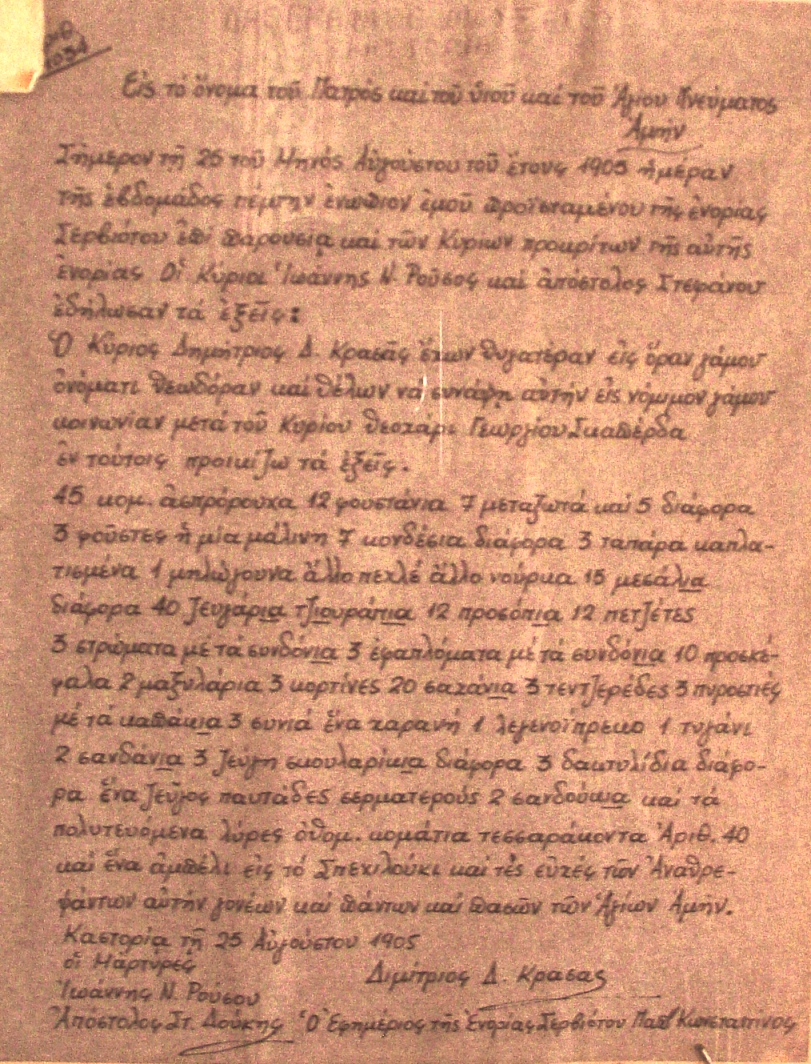
Being for the wife/spouse and being accorded by law, dower differs essentially from a conventional marriage portion such as the English dowry (cf. Roman dos, Byzantine proíx, Italian dote, French dot, Dutch bruidsschat, German Mitgift).
The bride received a right to certain property from the bridegroom or his family. It was intended to ensure her livelihood in widowhood, and it was to be kept separate and in the wife's possession.
Dower is the gift given by the groom to the bride, customarily on the morning after the wedding, though all dowerings from the man to his fiancée, either during the betrothal period, or wedding, during marriage or afterwards, even as late as in the testamentary dowering, are understood as dowers if specifically intended for the maintenance of the wife.
Dower was a property arrangement for marriage first used in early medieval German cultures, and the Catholic Church drove its adoption into other countries, in order to improve the wife's security by this additional benefit. The practice of dower was prevalent in those parts of Europe influenced by Germanic Scandinavian culture, such as Sweden, Germany, Normandy and successor states of the Langobardian kingdom.
The husband was legally prevented from using the wife's dower — as contrasted with her dowry, which was brought to the marriage by the bride and used by both spouses. This often meant that the woman's legal representative, usually a male relative, became guardian or executor of the dower, to ensure that it was not squandered.
Hub AI
Dower AI simulator
(@Dower_simulator)
Dower
Dower is a provision accorded traditionally by a husband or his family, to a wife for her support should she become widowed. It was settled on the bride (being given into trust) by agreement at the time of the wedding, or as provided by law.
The dower grew out of the practice of bride price, which was given over to a bride's family well in advance for arranging the marriage, but during the early Middle Ages, was given directly to the bride instead. However, in popular parlance, the term may be used for a life interest in property settled by a husband on his wife at any time, not just at the wedding. The verb to dower is sometimes used.
In popular usage, the term dower may be confused with:
Being for the wife/spouse and being accorded by law, dower differs essentially from a conventional marriage portion such as the English dowry (cf. Roman dos, Byzantine proíx, Italian dote, French dot, Dutch bruidsschat, German Mitgift).
The bride received a right to certain property from the bridegroom or his family. It was intended to ensure her livelihood in widowhood, and it was to be kept separate and in the wife's possession.
Dower is the gift given by the groom to the bride, customarily on the morning after the wedding, though all dowerings from the man to his fiancée, either during the betrothal period, or wedding, during marriage or afterwards, even as late as in the testamentary dowering, are understood as dowers if specifically intended for the maintenance of the wife.
Dower was a property arrangement for marriage first used in early medieval German cultures, and the Catholic Church drove its adoption into other countries, in order to improve the wife's security by this additional benefit. The practice of dower was prevalent in those parts of Europe influenced by Germanic Scandinavian culture, such as Sweden, Germany, Normandy and successor states of the Langobardian kingdom.
The husband was legally prevented from using the wife's dower — as contrasted with her dowry, which was brought to the marriage by the bride and used by both spouses. This often meant that the woman's legal representative, usually a male relative, became guardian or executor of the dower, to ensure that it was not squandered.
Recent media