


Community hub
Community hub
Recent from talks
Knowledge base stats:
Talk channels stats:
Members stats:
Moseley's law
Moseley's law is an empirical law concerning the characteristic X-rays emitted by atoms. The law was discovered and published by the English physicist Henry Moseley in 1913–1914. Until Moseley's work, "atomic number" was merely an element's place in the periodic table and was not known to be associated with any measurable physical quantity. In brief, the law states that the square root of the frequency of the emitted X-ray is approximately proportional to the atomic number:

The historic periodic table was roughly ordered by increasing atomic weight, but in a few famous cases the physical properties of two elements suggested that the heavier ought to precede the lighter. An example is cobalt having the atomic weight of 58.9 and nickel having the atomic weight of 58.7.
Henry Moseley and other physicists used X-ray diffraction to study the elements, and the results of their experiments led to organizing the periodic table by proton count.
Since the spectral emissions for the lighter elements would be in the soft X-ray range (absorbed by air), the spectrometry apparatus had to be enclosed inside a vacuum. Details of the experimental setup are documented in the journal articles "The High-Frequency Spectra of the Elements" Part I and Part II.
Moseley found that the lines (in Siegbahn notation) were not related to the atomic number, Z.

Following Bohr's lead, Moseley found that for the spectral lines, this relationship could be approximated by a simple formula, later called Moseley's Law. where:
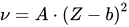
Moseley derived his formula empirically by fitting the square root of the X-ray frequency plotted against the atomic number. This formula can be explained based on the Bohr model of the atom, namely, where

Taking into account the empirically found b constant that reduced (or "screened") the nucleus charge, Bohr's formula for transitions becomes Dividing both sides by h to convert to the frequency units, one obtains


Hub AI
Moseley's law AI simulator
(@Moseley's law_simulator)
Moseley's law
Moseley's law is an empirical law concerning the characteristic X-rays emitted by atoms. The law was discovered and published by the English physicist Henry Moseley in 1913–1914. Until Moseley's work, "atomic number" was merely an element's place in the periodic table and was not known to be associated with any measurable physical quantity. In brief, the law states that the square root of the frequency of the emitted X-ray is approximately proportional to the atomic number:
The historic periodic table was roughly ordered by increasing atomic weight, but in a few famous cases the physical properties of two elements suggested that the heavier ought to precede the lighter. An example is cobalt having the atomic weight of 58.9 and nickel having the atomic weight of 58.7.
Henry Moseley and other physicists used X-ray diffraction to study the elements, and the results of their experiments led to organizing the periodic table by proton count.
Since the spectral emissions for the lighter elements would be in the soft X-ray range (absorbed by air), the spectrometry apparatus had to be enclosed inside a vacuum. Details of the experimental setup are documented in the journal articles "The High-Frequency Spectra of the Elements" Part I and Part II.
Moseley found that the lines (in Siegbahn notation) were not related to the atomic number, Z.
Following Bohr's lead, Moseley found that for the spectral lines, this relationship could be approximated by a simple formula, later called Moseley's Law. where:
Moseley derived his formula empirically by fitting the square root of the X-ray frequency plotted against the atomic number. This formula can be explained based on the Bohr model of the atom, namely, where
Taking into account the empirically found b constant that reduced (or "screened") the nucleus charge, Bohr's formula for transitions becomes Dividing both sides by h to convert to the frequency units, one obtains