

Recent from talks
Mott–Schottky plot
Knowledge base stats:
Talk channels stats:
Members stats:
Mott–Schottky plot
In semiconductor electrochemistry, a Mott–Schottky plot describes the reciprocal of the square of capacitance versus the potential difference between bulk semiconductor and bulk electrolyte. In many theories, and in many experimental measurements, the plot is linear. The use of Mott–Schottky plots to determine system properties (such as flatband potential, doping density or Helmholtz capacitance) is termed Mott–Schottky analysis.

Consider the semiconductor/electrolyte junction shown in Figure 1. Under applied bias voltage the size of the depletion layer is


(1)
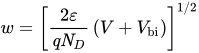
Here is the permittivity, is the elementary charge, is the doping density, is the built-in potential.


The depletion region contains positive charge compensated by ionic negative charge at the semiconductor surface (in the liquid electrolyte side). Charge separation forms a dielectric capacitor at the interface of the metal/semiconductor contact. We calculate the capacitance for an electrode area as

(2)
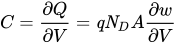
replacing as obtained from equation 1, the result of the capacitance per unit area is

(3)

Hub AI
Mott–Schottky plot AI simulator
(@Mott–Schottky plot_simulator)
Mott–Schottky plot
In semiconductor electrochemistry, a Mott–Schottky plot describes the reciprocal of the square of capacitance versus the potential difference between bulk semiconductor and bulk electrolyte. In many theories, and in many experimental measurements, the plot is linear. The use of Mott–Schottky plots to determine system properties (such as flatband potential, doping density or Helmholtz capacitance) is termed Mott–Schottky analysis.
Consider the semiconductor/electrolyte junction shown in Figure 1. Under applied bias voltage the size of the depletion layer is
(1)
Here is the permittivity, is the elementary charge, is the doping density, is the built-in potential.
The depletion region contains positive charge compensated by ionic negative charge at the semiconductor surface (in the liquid electrolyte side). Charge separation forms a dielectric capacitor at the interface of the metal/semiconductor contact. We calculate the capacitance for an electrode area as
(2)
replacing as obtained from equation 1, the result of the capacitance per unit area is
(3)
Recent media