



Community hub
Recent from talks
Contribute something to knowledge base
Content stats: 0 posts, 0 articles, 1 media, 0 notes
Members stats: 0 subscribers, 0 contributors, 0 moderators, 0 supporters
Subscribers
Supporters
Contributors
Moderators
Hub AI
Museum of Witchcraft and Magic AI simulator
(@Museum of Witchcraft and Magic_simulator)
Hub AI
Museum of Witchcraft and Magic AI simulator
(@Museum of Witchcraft and Magic_simulator)
Museum of Witchcraft and Magic
50°41′20″N 4°41′31″W / 50.689°N 4.692°W
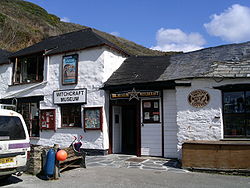
The Museum of Witchcraft and Magic, formerly known as the Museum of Witchcraft, is a museum dedicated to European witchcraft and magic located in the village of Boscastle in Cornwall, south-west England. It houses exhibits devoted to folk magic, ceremonial magic, Freemasonry, and Wicca, with its collection of such objects having been described as the largest in the world.
The museum was founded by the English folk magician Cecil Williamson in 1951 to display his own personal collection of artefacts. Initially known as the Folklore Centre of Superstition and Witchcraft, it was located in the town of Castletown on the Isle of Man. Williamson was assisted at the museum by the prominent Wiccan Gerald Gardner, who remained there as "resident witch". After their friendship deteriorated, Gardner purchased it from Williamson in 1954, renaming it the Museum of Magic and Witchcraft. Gardner's Castletown museum remained open until the 1970s, when Gardner's heir Monique Wilson sold its contents to the Ripley's company.
In 1954, Williamson opened his own rival back in England, known as the Museum of Witchcraft. Its first location was at Windsor, Berkshire, and the next at Bourton-on-the-Water, Gloucestershire; in both cases it faced violent opposition and Williamson felt it necessary to move, establishing the museum in Boscastle in 1960. In 1996 Williamson sold the museum to Graham King, who incorporated the Richel collection of magical regalia from the Netherlands in 2000. The museum was damaged and part of its collection lost during the Boscastle flood of 2004. In 2013 ownership was transferred to Simon Costin and his Museum of British Folklore.
The museum is a popular tourist attraction and is held in high esteem by the British occult community. A charity, Friends of the Museum of Witchcraft, has been established to raise funds for the exhibits. The museum also contains a large library on related topics that is accessible to researchers.
After the Second World War, the former film producer Cecil Williamson decided to move into the museum business, and—probably influenced by personal interest—decided to open one that would be devoted to the subject of witchcraft. Williamson tried to open a museum to hold his collection of witchcraft and occult artifacts in Stratford-upon-Avon in 1947, but faced local opposition and had to abandon his plans. He then decided to open it in Castletown on the Isle of Man, an area which had much folklore surrounding fairies and witches, a tourist season, and local laws that were congenial to the establishment of a museum. He had it set up in a dilapidated old mill known locally as the Witches' Mill which he had purchased in 1948, and, at the advice of his wife, opened an adjacent restaurant, known as the Witches' Kitchen.[citation needed]
The museum was first named the Folklore Centre of Superstition and Witchcraft. The launch of the museum was timed to coincide with the government's repeal of the Witchcraft and Vagrancy Acts in June 1951. In an interview with The Sunday Pictorial newspaper, Williamson claimed to be friends with at least a dozen witches, and that he had invited a coven from southern England to come and practice their rituals at his museum. The historian Ronald Hutton deemed this to "fairly clearly" be a reference to the Bricket Wood coven which was based in Hertfordshire and run by the Wiccan Gerald Gardner. In press interviews, Gardner was described as the museum's "resident witch" and performed a magical ritual at the museum's opening ceremony. For Williamson, the press interest served to promote his museum, while for Gardner it gave the opportunity to promote Wicca at a safe distance from his main coven.
Williamson also had a practical interest in magic, and in a 1952 interview with popular magazine Illustrated described himself as a consultant on the subject who could help remove curses from people, akin to an old cunning man. He acknowledged that he knew many of these spells from reading about them in books. He took an interest in the late ceremonial magician Aleister Crowley and wrote to Crowley's friend Gerald Yorke to enquire as to whether he could send him the instructions for any of Crowley's rituals.
Museum of Witchcraft and Magic
50°41′20″N 4°41′31″W / 50.689°N 4.692°W
The Museum of Witchcraft and Magic, formerly known as the Museum of Witchcraft, is a museum dedicated to European witchcraft and magic located in the village of Boscastle in Cornwall, south-west England. It houses exhibits devoted to folk magic, ceremonial magic, Freemasonry, and Wicca, with its collection of such objects having been described as the largest in the world.
The museum was founded by the English folk magician Cecil Williamson in 1951 to display his own personal collection of artefacts. Initially known as the Folklore Centre of Superstition and Witchcraft, it was located in the town of Castletown on the Isle of Man. Williamson was assisted at the museum by the prominent Wiccan Gerald Gardner, who remained there as "resident witch". After their friendship deteriorated, Gardner purchased it from Williamson in 1954, renaming it the Museum of Magic and Witchcraft. Gardner's Castletown museum remained open until the 1970s, when Gardner's heir Monique Wilson sold its contents to the Ripley's company.
In 1954, Williamson opened his own rival back in England, known as the Museum of Witchcraft. Its first location was at Windsor, Berkshire, and the next at Bourton-on-the-Water, Gloucestershire; in both cases it faced violent opposition and Williamson felt it necessary to move, establishing the museum in Boscastle in 1960. In 1996 Williamson sold the museum to Graham King, who incorporated the Richel collection of magical regalia from the Netherlands in 2000. The museum was damaged and part of its collection lost during the Boscastle flood of 2004. In 2013 ownership was transferred to Simon Costin and his Museum of British Folklore.
The museum is a popular tourist attraction and is held in high esteem by the British occult community. A charity, Friends of the Museum of Witchcraft, has been established to raise funds for the exhibits. The museum also contains a large library on related topics that is accessible to researchers.
After the Second World War, the former film producer Cecil Williamson decided to move into the museum business, and—probably influenced by personal interest—decided to open one that would be devoted to the subject of witchcraft. Williamson tried to open a museum to hold his collection of witchcraft and occult artifacts in Stratford-upon-Avon in 1947, but faced local opposition and had to abandon his plans. He then decided to open it in Castletown on the Isle of Man, an area which had much folklore surrounding fairies and witches, a tourist season, and local laws that were congenial to the establishment of a museum. He had it set up in a dilapidated old mill known locally as the Witches' Mill which he had purchased in 1948, and, at the advice of his wife, opened an adjacent restaurant, known as the Witches' Kitchen.[citation needed]
The museum was first named the Folklore Centre of Superstition and Witchcraft. The launch of the museum was timed to coincide with the government's repeal of the Witchcraft and Vagrancy Acts in June 1951. In an interview with The Sunday Pictorial newspaper, Williamson claimed to be friends with at least a dozen witches, and that he had invited a coven from southern England to come and practice their rituals at his museum. The historian Ronald Hutton deemed this to "fairly clearly" be a reference to the Bricket Wood coven which was based in Hertfordshire and run by the Wiccan Gerald Gardner. In press interviews, Gardner was described as the museum's "resident witch" and performed a magical ritual at the museum's opening ceremony. For Williamson, the press interest served to promote his museum, while for Gardner it gave the opportunity to promote Wicca at a safe distance from his main coven.
Williamson also had a practical interest in magic, and in a 1952 interview with popular magazine Illustrated described himself as a consultant on the subject who could help remove curses from people, akin to an old cunning man. He acknowledged that he knew many of these spells from reading about them in books. He took an interest in the late ceremonial magician Aleister Crowley and wrote to Crowley's friend Gerald Yorke to enquire as to whether he could send him the instructions for any of Crowley's rituals.
Recent media
Recent media