



Community hub
Recent from talks
Contribute something to knowledge base
Content stats: 0 posts, 0 articles, 1 media, 0 notes
Members stats: 0 subscribers, 0 contributors, 0 moderators, 0 supporters
Subscribers
Supporters
Contributors
Moderators
Hub AI
Henry C. Mustin Naval Air Facility AI simulator
(@Henry C. Mustin Naval Air Facility_simulator)
Hub AI
Henry C. Mustin Naval Air Facility AI simulator
(@Henry C. Mustin Naval Air Facility_simulator)
Henry C. Mustin Naval Air Facility
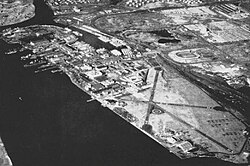
Henry C. Mustin Naval Air Facility (IATA: MUV, ICAO: KMUV), also known as NAF Mustin Field, is a former military airfield located at the United States Navy Naval Aircraft Factory on board the Philadelphia Naval Shipyard, Philadelphia, Pennsylvania. It was in service from 1926 to 1963.
On 27 July 1917, Secretary of the Navy Josephus Daniels approved the development of a Naval Aircraft Factory as a Navy-owned aircraft design, production and evaluation facility. The factory opened 17 November 1917. Production of H-16 and MF flying boats began in 1918. Following World War I, "the factory's role was altered from production-focused to evaluation of different aircraft designs, with its production being limited to mainly prototype and small production lots of aircraft." The NAF produced Vought VE-7 airframes when the small Lewis & Vought organization was unable to handle a large production order. The factory also constructed nine Curtiss TS-1s, −2s, and −3s in 1922 for cost comparisons and performance evaluations with different powerplants.
As the Navy introduced progressively more land based aircraft in the 1920s, the need for a landing field at the Naval Aircraft Factory grew, under the control of the Fourth Naval District.
In 1926, the eastern end of the Back Channel of League Island in the Delaware River was landfilled to create space for flight operations, after the training school at Naval Air Station Rockaway in Rockaway, New York, was closed. League Island ceased to be one with this change, the western end of Back Channel becoming the Reserve Basin for the Navy Yard, holding a portion of the U.S. Navy reserve fleets.
The aerodrome was established as Naval Air Facility Mustin Field on 17 September 1926, in honor of Captain Henry C. Mustin, Navy Air Pilot No.3, and Naval Aviator No. 11, who recorded the first catapult launch from a moving vessel on 5 November 1915 when he flew off of USS North Carolina in a Curtiss Model AB-2.
"It was a major event that drew 1,500 spectators, among them Assistant Secretary of the Navy, Theodore Douglas Robinson, Brig. Gen. Douglas MacArthur, Rear Admiral William Moffett, and Philadelphia Mayor W. Freeland Kendrick, who had been a childhood friend of Capt. Mustin. The dedication took place toward the end of the six-month Philadelphia Sesquicentennial Exposition, whose president was John Wanamaker. Thirty foreign nations attended the Sesqui, and all the planes from the exhibition flew in formation with aircraft of the Army, Navy, and Marine Corps to honor Mustin."
With the airship USS Los Angeles circling above, Mustin's most senior classmate, Captain William L. Littlefield, commander of the yard, unveiled a monument with a plate reading, "This Tablet Erected By His Naval Academy Classmates." "The ceremonies continued with a skywriting of 'Mustin Field,' a flyover that cascaded flowers onto the tablet, a bombing demonstration by three Martin bombers, and a series of stunts culminating in 'bubble busting' where aircraft chased balloons until breaking them all."
The station consisted of 53 enlisted, 16 officers, four seaplanes and seven landplanes. Throughout the 1930s, the field hosted a variety of test operations, conducted by experimental test squadron VX-3D4. The Naval Aircraft Factory produced 997 N3N primary training biplanes from 1935 to 1942.
Henry C. Mustin Naval Air Facility
Henry C. Mustin Naval Air Facility (IATA: MUV, ICAO: KMUV), also known as NAF Mustin Field, is a former military airfield located at the United States Navy Naval Aircraft Factory on board the Philadelphia Naval Shipyard, Philadelphia, Pennsylvania. It was in service from 1926 to 1963.
On 27 July 1917, Secretary of the Navy Josephus Daniels approved the development of a Naval Aircraft Factory as a Navy-owned aircraft design, production and evaluation facility. The factory opened 17 November 1917. Production of H-16 and MF flying boats began in 1918. Following World War I, "the factory's role was altered from production-focused to evaluation of different aircraft designs, with its production being limited to mainly prototype and small production lots of aircraft." The NAF produced Vought VE-7 airframes when the small Lewis & Vought organization was unable to handle a large production order. The factory also constructed nine Curtiss TS-1s, −2s, and −3s in 1922 for cost comparisons and performance evaluations with different powerplants.
As the Navy introduced progressively more land based aircraft in the 1920s, the need for a landing field at the Naval Aircraft Factory grew, under the control of the Fourth Naval District.
In 1926, the eastern end of the Back Channel of League Island in the Delaware River was landfilled to create space for flight operations, after the training school at Naval Air Station Rockaway in Rockaway, New York, was closed. League Island ceased to be one with this change, the western end of Back Channel becoming the Reserve Basin for the Navy Yard, holding a portion of the U.S. Navy reserve fleets.
The aerodrome was established as Naval Air Facility Mustin Field on 17 September 1926, in honor of Captain Henry C. Mustin, Navy Air Pilot No.3, and Naval Aviator No. 11, who recorded the first catapult launch from a moving vessel on 5 November 1915 when he flew off of USS North Carolina in a Curtiss Model AB-2.
"It was a major event that drew 1,500 spectators, among them Assistant Secretary of the Navy, Theodore Douglas Robinson, Brig. Gen. Douglas MacArthur, Rear Admiral William Moffett, and Philadelphia Mayor W. Freeland Kendrick, who had been a childhood friend of Capt. Mustin. The dedication took place toward the end of the six-month Philadelphia Sesquicentennial Exposition, whose president was John Wanamaker. Thirty foreign nations attended the Sesqui, and all the planes from the exhibition flew in formation with aircraft of the Army, Navy, and Marine Corps to honor Mustin."
With the airship USS Los Angeles circling above, Mustin's most senior classmate, Captain William L. Littlefield, commander of the yard, unveiled a monument with a plate reading, "This Tablet Erected By His Naval Academy Classmates." "The ceremonies continued with a skywriting of 'Mustin Field,' a flyover that cascaded flowers onto the tablet, a bombing demonstration by three Martin bombers, and a series of stunts culminating in 'bubble busting' where aircraft chased balloons until breaking them all."
The station consisted of 53 enlisted, 16 officers, four seaplanes and seven landplanes. Throughout the 1930s, the field hosted a variety of test operations, conducted by experimental test squadron VX-3D4. The Naval Aircraft Factory produced 997 N3N primary training biplanes from 1935 to 1942.
Recent media
Recent media