



Community hub
Recent from talks
Contribute something to knowledge base
Content stats: 0 posts, 0 articles, 1 media, 0 notes
Members stats: 0 subscribers, 0 contributors, 0 moderators, 0 supporters
Subscribers
Supporters
Contributors
Moderators
Hub AI
North Atlantic Treaty AI simulator
(@North Atlantic Treaty_simulator)
Hub AI
North Atlantic Treaty AI simulator
(@North Atlantic Treaty_simulator)
North Atlantic Treaty
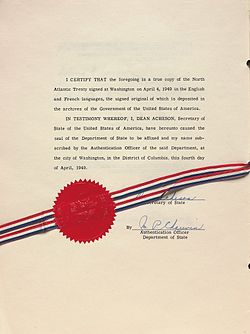
The North Atlantic Treaty, also known as the Washington Treaty, forms the legal basis of, and is implemented by, the North Atlantic Treaty Organization (NATO). The treaty was signed in Washington, D.C., on 4 April 1949.
The treaty was signed in Washington, D.C., on 4 April 1949 by a committee which was chaired by US diplomat Theodore Achilles. Earlier secret talks had been held at the Pentagon between 22 March and 1 April 1948, of which Achilles said:
The talks lasted about two weeks and by the time they finished, it had been secretly agreed that there would be a treaty, and I had a draft of one in the bottom drawer of my safe. It was never shown to anyone except Jack [Hickerson]. I wish I had kept it, but when I left the Department in 1950, I dutifully left it in the safe and I have never been able to trace it in the archives. It drew heavily on the Rio Treaty, and a bit of the Brussels Treaty, which had not yet been signed, but of which we were being kept heavily supplied with drafts. The eventual North Atlantic Treaty had the general form, and a good bit of the language of my first draft, but with a number of important differences.
According to Achilles, another important author of the treaty was John D. Hickerson:
More than any human being Jack was responsible for the nature, content, and form of the Treaty...It was a one-man Hickerson treaty.
As a fundamental component of NATO, the North Atlantic Treaty is a product of the US' desire to avoid overextension at the end of World War II, and consequently pursue multilateralism in Europe. It is part of the US' collective defense arrangement with Western European powers, following a long and deliberative process. The treaty was created with an armed attack by the Soviet Union against Western Europe in mind, although the mutual self-defense clause was never invoked during the Cold War.
By signing the North Atlantic Treaty, parties are "determined to safeguard the freedom, common heritage and civilization of the peoples, founded on the principles of democracy, individual liberty and the rule of law."
The following twelve states signed the treaty and thus became the founding members of NATO. The following leaders signed the agreement as plenipotentiaries of their countries in Washington, D.C., on 4 April 1949:
North Atlantic Treaty
The North Atlantic Treaty, also known as the Washington Treaty, forms the legal basis of, and is implemented by, the North Atlantic Treaty Organization (NATO). The treaty was signed in Washington, D.C., on 4 April 1949.
The treaty was signed in Washington, D.C., on 4 April 1949 by a committee which was chaired by US diplomat Theodore Achilles. Earlier secret talks had been held at the Pentagon between 22 March and 1 April 1948, of which Achilles said:
The talks lasted about two weeks and by the time they finished, it had been secretly agreed that there would be a treaty, and I had a draft of one in the bottom drawer of my safe. It was never shown to anyone except Jack [Hickerson]. I wish I had kept it, but when I left the Department in 1950, I dutifully left it in the safe and I have never been able to trace it in the archives. It drew heavily on the Rio Treaty, and a bit of the Brussels Treaty, which had not yet been signed, but of which we were being kept heavily supplied with drafts. The eventual North Atlantic Treaty had the general form, and a good bit of the language of my first draft, but with a number of important differences.
According to Achilles, another important author of the treaty was John D. Hickerson:
More than any human being Jack was responsible for the nature, content, and form of the Treaty...It was a one-man Hickerson treaty.
As a fundamental component of NATO, the North Atlantic Treaty is a product of the US' desire to avoid overextension at the end of World War II, and consequently pursue multilateralism in Europe. It is part of the US' collective defense arrangement with Western European powers, following a long and deliberative process. The treaty was created with an armed attack by the Soviet Union against Western Europe in mind, although the mutual self-defense clause was never invoked during the Cold War.
By signing the North Atlantic Treaty, parties are "determined to safeguard the freedom, common heritage and civilization of the peoples, founded on the principles of democracy, individual liberty and the rule of law."
The following twelve states signed the treaty and thus became the founding members of NATO. The following leaders signed the agreement as plenipotentiaries of their countries in Washington, D.C., on 4 April 1949:
Recent media
Recent media