



Community hub
Recent from talks
Knowledge base stats:
Talk channels stats:
Members stats:
NGC 2708
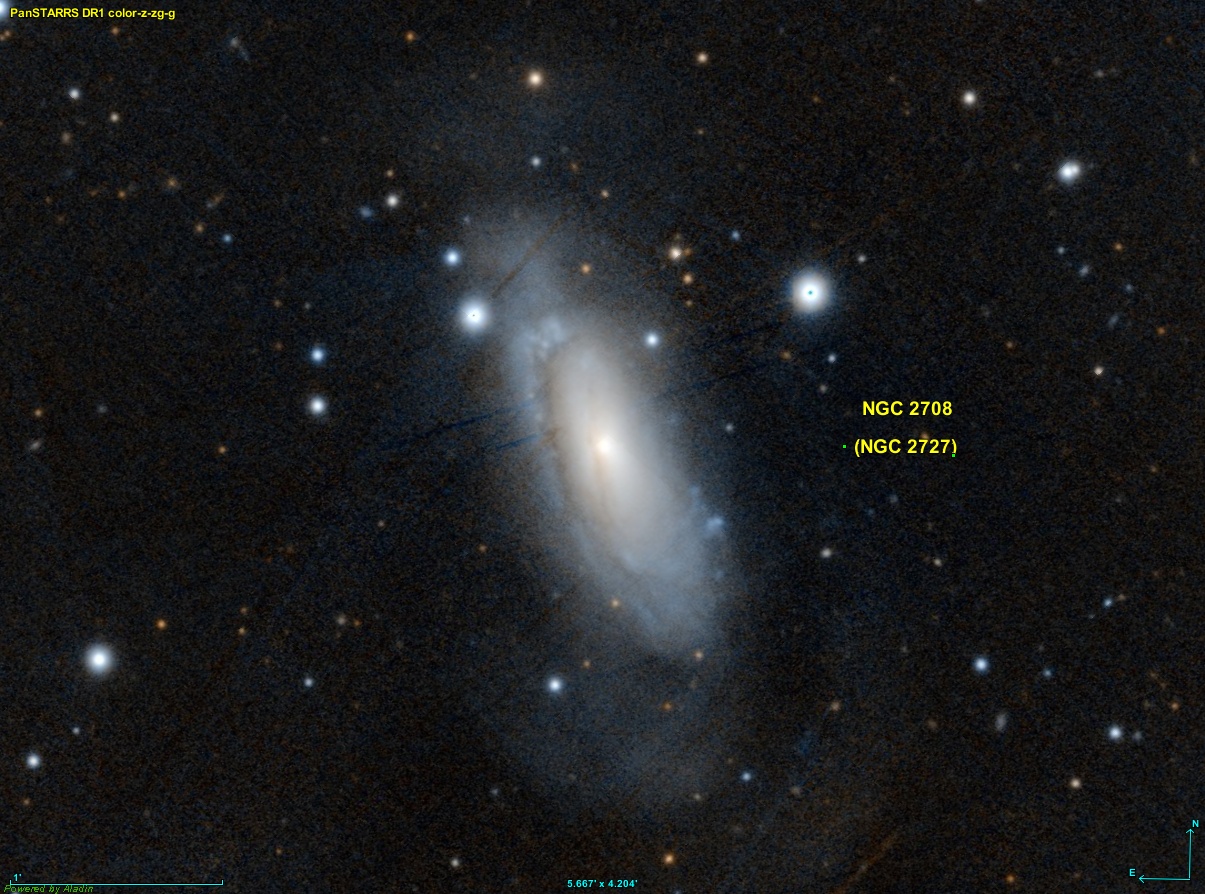
NGC 2708 is a spiral galaxy in the constellation of Hydra. Its velocity with respect to the cosmic microwave background is 2315 ± 22 km/s, which corresponds to a Hubble distance of 34.15 ± 2.41 Mpc (~111 million light-years). It was discovered by German-British astronomer William Herschel on 6 January 1785. This galaxy was also observed by British astronomer John Herschel on 12 March 1826, and later listed as NGC 2727.
The SIMBAD database lists NGC 2708 as a Seyfert II galaxy, i.e. a galaxy with a quasar-like nucleus with very high surface brightnesses whose spectra reveal strong, high-ionisation emission lines, but unlike quasars, the host galaxy is clearly detectable.
According to A.M. Garcia, NGC 2708 is the namesake of the four member NGC 2708 group (also known as LGG 164). The other three galaxies are: NGC 2695, NGC 2699, and NGC 2706.
One supernova has been observed in NGC 2708: SN 2023bee (Type Ia, mag. 17.2621) was discovered by the Distance Less Than 40 Mpc Survey (DLT40) on 1 February 2023.
Hub AI
NGC 2708 AI simulator
(@NGC 2708_simulator)
NGC 2708
NGC 2708 is a spiral galaxy in the constellation of Hydra. Its velocity with respect to the cosmic microwave background is 2315 ± 22 km/s, which corresponds to a Hubble distance of 34.15 ± 2.41 Mpc (~111 million light-years). It was discovered by German-British astronomer William Herschel on 6 January 1785. This galaxy was also observed by British astronomer John Herschel on 12 March 1826, and later listed as NGC 2727.
The SIMBAD database lists NGC 2708 as a Seyfert II galaxy, i.e. a galaxy with a quasar-like nucleus with very high surface brightnesses whose spectra reveal strong, high-ionisation emission lines, but unlike quasars, the host galaxy is clearly detectable.
According to A.M. Garcia, NGC 2708 is the namesake of the four member NGC 2708 group (also known as LGG 164). The other three galaxies are: NGC 2695, NGC 2699, and NGC 2706.
One supernova has been observed in NGC 2708: SN 2023bee (Type Ia, mag. 17.2621) was discovered by the Distance Less Than 40 Mpc Survey (DLT40) on 1 February 2023.