



Community hub
Recent from talks
Contribute something to knowledge base
Content stats: 0 posts, 0 articles, 1 media, 0 notes
Members stats: 0 subscribers, 0 contributors, 0 moderators, 0 supporters
Subscribers
Supporters
Contributors
Moderators
Hub AI
Nagarparkar Jain temples AI simulator
(@Nagarparkar Jain temples_simulator)
Hub AI
Nagarparkar Jain temples AI simulator
(@Nagarparkar Jain temples_simulator)
Nagarparkar Jain temples
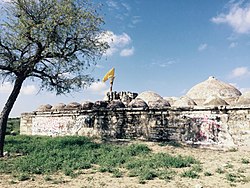
The Nagarparkar Jain Temples (Urdu: نگرپارکر جین مندر) are located in the region around Nagarparkar, in Pakistan's southern Sindh province. The site consists of a collection of abandoned Śvetāmbara Jain temples, as well as a mosque heavily influenced by the architectural style of the temples. Buildings in the region date from the 12th to the 15th centuries - a period when Jain architectural expression was at its zenith. Frescoes at the Gori Temple are the oldest Jain frescoes still in existence in the northern regions of the Indian subcontinent. The temples were inscribed on the tentative list for UNESCO World Heritage status in 2016 as the Nagarparkar Cultural Landscape.
The region around Nagarparkar forms a zone of transition between the marshes and salt-flats of the Rann of Kutch, and the dry grounds of stabilized sand dunes and nearby pink-granite Karoonjhar Mountains. The region had been mostly covered by the Arabian Sea until the 15th century, though the region around Nagarparkar formed an area of raised and perennially dry land.
Nagarparkar was a centre of Jainism for several centuries, and the wealthy local Jain community built several extravagant temples in the nearby hills between the 12th and 15th centuries - considered a high point of Jain architectural expression. The region became a place of pilgrimage known as Sardhara, with Jain ascetics establishing themselves in the Karoonjhar Mountains. The Nagarparkar region was described in 1650 as the "most glorious of all regions of India".
Jain influence in the region began to decline due to shifting of the Arabian Sea away from centres of Jain economic activity, as silt from the Indus River deposited in the Rann of Kutch. Changes in the coast line resulted in a large-scale shift of the local Jain population in the 19th century, while remaining Jains left the area following the Partition of British India in 1947, though several of the temples continue to be maintained by the area's sizable Hindu community. Several new temples were built in nearby Rajasthan, which trace their heritage back to older sites in Nagarparkar.
The remains of a number of Jain temples are popular tourist attractions and heritage sites in the region. A lack of an adequate road system in the area contributed to the site's state of good preservation, though the recent construction of roadways has led to a surge of tourists, despite the lack of adequate protection at the site. In 2009, satellite imagery was employed to document the site, and to help devise a plan to manage tourism.
The region was submitted by the Pakistani government in 2016 to be inscribed on the tentative list of UNESCO World Heritage Site status, not only for its architectural value, but also as reflection of Jainism as part of a commercial community based on maritime trade, and the effects of a changing natural environment around the region.
Approximately 14 Jain temples are scattered throughout the region.
The Gori Temple is located approximately 14 miles northwest of the Viravah Temple. The temple was built in 1375-1376 CE, in a Gujarati-style, and features 3 mandaps, with 52 Islamic-style domes. The temple measures 125 feet by 60 feet, and is built of marble. The entire temple is built on a high platform that is reached by a series of steps carved into stone.
Nagarparkar Jain temples
The Nagarparkar Jain Temples (Urdu: نگرپارکر جین مندر) are located in the region around Nagarparkar, in Pakistan's southern Sindh province. The site consists of a collection of abandoned Śvetāmbara Jain temples, as well as a mosque heavily influenced by the architectural style of the temples. Buildings in the region date from the 12th to the 15th centuries - a period when Jain architectural expression was at its zenith. Frescoes at the Gori Temple are the oldest Jain frescoes still in existence in the northern regions of the Indian subcontinent. The temples were inscribed on the tentative list for UNESCO World Heritage status in 2016 as the Nagarparkar Cultural Landscape.
The region around Nagarparkar forms a zone of transition between the marshes and salt-flats of the Rann of Kutch, and the dry grounds of stabilized sand dunes and nearby pink-granite Karoonjhar Mountains. The region had been mostly covered by the Arabian Sea until the 15th century, though the region around Nagarparkar formed an area of raised and perennially dry land.
Nagarparkar was a centre of Jainism for several centuries, and the wealthy local Jain community built several extravagant temples in the nearby hills between the 12th and 15th centuries - considered a high point of Jain architectural expression. The region became a place of pilgrimage known as Sardhara, with Jain ascetics establishing themselves in the Karoonjhar Mountains. The Nagarparkar region was described in 1650 as the "most glorious of all regions of India".
Jain influence in the region began to decline due to shifting of the Arabian Sea away from centres of Jain economic activity, as silt from the Indus River deposited in the Rann of Kutch. Changes in the coast line resulted in a large-scale shift of the local Jain population in the 19th century, while remaining Jains left the area following the Partition of British India in 1947, though several of the temples continue to be maintained by the area's sizable Hindu community. Several new temples were built in nearby Rajasthan, which trace their heritage back to older sites in Nagarparkar.
The remains of a number of Jain temples are popular tourist attractions and heritage sites in the region. A lack of an adequate road system in the area contributed to the site's state of good preservation, though the recent construction of roadways has led to a surge of tourists, despite the lack of adequate protection at the site. In 2009, satellite imagery was employed to document the site, and to help devise a plan to manage tourism.
The region was submitted by the Pakistani government in 2016 to be inscribed on the tentative list of UNESCO World Heritage Site status, not only for its architectural value, but also as reflection of Jainism as part of a commercial community based on maritime trade, and the effects of a changing natural environment around the region.
Approximately 14 Jain temples are scattered throughout the region.
The Gori Temple is located approximately 14 miles northwest of the Viravah Temple. The temple was built in 1375-1376 CE, in a Gujarati-style, and features 3 mandaps, with 52 Islamic-style domes. The temple measures 125 feet by 60 feet, and is built of marble. The entire temple is built on a high platform that is reached by a series of steps carved into stone.
Recent media
Recent media