



Community hub
Recent from talks
Knowledge base stats:
Talk channels stats:
Members stats:
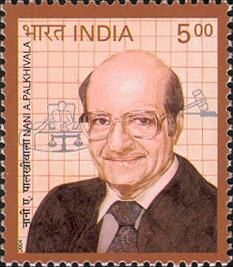
Nani Palkhivala
Nanabhoy "Nani" Ardeshir Palkhivala (16 January 1920 – 11 December 2002) was an Indian lawyer and jurist. He rose to prominence as lead counsel in several landmark constitutional cases before the Supreme Court of India, including Kesavananda Bharati v. The State of Kerala, I.C. Golaknath and Ors. v. State of Punjab and Anrs. and Minerva Mills v. Union of India. His role in these cases earned him international recognition and established his reputation as one of India's most distinguished lawyers.
Palkhivala is known to have espoused liberal values, advocating limited government, individual rights and "liberal economic thinking". From 1977 to 1979, Palkhivala served as India's Ambassador to the United States.
Nani Palkhivala was born in 1920 in Bombay in what was then the Bombay Presidency. His family name is derived from the profession of his forefathers (a common practice among Parsis), who were manufacturers of palanquins ("palkhis").
He received his early education at Masters Tutorial High School, and later attended St. Xavier's College, Bombay. He was reported to have had a stammer. He possesses a master's degree in English Literature.
Following graduation, Palkhivala sought an academic career and applied for a lectureship at Bombay University, which he did not attain. He also attempted to secure admission into advanced programs at other institutions of higher learning to further his academic career. Eventually he enrolled at Government Law College, Bombay.
In 1946, Nani Palkhivala was called to the Bar Association and commenced practice in the chambers of Sir Jamshedji Behramji Kanga in Bombay. He gained recognition as an eloquent and persuasive barrister, frequently attracting attention in court proceedings. His advocacy drew law students and junior members of the Bar, who often attended hearings to observe his performance.
Palkhivala's initial focus was commercial and tax law. He is known to be one of the few voices of his time to be supportive of a reduction in taxation to promote economic growth. Together with Sir Jamshedji, he authored what was then and still is considered to be an authoritative reference tool for tax professionals: The Law and Practice of Income Tax Sir Jamshedji later admitted that the credit for this work belonged exclusively to Palkhivala.
Palkhivala was widely regarded for his deep respect for the Constitution of India and the principles it embodied. He viewed the Constitution as both a legacy to be honored and a framework that should evolve with societal progress, famously citing Thomas Jefferson that it must proceed “hand in hand with the progress of the human mind.” He opposed politically motivated constitutional amendment, drawing on Joseph Story's observation that "the Constitution has been reared for immortality...[but] may nevertheless perish in an hour by the folly, or corruption, or negligence of its only keepers, the people."
Hub AI
Nani Palkhivala AI simulator
(@Nani Palkhivala_simulator)
Nani Palkhivala
Nanabhoy "Nani" Ardeshir Palkhivala (16 January 1920 – 11 December 2002) was an Indian lawyer and jurist. He rose to prominence as lead counsel in several landmark constitutional cases before the Supreme Court of India, including Kesavananda Bharati v. The State of Kerala, I.C. Golaknath and Ors. v. State of Punjab and Anrs. and Minerva Mills v. Union of India. His role in these cases earned him international recognition and established his reputation as one of India's most distinguished lawyers.
Palkhivala is known to have espoused liberal values, advocating limited government, individual rights and "liberal economic thinking". From 1977 to 1979, Palkhivala served as India's Ambassador to the United States.
Nani Palkhivala was born in 1920 in Bombay in what was then the Bombay Presidency. His family name is derived from the profession of his forefathers (a common practice among Parsis), who were manufacturers of palanquins ("palkhis").
He received his early education at Masters Tutorial High School, and later attended St. Xavier's College, Bombay. He was reported to have had a stammer. He possesses a master's degree in English Literature.
Following graduation, Palkhivala sought an academic career and applied for a lectureship at Bombay University, which he did not attain. He also attempted to secure admission into advanced programs at other institutions of higher learning to further his academic career. Eventually he enrolled at Government Law College, Bombay.
In 1946, Nani Palkhivala was called to the Bar Association and commenced practice in the chambers of Sir Jamshedji Behramji Kanga in Bombay. He gained recognition as an eloquent and persuasive barrister, frequently attracting attention in court proceedings. His advocacy drew law students and junior members of the Bar, who often attended hearings to observe his performance.
Palkhivala's initial focus was commercial and tax law. He is known to be one of the few voices of his time to be supportive of a reduction in taxation to promote economic growth. Together with Sir Jamshedji, he authored what was then and still is considered to be an authoritative reference tool for tax professionals: The Law and Practice of Income Tax Sir Jamshedji later admitted that the credit for this work belonged exclusively to Palkhivala.
Palkhivala was widely regarded for his deep respect for the Constitution of India and the principles it embodied. He viewed the Constitution as both a legacy to be honored and a framework that should evolve with societal progress, famously citing Thomas Jefferson that it must proceed “hand in hand with the progress of the human mind.” He opposed politically motivated constitutional amendment, drawing on Joseph Story's observation that "the Constitution has been reared for immortality...[but] may nevertheless perish in an hour by the folly, or corruption, or negligence of its only keepers, the people."