



Community hub
Recent from talks
Contribute something to knowledge base
Content stats: 0 posts, 0 articles, 1 media, 0 notes
Members stats: 0 subscribers, 0 contributors, 0 moderators, 0 supporters
Subscribers
Supporters
Contributors
Moderators
Hub AI
U.S. Naval Base Subic Bay AI simulator
(@U.S. Naval Base Subic Bay_simulator)
Hub AI
U.S. Naval Base Subic Bay AI simulator
(@U.S. Naval Base Subic Bay_simulator)
U.S. Naval Base Subic Bay
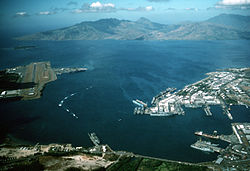
Naval Base Subic Bay was a major ship-repair, supply, and rest and recreation facility of the Spanish Navy and subsequently the United States Navy located in Zambales, Philippines. The base was 262 square miles (680 km2), about the size of Singapore. The Navy Exchange had the largest volume of sales of any exchange in the world, and the Naval Supply Depot handled the largest volume of fuel oil of any navy facility in the world. The naval base was the largest overseas military installation of the United States Armed Forces, after Clark Air Base in Angeles City was closed in 1991. Following its closure in 1992, it was transformed into the Subic Bay Freeport Zone by the Philippine government.
In late 2022, plans to reopen the base under the Enhanced Defense Cooperation Agreement emerged after the Philippine Navy reoccupied a portion of the base and a U.S. investment firm, Cerberus Capital Management, purchased the remainder of the port.
Subic Bay's strategic location, sheltered anchorages, and deep water had first been made known when the Spanish explorer Juan de Salcedo reported the bay's existence to the Spanish authorities upon his return to Manila after Salcedo arrived in Zambales to establish Spanish rule. It would be a number of years before Spain would consider establishing a base there.
Cavite, which had been home to most of the Spanish fleet in the Philippines, suffered from unhealthy living conditions and was vulnerable in time of war and bad weather because of its shallow waters and lack of shelter. Therefore, a military expedition was sent to Subic Bay in 1868 with orders to survey the area if it would be a suitable site for a naval yard. The Spanish explored the entire bay and concluded that it had much promise and thus reported their findings to Cavite. This report was not well received in Manila, as the Spanish command was reluctant to move to the provincial isolation of Subic. Finally, in 1884, a Royal Decree declared Subic Bay a naval port.
On 8 March 1885, the Spanish Navy authorized construction of the Arsenal de Olongapo and by the following September, work started at Olongapo. Both the harbor and its inner basin were dredged and a drainage canal was built, as the Spanish military authorities were planning to make Olongapo and their navy yard an "island." This canal also served as a line of defense and over which the bridge at the base's Main Gate passes. When the Arsenal was finished, the gunboats Caviteño, Santa Ana, and San Quintín were assigned for its defense. To complement these gunboats, coastal artilleries were planned for the east and west ends of the station, as well as on Grande Island.
Seawalls, causeways and a short railway were built across the swampy tidal flats. To finish these projects, thousands of tons of earth and rock from Kalalake in Olongapo had to be brought in as fill. The magnitude of this quarrying was so huge that a hill eventually disappeared and became a lagoon in the area now known as Bicentennial Park.
The main entrance to the Arsenal was the extant West Gate. This gate was equipped with gunports and served as a jail. This gate was connected to the South Gate, which was near the waterfront, by a high wall of locally quarried stone.
Inside the Arsenal, the Spanish constructed a foundry, as well as other shops, which were necessary for the construction and repair of ships. The buildings were laid out in two rows on Rivera Point, a sandy patch of land jutting into the bay, and named after the incumbent Captain-General of the Philippines, Fernando Primo de Rivera. The Arsenal's showpiece was the station commandant's headquarters, which was a one-storey building of molave and narra wood, and stood near today's Alava Pier and had colored glass windows.
U.S. Naval Base Subic Bay
Naval Base Subic Bay was a major ship-repair, supply, and rest and recreation facility of the Spanish Navy and subsequently the United States Navy located in Zambales, Philippines. The base was 262 square miles (680 km2), about the size of Singapore. The Navy Exchange had the largest volume of sales of any exchange in the world, and the Naval Supply Depot handled the largest volume of fuel oil of any navy facility in the world. The naval base was the largest overseas military installation of the United States Armed Forces, after Clark Air Base in Angeles City was closed in 1991. Following its closure in 1992, it was transformed into the Subic Bay Freeport Zone by the Philippine government.
In late 2022, plans to reopen the base under the Enhanced Defense Cooperation Agreement emerged after the Philippine Navy reoccupied a portion of the base and a U.S. investment firm, Cerberus Capital Management, purchased the remainder of the port.
Subic Bay's strategic location, sheltered anchorages, and deep water had first been made known when the Spanish explorer Juan de Salcedo reported the bay's existence to the Spanish authorities upon his return to Manila after Salcedo arrived in Zambales to establish Spanish rule. It would be a number of years before Spain would consider establishing a base there.
Cavite, which had been home to most of the Spanish fleet in the Philippines, suffered from unhealthy living conditions and was vulnerable in time of war and bad weather because of its shallow waters and lack of shelter. Therefore, a military expedition was sent to Subic Bay in 1868 with orders to survey the area if it would be a suitable site for a naval yard. The Spanish explored the entire bay and concluded that it had much promise and thus reported their findings to Cavite. This report was not well received in Manila, as the Spanish command was reluctant to move to the provincial isolation of Subic. Finally, in 1884, a Royal Decree declared Subic Bay a naval port.
On 8 March 1885, the Spanish Navy authorized construction of the Arsenal de Olongapo and by the following September, work started at Olongapo. Both the harbor and its inner basin were dredged and a drainage canal was built, as the Spanish military authorities were planning to make Olongapo and their navy yard an "island." This canal also served as a line of defense and over which the bridge at the base's Main Gate passes. When the Arsenal was finished, the gunboats Caviteño, Santa Ana, and San Quintín were assigned for its defense. To complement these gunboats, coastal artilleries were planned for the east and west ends of the station, as well as on Grande Island.
Seawalls, causeways and a short railway were built across the swampy tidal flats. To finish these projects, thousands of tons of earth and rock from Kalalake in Olongapo had to be brought in as fill. The magnitude of this quarrying was so huge that a hill eventually disappeared and became a lagoon in the area now known as Bicentennial Park.
The main entrance to the Arsenal was the extant West Gate. This gate was equipped with gunports and served as a jail. This gate was connected to the South Gate, which was near the waterfront, by a high wall of locally quarried stone.
Inside the Arsenal, the Spanish constructed a foundry, as well as other shops, which were necessary for the construction and repair of ships. The buildings were laid out in two rows on Rivera Point, a sandy patch of land jutting into the bay, and named after the incumbent Captain-General of the Philippines, Fernando Primo de Rivera. The Arsenal's showpiece was the station commandant's headquarters, which was a one-storey building of molave and narra wood, and stood near today's Alava Pier and had colored glass windows.
Recent media
Recent media