



Community hub
Recent from talks
Contribute something to knowledge base
Content stats: 0 posts, 0 articles, 1 media, 0 notes
Members stats: 0 subscribers, 0 contributors, 0 moderators, 0 supporters
Subscribers
Supporters
Contributors
Moderators
Hub AI
Chernobyl New Safe Confinement AI simulator
(@Chernobyl New Safe Confinement_simulator)
Hub AI
Chernobyl New Safe Confinement AI simulator
(@Chernobyl New Safe Confinement_simulator)
Chernobyl New Safe Confinement
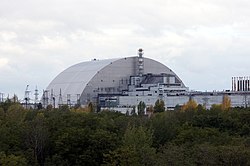
The New Safe Confinement (NSC or New Shelter; Ukrainian: Новий безпечний конфайнмент, romanized: Novyy bezpechnyy konfaynment) is a structure put in place in 2016 to confine the remains of the number 4 reactor unit at the Chernobyl Nuclear Power Plant, in Ukraine, which was destroyed during the Chernobyl disaster in 1986. The structure also encloses the temporary Shelter Structure (sarcophagus) that was built around the reactor immediately after the disaster. The New Safe Confinement is designed to prevent the release of radioactive contaminants, protect the reactor from external influence, facilitate the disassembly and decommissioning of the reactor, and prevent water intrusion.
The New Safe Confinement is a megaproject that is part of the Shelter Implementation Plan and supported by the Chernobyl Shelter Fund. It was designed with the primary goal of confining the radioactive remains of reactor 4 for 100 years. It also aims to allow for a partial demolition of the original sarcophagus, which was hastily constructed by Chernobyl liquidators after a beyond design-basis accident destroyed the reactor. The word confinement is used rather than the traditional containment to emphasize the difference between the containment of radioactive gases—the primary focus of most reactor containment buildings—and the confinement of solid radioactive waste, which is the primary purpose of the New Safe Confinement.
In 2015, the European Bank for Reconstruction and Development (EBRD) stated that the international community was aiming to close a €100 million funding gap, with administration by the EBRD in its role as manager of the Chernobyl decommissioning funds. The total cost of the Shelter Implementation Plan, of which the New Safe Confinement is the most prominent element, is estimated to be around €2.15 billion (US$2.3 billion). The New Safe Confinement accounts for €1.5 billion.
The French consortium Novarka with partners Vinci Construction Grands Projets and Bouygues Travaux Publics designed and built the New Safe Confinement. Construction was completed at the end of 2018.
On 14 February 2025, during the Russian Invasion of Ukraine, a Russian "Geran-2" drone attack significantly damaged the NSC. Both the internal and external layers were breached during the attack.
The predecessor to the New Safe Containment was a structure formally referred to as the Shelter Structure, and often called the sarcophagus. Built between May and November 1986, the Shelter Structure was an emergency measure to confine the radioactive materials within reactor 4 at the Chernobyl Nuclear Power Plant. The Shelter Structure was moderately successful in confining radioactive contamination and providing for post-accident monitoring of the destroyed nuclear reactor unit; it has been estimated that up to 95% of the original radioactive inventory of reactor 4 remains inside the ruins of the reactor building.
However, the Shelter Structure—constructed under extreme conditions and severe time constraints—was never intended to be a permanent containment structure. As such, the shelter's deterioration over the years increased the risk of its radioactive contents leaking into the environment. Additionally the shelter was primarily supported by the remains of the reactor 4 building, which had been damaged by the initial explosion and were considered to be structurally unsound.
Between 2004 and 2008, workers stabilized the roof and western wall of the shelter. However, construction of a new confinement system was deemed necessary to continue confining the radioactive remains of Chernobyl Nuclear Power Plant reactor 4.
Chernobyl New Safe Confinement
The New Safe Confinement (NSC or New Shelter; Ukrainian: Новий безпечний конфайнмент, romanized: Novyy bezpechnyy konfaynment) is a structure put in place in 2016 to confine the remains of the number 4 reactor unit at the Chernobyl Nuclear Power Plant, in Ukraine, which was destroyed during the Chernobyl disaster in 1986. The structure also encloses the temporary Shelter Structure (sarcophagus) that was built around the reactor immediately after the disaster. The New Safe Confinement is designed to prevent the release of radioactive contaminants, protect the reactor from external influence, facilitate the disassembly and decommissioning of the reactor, and prevent water intrusion.
The New Safe Confinement is a megaproject that is part of the Shelter Implementation Plan and supported by the Chernobyl Shelter Fund. It was designed with the primary goal of confining the radioactive remains of reactor 4 for 100 years. It also aims to allow for a partial demolition of the original sarcophagus, which was hastily constructed by Chernobyl liquidators after a beyond design-basis accident destroyed the reactor. The word confinement is used rather than the traditional containment to emphasize the difference between the containment of radioactive gases—the primary focus of most reactor containment buildings—and the confinement of solid radioactive waste, which is the primary purpose of the New Safe Confinement.
In 2015, the European Bank for Reconstruction and Development (EBRD) stated that the international community was aiming to close a €100 million funding gap, with administration by the EBRD in its role as manager of the Chernobyl decommissioning funds. The total cost of the Shelter Implementation Plan, of which the New Safe Confinement is the most prominent element, is estimated to be around €2.15 billion (US$2.3 billion). The New Safe Confinement accounts for €1.5 billion.
The French consortium Novarka with partners Vinci Construction Grands Projets and Bouygues Travaux Publics designed and built the New Safe Confinement. Construction was completed at the end of 2018.
On 14 February 2025, during the Russian Invasion of Ukraine, a Russian "Geran-2" drone attack significantly damaged the NSC. Both the internal and external layers were breached during the attack.
The predecessor to the New Safe Containment was a structure formally referred to as the Shelter Structure, and often called the sarcophagus. Built between May and November 1986, the Shelter Structure was an emergency measure to confine the radioactive materials within reactor 4 at the Chernobyl Nuclear Power Plant. The Shelter Structure was moderately successful in confining radioactive contamination and providing for post-accident monitoring of the destroyed nuclear reactor unit; it has been estimated that up to 95% of the original radioactive inventory of reactor 4 remains inside the ruins of the reactor building.
However, the Shelter Structure—constructed under extreme conditions and severe time constraints—was never intended to be a permanent containment structure. As such, the shelter's deterioration over the years increased the risk of its radioactive contents leaking into the environment. Additionally the shelter was primarily supported by the remains of the reactor 4 building, which had been damaged by the initial explosion and were considered to be structurally unsound.
Between 2004 and 2008, workers stabilized the roof and western wall of the shelter. However, construction of a new confinement system was deemed necessary to continue confining the radioactive remains of Chernobyl Nuclear Power Plant reactor 4.
Recent media
Recent media