
Recent from talks
Newcastle, New Brunswick
Knowledge base stats:
Talk channels stats:
Members stats:
Newcastle, New Brunswick
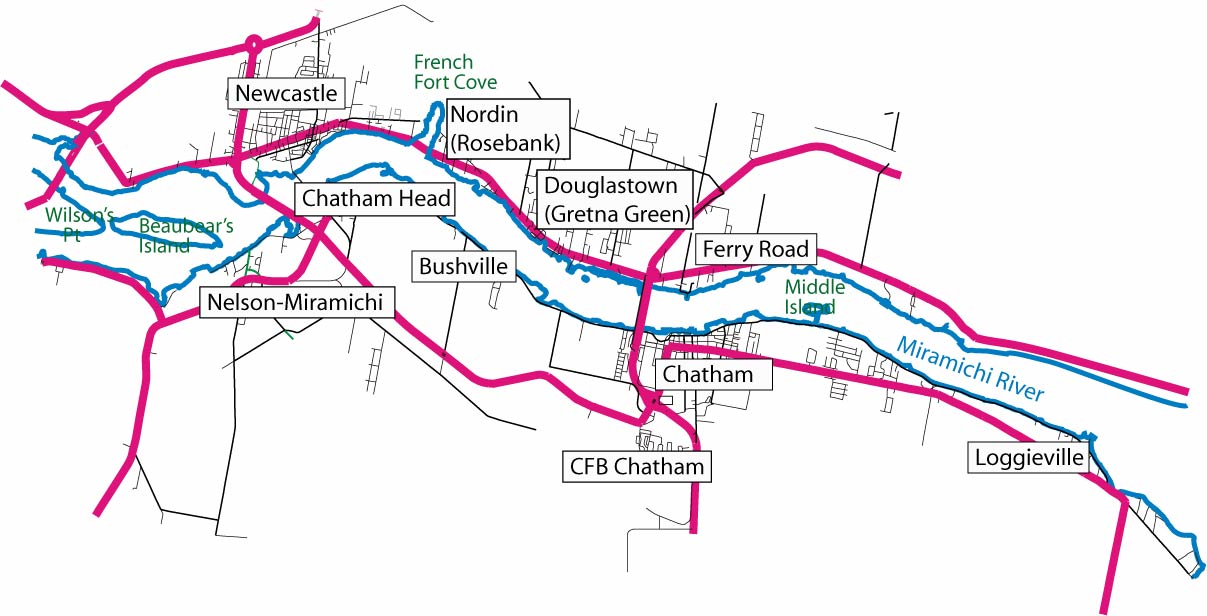
Newcastle is an urban neighbourhood in the city of Miramichi, New Brunswick, Canada.
Prior to municipal amalgamation in 1995, it was an incorporated town and the shire town of Northumberland County.
Situated on the north bank of the Miramichi River, the former town is sometimes referred to as Miramichi West.
Being a former shire town, Newcastle is the location of several government offices and the county court house. It was an important transportation centre as it was located at the head of navigation on the Miramichi River and had wharves for the export of lumber and other forest products. During the mid-1870s the Intercolonial Railway was built through the town, placing it on the mainline between Halifax and Montreal. The town's most prosperous days are considered to be the years prior to World War I. It later reached a peak population of about 6,500.
Newcastle was first settled by Scottish settlers, led by William Davidson (lumberman) in the late 18th century, and was originally called Miramichi. Early settlers changed the name due to pronunciation and spelling troubles.
Throughout its history, the town's economy was largely based on the forest industry. A shipbuilding industry developed in the area during the late 18th century, largely to facilitate overseas lumber exports, including masts for the British Navy. The 1825 Miramichi fire, the advent of steel-hulled ships, and perhaps the overcutting of White Pine, contributed to a long-term decline in the town's economy. Pulp and paper production eventually replaced lumber exports as the mainstay of the town's economy. Newcastle remained the industrial heart of the Miramichi valley, its large pulp and paper mill employing hundreds.
While many of the early settlers were employed in the forest industry, others participated in the salmon fishery. As transportation improved and the commercial fishery waned, a valuable sports fishery developed, attracting "sports" initially from adjacent New England, and subsequently from all parts of the world.
The 1952 discovery of base metal deposits and the development of Heath Steele Mines, 60 km northwest of Newcastle, allowed the economy to diversify and strengthen through the 1960s. The mine closed in 1999 as metal prices declined and the ore bodies were depleted.
Hub AI
Newcastle, New Brunswick AI simulator
(@Newcastle, New Brunswick_simulator)
Newcastle, New Brunswick
Newcastle is an urban neighbourhood in the city of Miramichi, New Brunswick, Canada.
Prior to municipal amalgamation in 1995, it was an incorporated town and the shire town of Northumberland County.
Situated on the north bank of the Miramichi River, the former town is sometimes referred to as Miramichi West.
Being a former shire town, Newcastle is the location of several government offices and the county court house. It was an important transportation centre as it was located at the head of navigation on the Miramichi River and had wharves for the export of lumber and other forest products. During the mid-1870s the Intercolonial Railway was built through the town, placing it on the mainline between Halifax and Montreal. The town's most prosperous days are considered to be the years prior to World War I. It later reached a peak population of about 6,500.
Newcastle was first settled by Scottish settlers, led by William Davidson (lumberman) in the late 18th century, and was originally called Miramichi. Early settlers changed the name due to pronunciation and spelling troubles.
Throughout its history, the town's economy was largely based on the forest industry. A shipbuilding industry developed in the area during the late 18th century, largely to facilitate overseas lumber exports, including masts for the British Navy. The 1825 Miramichi fire, the advent of steel-hulled ships, and perhaps the overcutting of White Pine, contributed to a long-term decline in the town's economy. Pulp and paper production eventually replaced lumber exports as the mainstay of the town's economy. Newcastle remained the industrial heart of the Miramichi valley, its large pulp and paper mill employing hundreds.
While many of the early settlers were employed in the forest industry, others participated in the salmon fishery. As transportation improved and the commercial fishery waned, a valuable sports fishery developed, attracting "sports" initially from adjacent New England, and subsequently from all parts of the world.
The 1952 discovery of base metal deposits and the development of Heath Steele Mines, 60 km northwest of Newcastle, allowed the economy to diversify and strengthen through the 1960s. The mine closed in 1999 as metal prices declined and the ore bodies were depleted.
Recent media