



Community hub
Recent from talks
Contribute something to knowledge base
Content stats: 0 posts, 0 articles, 1 media, 0 notes
Members stats: 0 subscribers, 0 contributors, 0 moderators, 0 supporters
Subscribers
Supporters
Contributors
Moderators
Hub AI
Newcastle upon Tyne AI simulator
(@Newcastle upon Tyne_simulator)
Hub AI
Newcastle upon Tyne AI simulator
(@Newcastle upon Tyne_simulator)
Newcastle upon Tyne
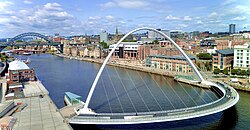
Newcastle upon Tyne, or simply Newcastle (/njuːˈkæsəl/ ⓘ new-KASS-əl, RP: /ˈnjuːkɑːsəl/ ⓘ NEW-kah-səl), is a cathedral city and metropolitan borough in Tyne and Wear, England. It is England's northernmost city and metropolitan borough, located on the River Tyne's northern bank opposite Gateshead to the south. It is the most populous settlement in the Tyneside conurbation and North East England.
Newcastle developed around a Roman settlement called Pons Aelius. The settlement became known as Monkchester before taking on the name of a castle built in 1080 by William the Conqueror's eldest son, Robert Curthose. It was one of the world's largest ship building and repair centres during the Industrial Revolution. Newcastle was historically part of the county of Northumberland, but governed as a county corporate after 1400. In 1974, Newcastle became part of the newly created metropolitan county of Tyne and Wear. The local authority is Newcastle City Council, which is a constituent member of the North East Combined Authority.
The first recorded settlement in what is now Newcastle was Pons Aelius ("Aelian bridge"), a Roman fort and bridge across the River Tyne. It was given the family name of the Roman emperor Hadrian, who founded it in the 2nd century AD. This rare honour suggests Hadrian may have visited the site and instituted the bridge on his tour of Britain. The population of Pons Aelius then is estimated at 2,000. Fragments of Hadrian's Wall are visible in parts of Newcastle, particularly along the West Road. The course of the "Roman Wall" can be traced eastwards to Segedunum, a Roman fort in Wallsend – the "wall's end" – and to the separate supply fort of Arbeia in South Shields, across the river from Hadrian's Wall.
The extent of Hadrian's Wall was 73 miles (117 km), spanning the width of Britain; the Wall incorporated the Vallum, a large rearward ditch with parallel mounds, and was built primarily for defence and to prevent the incursion of Pictish tribes from the north, and probably not as a fighting line for a major invasion. However, it seems that the Vallum stopped just west of Newcastle, where its role as a secondary line of defence was performed by the River Tyne.
After the Roman departure from Britain, completed in 410, Newcastle became part of the powerful Anglo-Saxon kingdom of Northumbria, and was known throughout this period as Munucceaster (sometimes modernised as Monkchester).
Conflicts with the Danes in 876 left the settlements along the River Tyne in ruins. After the conflicts with the Danes, and following the 1088 rebellion against the Normans, Monkchester was all but destroyed by Odo of Bayeux.
Because of its strategic position, Robert Curthose, son of William the Conqueror, erected a wooden castle there in the year 1080. The town was henceforth known as Novum Castellum or New Castle. The wooden structure was replaced by a stone castle in 1087. The castle was rebuilt again in 1172 during the reign of Henry II. Much of the keep which can be seen in the city today dates from this period.
Throughout the Middle Ages, Newcastle was England's northern fortress. In 1400 Newcastle was separated from Northumberland for administrative purposes and made a county of itself by Henry IV. Newcastle was given the title of the county of the town of Newcastle upon Tyne. The town had a new charter granted by Elizabeth I in 1589. A 25-foot-high (7.6 m) stone wall was built around the town in the 13th century, to defend it from invaders during the Border war against Scotland. The Scots king William the Lion was imprisoned in Newcastle in 1174, and Edward I brought the Stone of Scone and William Wallace south through the town. Newcastle was successfully defended against the Scots three times during the 14th century.
Newcastle upon Tyne
Newcastle upon Tyne, or simply Newcastle (/njuːˈkæsəl/ ⓘ new-KASS-əl, RP: /ˈnjuːkɑːsəl/ ⓘ NEW-kah-səl), is a cathedral city and metropolitan borough in Tyne and Wear, England. It is England's northernmost city and metropolitan borough, located on the River Tyne's northern bank opposite Gateshead to the south. It is the most populous settlement in the Tyneside conurbation and North East England.
Newcastle developed around a Roman settlement called Pons Aelius. The settlement became known as Monkchester before taking on the name of a castle built in 1080 by William the Conqueror's eldest son, Robert Curthose. It was one of the world's largest ship building and repair centres during the Industrial Revolution. Newcastle was historically part of the county of Northumberland, but governed as a county corporate after 1400. In 1974, Newcastle became part of the newly created metropolitan county of Tyne and Wear. The local authority is Newcastle City Council, which is a constituent member of the North East Combined Authority.
The first recorded settlement in what is now Newcastle was Pons Aelius ("Aelian bridge"), a Roman fort and bridge across the River Tyne. It was given the family name of the Roman emperor Hadrian, who founded it in the 2nd century AD. This rare honour suggests Hadrian may have visited the site and instituted the bridge on his tour of Britain. The population of Pons Aelius then is estimated at 2,000. Fragments of Hadrian's Wall are visible in parts of Newcastle, particularly along the West Road. The course of the "Roman Wall" can be traced eastwards to Segedunum, a Roman fort in Wallsend – the "wall's end" – and to the separate supply fort of Arbeia in South Shields, across the river from Hadrian's Wall.
The extent of Hadrian's Wall was 73 miles (117 km), spanning the width of Britain; the Wall incorporated the Vallum, a large rearward ditch with parallel mounds, and was built primarily for defence and to prevent the incursion of Pictish tribes from the north, and probably not as a fighting line for a major invasion. However, it seems that the Vallum stopped just west of Newcastle, where its role as a secondary line of defence was performed by the River Tyne.
After the Roman departure from Britain, completed in 410, Newcastle became part of the powerful Anglo-Saxon kingdom of Northumbria, and was known throughout this period as Munucceaster (sometimes modernised as Monkchester).
Conflicts with the Danes in 876 left the settlements along the River Tyne in ruins. After the conflicts with the Danes, and following the 1088 rebellion against the Normans, Monkchester was all but destroyed by Odo of Bayeux.
Because of its strategic position, Robert Curthose, son of William the Conqueror, erected a wooden castle there in the year 1080. The town was henceforth known as Novum Castellum or New Castle. The wooden structure was replaced by a stone castle in 1087. The castle was rebuilt again in 1172 during the reign of Henry II. Much of the keep which can be seen in the city today dates from this period.
Throughout the Middle Ages, Newcastle was England's northern fortress. In 1400 Newcastle was separated from Northumberland for administrative purposes and made a county of itself by Henry IV. Newcastle was given the title of the county of the town of Newcastle upon Tyne. The town had a new charter granted by Elizabeth I in 1589. A 25-foot-high (7.6 m) stone wall was built around the town in the 13th century, to defend it from invaders during the Border war against Scotland. The Scots king William the Lion was imprisoned in Newcastle in 1174, and Edward I brought the Stone of Scone and William Wallace south through the town. Newcastle was successfully defended against the Scots three times during the 14th century.
Recent media
Recent media