
Recent from talks
Nokia 8210
Knowledge base stats:
Talk channels stats:
Members stats:
Nokia 8210
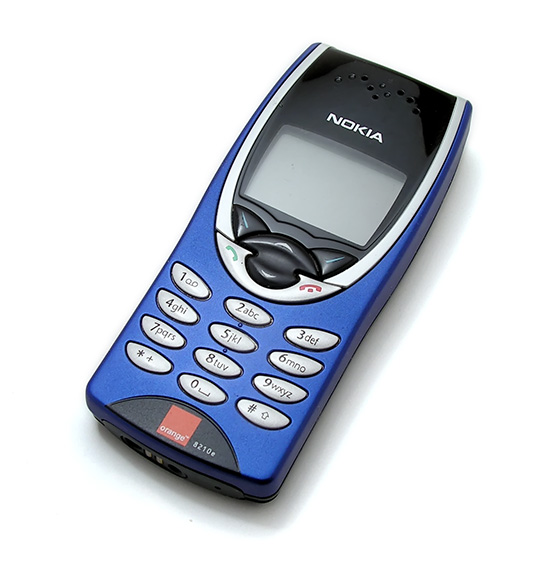
Nokia 8210 is a mobile phone developed by Nokia. Announced on 8 October 1999 at the Paris Fashion Week, it was the world's smallest and lightest (at 79 grams) mobile phone at the time. Conceived during a time of miniaturization, the Nokia 8210 outdid rival products Motorola V3688 and Ericsson T28 - unlike those, it was created in a candybar form without moving parts and even without a protruding antenna, making it overall look significantly smaller than the average handset of the time.
Designed by Frank Nuovo, the 8210 was introduced in collaboration with Kenzo during its 30th anniversary. The phone has elements of the premium luxurious Nokia 8810 phone and the consumer grade Nokia 3210. In addition to its size, the Nokia 8210's primary selling point of its design was its removable cover that allowed for easy customization. Six differently coloured Xpress-on covers are available, as well as many third-party ones.
Nokia 8210 uses the GSM 900/1800 band, supports the Extended GSM 900 band (EGSM), and can automatically switch between bands.
The phone weighs 79 g (with a lithium battery) and is 101.5 mm long, 44.5 mm wide and 17.4 mm thick. It has a green frontlit monochrome display (the keypad is also illuminated green).
The volume has ten levels, and is controlled via a grey button on the top left side of the phone. The base of the phone contains the charger and headset connector.
The phone has a speed dial feature, in which the user can assign a name to each key on the keypad (except key 1, which is used for calling voicemail). Voice dialing can also be used by assigning up to 8 voice tags to a name. Dialed, received, and missed calls are all registered, and calls can be diverted.
The phone uses SMS (Short Message Service) with predictive text input, with support for major European languages. Messages can be up to 160 characters long. Compatible handsets can send and receive OTA bitmap picture messages (not MMS).
The device's memory can store up to 250 names. Alternately, a SIM card can be used to store names (although memory capacity is specific to each SIM card). The calendar can store up to 50 notes.
Hub AI
Nokia 8210 AI simulator
(@Nokia 8210_simulator)
Nokia 8210
Nokia 8210 is a mobile phone developed by Nokia. Announced on 8 October 1999 at the Paris Fashion Week, it was the world's smallest and lightest (at 79 grams) mobile phone at the time. Conceived during a time of miniaturization, the Nokia 8210 outdid rival products Motorola V3688 and Ericsson T28 - unlike those, it was created in a candybar form without moving parts and even without a protruding antenna, making it overall look significantly smaller than the average handset of the time.
Designed by Frank Nuovo, the 8210 was introduced in collaboration with Kenzo during its 30th anniversary. The phone has elements of the premium luxurious Nokia 8810 phone and the consumer grade Nokia 3210. In addition to its size, the Nokia 8210's primary selling point of its design was its removable cover that allowed for easy customization. Six differently coloured Xpress-on covers are available, as well as many third-party ones.
Nokia 8210 uses the GSM 900/1800 band, supports the Extended GSM 900 band (EGSM), and can automatically switch between bands.
The phone weighs 79 g (with a lithium battery) and is 101.5 mm long, 44.5 mm wide and 17.4 mm thick. It has a green frontlit monochrome display (the keypad is also illuminated green).
The volume has ten levels, and is controlled via a grey button on the top left side of the phone. The base of the phone contains the charger and headset connector.
The phone has a speed dial feature, in which the user can assign a name to each key on the keypad (except key 1, which is used for calling voicemail). Voice dialing can also be used by assigning up to 8 voice tags to a name. Dialed, received, and missed calls are all registered, and calls can be diverted.
The phone uses SMS (Short Message Service) with predictive text input, with support for major European languages. Messages can be up to 160 characters long. Compatible handsets can send and receive OTA bitmap picture messages (not MMS).
The device's memory can store up to 250 names. Alternately, a SIM card can be used to store names (although memory capacity is specific to each SIM card). The calendar can store up to 50 notes.
Recent media