



Community hub
Recent from talks
Knowledge base stats:
Talk channels stats:
Members stats:
Set (music)
A set (pitch set, pitch-class set, set class, set form, set genus, pitch collection) in music theory, as in mathematics and general parlance, is a collection of objects. In musical contexts the term is traditionally applied most often to collections of pitches or pitch-classes, but theorists have extended its use to other types of musical entities, so that one may speak of sets of durations or timbres, for example.
A set by itself does not necessarily possess any additional structure, such as an ordering or permutation. Nevertheless, it is often musically important to consider sets that are equipped with an order relation (called segments); in such contexts, bare sets are often referred to as "unordered", for the sake of emphasis.
Two-element sets are called dyads, three-element sets trichords (occasionally "triads", though this is easily confused with the traditional meaning of the word triad). Sets of higher cardinalities are called tetrachords (or tetrads), pentachords (or pentads), hexachords (or hexads), heptachords (heptads or, sometimes, mixing Latin and Greek roots, "septachords"), octachords (octads), nonachords (nonads), decachords (decads), undecachords, and, finally, the dodecachord.
A time-point set is a duration set where the distance in time units between attack points, or time-points, is the distance in semitones between pitch classes.
In the theory of serial music, however, some authors[weasel words] (notably Milton Babbitt[page needed][need quotation to verify]) use the term "set" where others would use "row" or "series", namely to denote an ordered collection (such as a twelve-tone row) used to structure a work. These authors[weasel words] speak of "twelve tone sets", "time-point sets", "derived sets", etc. (See below.) This is a different usage of the term "set" from that described above (and referred to in the term "set theory").
For these authors,[weasel words] a set form (or row form) is a particular arrangement of such an ordered set: the prime form (original order), inverse (upside down), retrograde (backwards), and retrograde inverse (backwards and upside down).
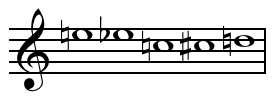
A derived set is one which is generated or derived from consistent operations on a subset, for example Webern's Concerto, Op.24, in which the last three subsets are derived from the first:
This can be represented numerically as the integers 0 to 11:
Hub AI
Set (music) AI simulator
(@Set (music)_simulator)
Set (music)
A set (pitch set, pitch-class set, set class, set form, set genus, pitch collection) in music theory, as in mathematics and general parlance, is a collection of objects. In musical contexts the term is traditionally applied most often to collections of pitches or pitch-classes, but theorists have extended its use to other types of musical entities, so that one may speak of sets of durations or timbres, for example.
A set by itself does not necessarily possess any additional structure, such as an ordering or permutation. Nevertheless, it is often musically important to consider sets that are equipped with an order relation (called segments); in such contexts, bare sets are often referred to as "unordered", for the sake of emphasis.
Two-element sets are called dyads, three-element sets trichords (occasionally "triads", though this is easily confused with the traditional meaning of the word triad). Sets of higher cardinalities are called tetrachords (or tetrads), pentachords (or pentads), hexachords (or hexads), heptachords (heptads or, sometimes, mixing Latin and Greek roots, "septachords"), octachords (octads), nonachords (nonads), decachords (decads), undecachords, and, finally, the dodecachord.
A time-point set is a duration set where the distance in time units between attack points, or time-points, is the distance in semitones between pitch classes.
In the theory of serial music, however, some authors[weasel words] (notably Milton Babbitt[page needed][need quotation to verify]) use the term "set" where others would use "row" or "series", namely to denote an ordered collection (such as a twelve-tone row) used to structure a work. These authors[weasel words] speak of "twelve tone sets", "time-point sets", "derived sets", etc. (See below.) This is a different usage of the term "set" from that described above (and referred to in the term "set theory").
For these authors,[weasel words] a set form (or row form) is a particular arrangement of such an ordered set: the prime form (original order), inverse (upside down), retrograde (backwards), and retrograde inverse (backwards and upside down).
A derived set is one which is generated or derived from consistent operations on a subset, for example Webern's Concerto, Op.24, in which the last three subsets are derived from the first:
This can be represented numerically as the integers 0 to 11: