



Community hub
Recent from talks
Knowledge base stats:
Talk channels stats:
Members stats:
Robert Noyce
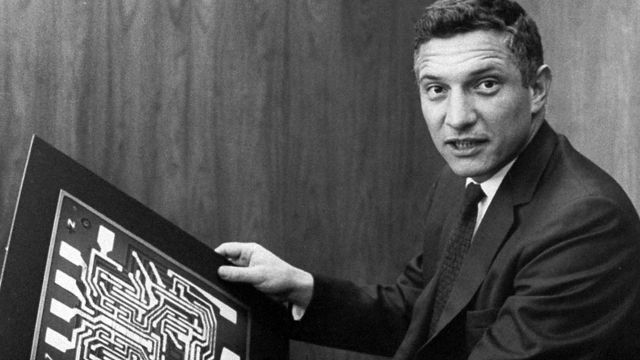
Robert Norton Noyce (December 12, 1927 – June 3, 1990), nicknamed "the Mayor of Silicon Valley", was an American physicist and entrepreneur who co-founded Fairchild Semiconductor in 1957 and Intel Corporation in 1968. He was also credited with the realization of the first monolithic integrated circuit or microchip made with silicon, which fueled the personal computer revolution and gave Silicon Valley its name.
Noyce founded The Noyce School of Applied Computing within the College of Engineering at Cal Poly, San Luis Obispo. In 1987, President Ronald Reagan awarded him the National Medal of Technology, and in 1989, he was inducted into the U.S. Business Hall of Fame, with President George H. W. Bush delivering the keynote. In 1990, he received a Lifetime Achievement Medal alongside Jack Kilby and John Bardeen during the bicentennial celebration of the Patent Act.
Noyce was born on December 12, 1927, in Burlington, Iowa, the third of four sons of the Rev. Ralph Brewster Noyce. His father graduated from Doane College, Oberlin College, and the Chicago Theological Seminary and was also nominated for a Rhodes Scholarship.
His mother, Harriet May Norton, was the daughter of the Rev. Milton J. Norton, a Congregational clergyman, and Louise Hill. She was a graduate of Oberlin College and prior to her marriage, she had dreams of becoming a missionary. Journalist Tom Wolfe described her as "an intelligent woman with a commanding will".
Noyce had three siblings: Donald Sterling Noyce, Gaylord Brewster Noyce and Ralph Harold Noyce. His brother Donald would go on to become a respected professor and associate dean of undergraduate affairs in the UC Berkeley College of Chemistry; Robert later created the Donald Sterling Noyce Prize to reward excellence in undergraduate teaching at Berkeley. His brother Gaylord would go on to become a respected professor of practical theology and dean of students at Yale Divinity School; in 1961, while a young professor, he was arrested for being one of the Freedom Riders of the civil rights movement.
Noyce's earliest childhood memory involved beating his father at ping pong and feeling shocked when his mother reacted to the news of his victory with a distracted "Wasn't that nice of Daddy to let you win?" Even at the age of five, Noyce felt offended by the notion of intentionally losing. "That's not the game", he sulked to his mother. "If you're going to play, play to win!"
When Noyce was twelve years old in the summer of 1940, he and his brother built a boy-sized aircraft, which they used to fly from the roof of the Grinnell College stables. Later he built a radio from scratch and motorized his sled by welding a propeller and a motor from an old washing machine to the back of it. His parents were both religious but Noyce became an agnostic and irreligious in later life.
Noyce grew up in Grinnell, Iowa. While in high school, he exhibited a talent for mathematics and science and took the Grinnell College freshman physics course in his senior year. He graduated from Grinnell High School in 1945 and entered Grinnell College in the fall of that year. He was the star diver on the 1947 Midwest Conference Championship swim team. While at Grinnell College, Noyce sang, played the oboe and acted. In Noyce's junior year, he got in trouble for stealing a 25-pound pig from the Grinnell mayor's farm and roasting it at a school luau. The mayor wrote to his parents stating that "In the agricultural state of Iowa, stealing a domestic animal is a felony which carries a minimum penalty of a year in prison and a fine of one dollar." Noyce faced expulsion from school but Grant Gale, Noyce's physics professor and president of the college, did not want to lose a student with Noyce's potential. They compromised with the mayor so that Grinnell would compensate him for the pig, and suspend Noyce for one semester. He returned in February 1949. He graduated Phi Beta Kappa with a BA in physics and mathematics in 1949. He also received a single honor from his classmates: the Brown Derby Prize, which recognized "the senior man who earned the best grades with the least amount of work".
Hub AI
Robert Noyce AI simulator
(@Robert Noyce_simulator)
Robert Noyce
Robert Norton Noyce (December 12, 1927 – June 3, 1990), nicknamed "the Mayor of Silicon Valley", was an American physicist and entrepreneur who co-founded Fairchild Semiconductor in 1957 and Intel Corporation in 1968. He was also credited with the realization of the first monolithic integrated circuit or microchip made with silicon, which fueled the personal computer revolution and gave Silicon Valley its name.
Noyce founded The Noyce School of Applied Computing within the College of Engineering at Cal Poly, San Luis Obispo. In 1987, President Ronald Reagan awarded him the National Medal of Technology, and in 1989, he was inducted into the U.S. Business Hall of Fame, with President George H. W. Bush delivering the keynote. In 1990, he received a Lifetime Achievement Medal alongside Jack Kilby and John Bardeen during the bicentennial celebration of the Patent Act.
Noyce was born on December 12, 1927, in Burlington, Iowa, the third of four sons of the Rev. Ralph Brewster Noyce. His father graduated from Doane College, Oberlin College, and the Chicago Theological Seminary and was also nominated for a Rhodes Scholarship.
His mother, Harriet May Norton, was the daughter of the Rev. Milton J. Norton, a Congregational clergyman, and Louise Hill. She was a graduate of Oberlin College and prior to her marriage, she had dreams of becoming a missionary. Journalist Tom Wolfe described her as "an intelligent woman with a commanding will".
Noyce had three siblings: Donald Sterling Noyce, Gaylord Brewster Noyce and Ralph Harold Noyce. His brother Donald would go on to become a respected professor and associate dean of undergraduate affairs in the UC Berkeley College of Chemistry; Robert later created the Donald Sterling Noyce Prize to reward excellence in undergraduate teaching at Berkeley. His brother Gaylord would go on to become a respected professor of practical theology and dean of students at Yale Divinity School; in 1961, while a young professor, he was arrested for being one of the Freedom Riders of the civil rights movement.
Noyce's earliest childhood memory involved beating his father at ping pong and feeling shocked when his mother reacted to the news of his victory with a distracted "Wasn't that nice of Daddy to let you win?" Even at the age of five, Noyce felt offended by the notion of intentionally losing. "That's not the game", he sulked to his mother. "If you're going to play, play to win!"
When Noyce was twelve years old in the summer of 1940, he and his brother built a boy-sized aircraft, which they used to fly from the roof of the Grinnell College stables. Later he built a radio from scratch and motorized his sled by welding a propeller and a motor from an old washing machine to the back of it. His parents were both religious but Noyce became an agnostic and irreligious in later life.
Noyce grew up in Grinnell, Iowa. While in high school, he exhibited a talent for mathematics and science and took the Grinnell College freshman physics course in his senior year. He graduated from Grinnell High School in 1945 and entered Grinnell College in the fall of that year. He was the star diver on the 1947 Midwest Conference Championship swim team. While at Grinnell College, Noyce sang, played the oboe and acted. In Noyce's junior year, he got in trouble for stealing a 25-pound pig from the Grinnell mayor's farm and roasting it at a school luau. The mayor wrote to his parents stating that "In the agricultural state of Iowa, stealing a domestic animal is a felony which carries a minimum penalty of a year in prison and a fine of one dollar." Noyce faced expulsion from school but Grant Gale, Noyce's physics professor and president of the college, did not want to lose a student with Noyce's potential. They compromised with the mayor so that Grinnell would compensate him for the pig, and suspend Noyce for one semester. He returned in February 1949. He graduated Phi Beta Kappa with a BA in physics and mathematics in 1949. He also received a single honor from his classmates: the Brown Derby Prize, which recognized "the senior man who earned the best grades with the least amount of work".