
Recent from talks
North American Rockwell OV-10 Bronco
Knowledge base stats:
Talk channels stats:
Members stats:
North American Rockwell OV-10 Bronco
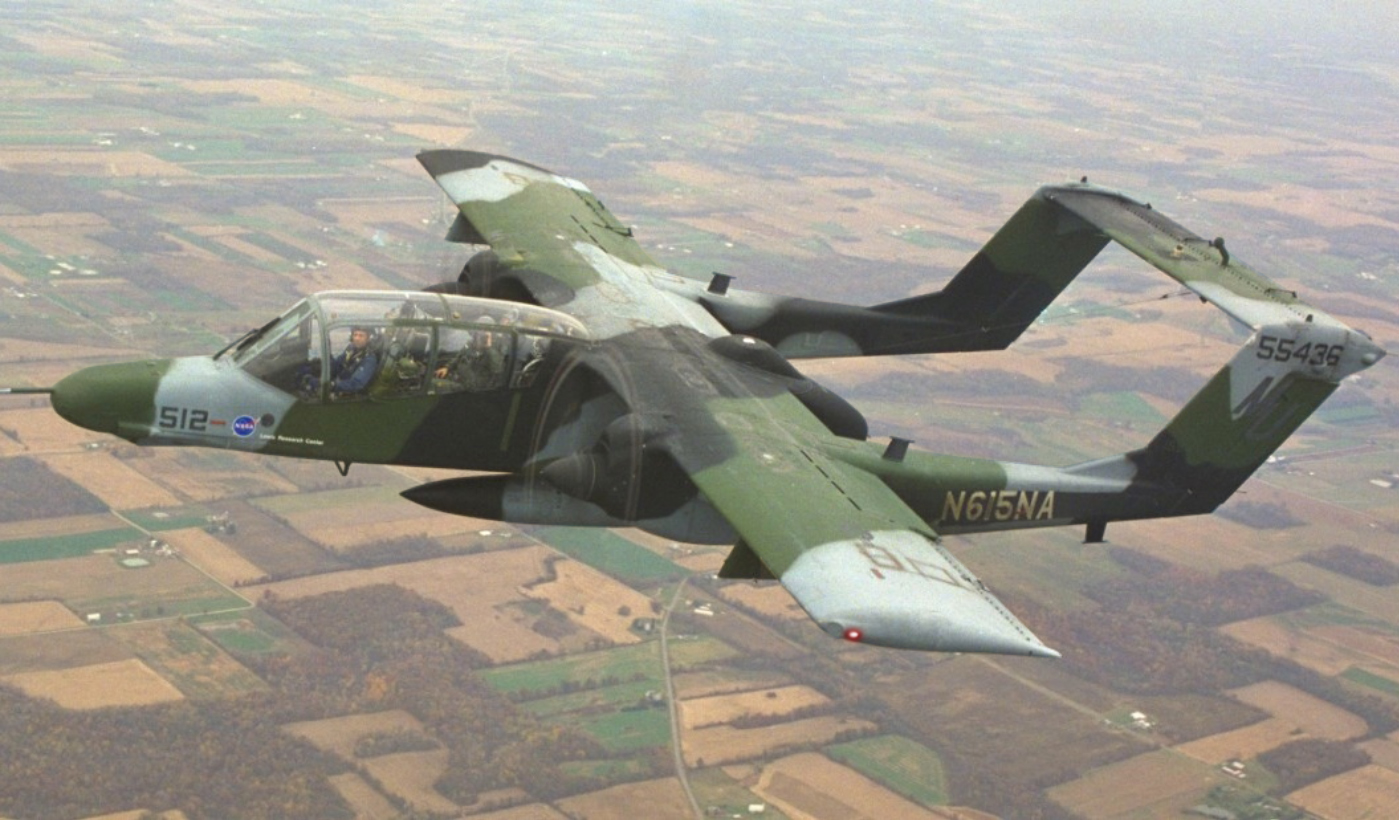
The North American Rockwell OV-10 Bronco is an American twin-turboprop light attack and observation aircraft. It was developed in the 1960s as a special aircraft for counter-insurgency (COIN) combat, and one of its primary missions was as a forward air control (FAC) aircraft. It can carry up to 3,200 lb (1,450 kg) of external munitions and internal loads such as paratroopers or stretchers, and can loiter for three or more hours.
The aircraft was initially conceived in the early 1960s through an informal collaboration between W.H. Beckett and Colonel K.P. Rice, U.S. Marine Corps, who met at Naval Air Weapons Station China Lake, California, and who also happened to live near each other. The original concept was for a rugged, simple, close-air-support aircraft integrated with forward ground operations. At the time, the U.S. Army was still experimenting with armed helicopters, and the U.S. Air Force was not interested in close air support.
The concept aircraft was to operate from expedient forward air bases using roads as runways. Speed was to be from very slow to medium subsonic, with much longer loiter times than a pure jet. Efficient turboprop engines would give better performance than piston engines. Weapons were to be mounted on the centerline to get efficient unranged aiming. The inventors favored strafing weapons such as self-loading recoilless rifles, which could deliver aimed explosive shells with less recoil than cannons, and a lower per-round weight than rockets. The airframe was to be designed to avoid the back blast.
Beckett and Rice developed a basic platform meeting these requirements, then attempted to build a fiberglass prototype in a garage. The effort produced enthusiastic supporters and an informal pamphlet describing the concept. W.H. Beckett, who had retired from the Marine Corps, went to work at North American Aviation to sell the aircraft.
Rice states:
The military definition of STOL (500 ft to a 50-ft obstacle) allows takeoff and landing in most of the areas in which limited war might be fought. In addition, the airplane was designed to use roads so that operation would even be possible in jungle areas, where clearings are few and far between. As a result, the wingspan was to be limited to 20 feet and a heavy trailing arm-type landing gear with a tread of 6.5 ft was provided for operation from roads. Float operation was to be feasible ... ...it is quite feasible to design the various components so that it can be disassembled easily and stored in a box that would fit in a 6×6 truck bed together with the equipment needed for re-assembly in the field. It could thus be transported by amphibious shipping and either heli-lifted or driven ashore by a 6×6 truck.
A "tri-service" specification for the Light Armed Reconnaissance Aircraft (LARA) was approved by the U.S. Navy, Air Force, and Army, and was issued in late 1963. The LARA requirement was based on a perceived need for a new type of "jungle fighting", versatile, light attack and observation aircraft. Existing military aircraft in the observation role, such as the Cessna O-1 Bird Dog and Cessna O-2 Skymaster, were perceived as obsolescent, with too slow a speed and too small a load capacity for this flexible role.
The specification called for a twin-engined, two-man aircraft that could carry at least 2,400 pounds (1,100 kg) of cargo or six paratroopers or stretchers, and be stressed for +8 and −3 g (basic aerobatic ability). It also had to be able to operate from an aircraft carrier, fly at least 350 miles per hour (560 km/h), take off in 800 feet (240 m), and convert to an amphibious version. Various armaments had to be carried, including four 7.62 mm (0.300 in) machine guns with 2,000 rounds, and external weapons including a gun pod with 20 mm (0.79 in) M197 electric cannon, and AIM-9 Sidewinder air-to-air missiles.
Hub AI
North American Rockwell OV-10 Bronco AI simulator
(@North American Rockwell OV-10 Bronco_simulator)
North American Rockwell OV-10 Bronco
The North American Rockwell OV-10 Bronco is an American twin-turboprop light attack and observation aircraft. It was developed in the 1960s as a special aircraft for counter-insurgency (COIN) combat, and one of its primary missions was as a forward air control (FAC) aircraft. It can carry up to 3,200 lb (1,450 kg) of external munitions and internal loads such as paratroopers or stretchers, and can loiter for three or more hours.
The aircraft was initially conceived in the early 1960s through an informal collaboration between W.H. Beckett and Colonel K.P. Rice, U.S. Marine Corps, who met at Naval Air Weapons Station China Lake, California, and who also happened to live near each other. The original concept was for a rugged, simple, close-air-support aircraft integrated with forward ground operations. At the time, the U.S. Army was still experimenting with armed helicopters, and the U.S. Air Force was not interested in close air support.
The concept aircraft was to operate from expedient forward air bases using roads as runways. Speed was to be from very slow to medium subsonic, with much longer loiter times than a pure jet. Efficient turboprop engines would give better performance than piston engines. Weapons were to be mounted on the centerline to get efficient unranged aiming. The inventors favored strafing weapons such as self-loading recoilless rifles, which could deliver aimed explosive shells with less recoil than cannons, and a lower per-round weight than rockets. The airframe was to be designed to avoid the back blast.
Beckett and Rice developed a basic platform meeting these requirements, then attempted to build a fiberglass prototype in a garage. The effort produced enthusiastic supporters and an informal pamphlet describing the concept. W.H. Beckett, who had retired from the Marine Corps, went to work at North American Aviation to sell the aircraft.
Rice states:
The military definition of STOL (500 ft to a 50-ft obstacle) allows takeoff and landing in most of the areas in which limited war might be fought. In addition, the airplane was designed to use roads so that operation would even be possible in jungle areas, where clearings are few and far between. As a result, the wingspan was to be limited to 20 feet and a heavy trailing arm-type landing gear with a tread of 6.5 ft was provided for operation from roads. Float operation was to be feasible ... ...it is quite feasible to design the various components so that it can be disassembled easily and stored in a box that would fit in a 6×6 truck bed together with the equipment needed for re-assembly in the field. It could thus be transported by amphibious shipping and either heli-lifted or driven ashore by a 6×6 truck.
A "tri-service" specification for the Light Armed Reconnaissance Aircraft (LARA) was approved by the U.S. Navy, Air Force, and Army, and was issued in late 1963. The LARA requirement was based on a perceived need for a new type of "jungle fighting", versatile, light attack and observation aircraft. Existing military aircraft in the observation role, such as the Cessna O-1 Bird Dog and Cessna O-2 Skymaster, were perceived as obsolescent, with too slow a speed and too small a load capacity for this flexible role.
The specification called for a twin-engined, two-man aircraft that could carry at least 2,400 pounds (1,100 kg) of cargo or six paratroopers or stretchers, and be stressed for +8 and −3 g (basic aerobatic ability). It also had to be able to operate from an aircraft carrier, fly at least 350 miles per hour (560 km/h), take off in 800 feet (240 m), and convert to an amphibious version. Various armaments had to be carried, including four 7.62 mm (0.300 in) machine guns with 2,000 rounds, and external weapons including a gun pod with 20 mm (0.79 in) M197 electric cannon, and AIM-9 Sidewinder air-to-air missiles.
Recent media