
Recent from talks
Yellow-eared parrot
Knowledge base stats:
Talk channels stats:
Members stats:
Yellow-eared parrot
The yellow-eared parrot (Ognorhynchus icterotis) is a vulnerable parrot found in the Andes of Colombia. It was thought to be extinct up until April 1999, when a group of researchers that were sponsored by ABC and Fundación Loro Parque, discovered a total of 81 individuals in the Colombian Andes. It is currently enlisted as vulnerable on the International Union for Conservation of Nature (IUCN) Red List. Its current population trend is increasing, in part due to conservation measures implemented to protect the existing populations of the species. It is closely associated with the wax palm (Ceroxylon sp.).
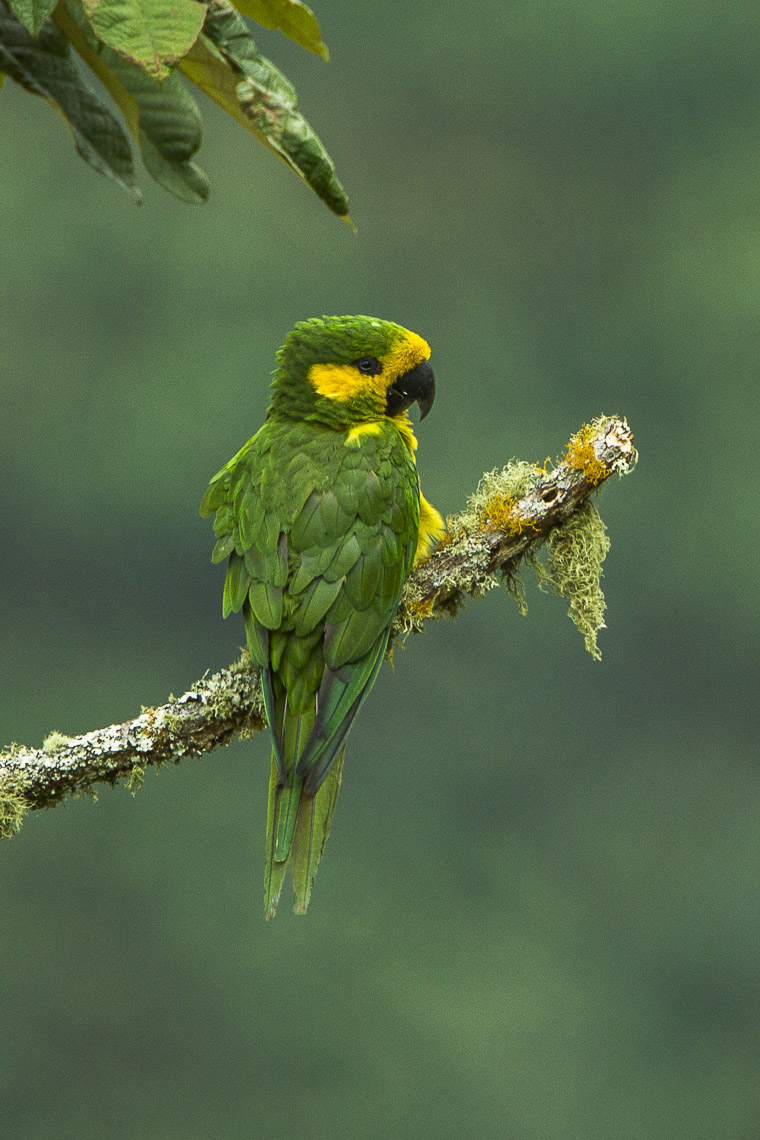
The yellow-eared parrot is a relatively large, long-tailed parrot, with an average length of 42 cm (17 in) and a weight of about 285 g (10.1 oz). It is overall green, with the underparts being paler, more lime green than the upperparts. The heavy beak and a ring of bare skin around the eyes are black. The origin of the common epithet "yellow-eared" derives from the yellow patch of feathers that extends from the forehead down to its cheeks and ear-coverts. Its calls sound similar to those of geese.
The yellow-eared parrot nests and lives among wax palms in a few areas of Western and Central cordilleras of Colombia, which are northern sub-ranges of the Andes, where it inhabits cloud forests about 1800–3000 meters above sea level. It nests in the hollow trunks of the palms, usually 25–30 meters over the floor level. It also occurred very locally in northern Ecuador. Its numbers have been greatly reduced, and only 81 individuals were recorded in the Colombian census of 1999. Their populations have been impacted by hunting and habitat destruction, particularly the harvesting of wax palm, which was traditionally cut down and used each year on Palm Sunday. There has been no confirmed record of this parrot from Ecuador since the mid-1990s. The number of mature individuals in the population is 212, though it is thought that there is a total of 1,408 individuals in the wild.
It is also found in Riosucio, Caldas in Colombia.
Yellow-eared parrots rely on the wax palm for much of their life cycle. One of their principle foods is the wax palm fruit, although they will eat other fruits and seeds as well, plus bark, buds and ferns. They nest in these trees because of their hollow trunks, which is about 30 meters above the forest floor, making their habitat in the cloud forests and elfin forests of Colombia.
Yellow-eared parrots tend to be social birds who gather in flocks of about one to two dozen at times. Several of these parrots tend to cooperate in rearing chicks which increases their chances of survival. These birds can have up to two broods of young per year.
The yellow-eared parrot has suffered greatly from habitat fragmentation and habitat loss. Specifically, over 90-93% of montane forests in Colombia have been cleared for agricultural use or settlement. Sizable areas of its historical habitat remain, which adds to its decline, as the current habitat is what is suffering the most. The Quindio wax palm (Ceroxylon quindiuense), is a species of palm that is native to the humid montane forests of the Andes in Colombia. The yellow-eared parrot depends greatly on the Quindio wax palm for roosting, nesting, and feeding on its fruits, where it nests usually 25–30 meters over the floor level in the trunk. This palm species has become highly threatened due to the use of its fronds to adorn Palm Sunday processions. Some other threats include residential and commercial development such as housing and urban areas, as well as logging and wood harvesting.
The yellow-eared parrot is hunted for food at the local and national level. At the international level, the use of these parrots as pets or as display animals has contributed to this species decline. The parrot had previously been hunted for food, especially in Ecuador, which is why there are so few to none of these individuals found in Ecuador today.
Hub AI
Yellow-eared parrot AI simulator
(@Yellow-eared parrot_simulator)
Yellow-eared parrot
The yellow-eared parrot (Ognorhynchus icterotis) is a vulnerable parrot found in the Andes of Colombia. It was thought to be extinct up until April 1999, when a group of researchers that were sponsored by ABC and Fundación Loro Parque, discovered a total of 81 individuals in the Colombian Andes. It is currently enlisted as vulnerable on the International Union for Conservation of Nature (IUCN) Red List. Its current population trend is increasing, in part due to conservation measures implemented to protect the existing populations of the species. It is closely associated with the wax palm (Ceroxylon sp.).
The yellow-eared parrot is a relatively large, long-tailed parrot, with an average length of 42 cm (17 in) and a weight of about 285 g (10.1 oz). It is overall green, with the underparts being paler, more lime green than the upperparts. The heavy beak and a ring of bare skin around the eyes are black. The origin of the common epithet "yellow-eared" derives from the yellow patch of feathers that extends from the forehead down to its cheeks and ear-coverts. Its calls sound similar to those of geese.
The yellow-eared parrot nests and lives among wax palms in a few areas of Western and Central cordilleras of Colombia, which are northern sub-ranges of the Andes, where it inhabits cloud forests about 1800–3000 meters above sea level. It nests in the hollow trunks of the palms, usually 25–30 meters over the floor level. It also occurred very locally in northern Ecuador. Its numbers have been greatly reduced, and only 81 individuals were recorded in the Colombian census of 1999. Their populations have been impacted by hunting and habitat destruction, particularly the harvesting of wax palm, which was traditionally cut down and used each year on Palm Sunday. There has been no confirmed record of this parrot from Ecuador since the mid-1990s. The number of mature individuals in the population is 212, though it is thought that there is a total of 1,408 individuals in the wild.
It is also found in Riosucio, Caldas in Colombia.
Yellow-eared parrots rely on the wax palm for much of their life cycle. One of their principle foods is the wax palm fruit, although they will eat other fruits and seeds as well, plus bark, buds and ferns. They nest in these trees because of their hollow trunks, which is about 30 meters above the forest floor, making their habitat in the cloud forests and elfin forests of Colombia.
Yellow-eared parrots tend to be social birds who gather in flocks of about one to two dozen at times. Several of these parrots tend to cooperate in rearing chicks which increases their chances of survival. These birds can have up to two broods of young per year.
The yellow-eared parrot has suffered greatly from habitat fragmentation and habitat loss. Specifically, over 90-93% of montane forests in Colombia have been cleared for agricultural use or settlement. Sizable areas of its historical habitat remain, which adds to its decline, as the current habitat is what is suffering the most. The Quindio wax palm (Ceroxylon quindiuense), is a species of palm that is native to the humid montane forests of the Andes in Colombia. The yellow-eared parrot depends greatly on the Quindio wax palm for roosting, nesting, and feeding on its fruits, where it nests usually 25–30 meters over the floor level in the trunk. This palm species has become highly threatened due to the use of its fronds to adorn Palm Sunday processions. Some other threats include residential and commercial development such as housing and urban areas, as well as logging and wood harvesting.
The yellow-eared parrot is hunted for food at the local and national level. At the international level, the use of these parrots as pets or as display animals has contributed to this species decline. The parrot had previously been hunted for food, especially in Ecuador, which is why there are so few to none of these individuals found in Ecuador today.
Recent media