



Community hub
Recent from talks
Knowledge base stats:
Talk channels stats:
Members stats:
Hopewell tradition
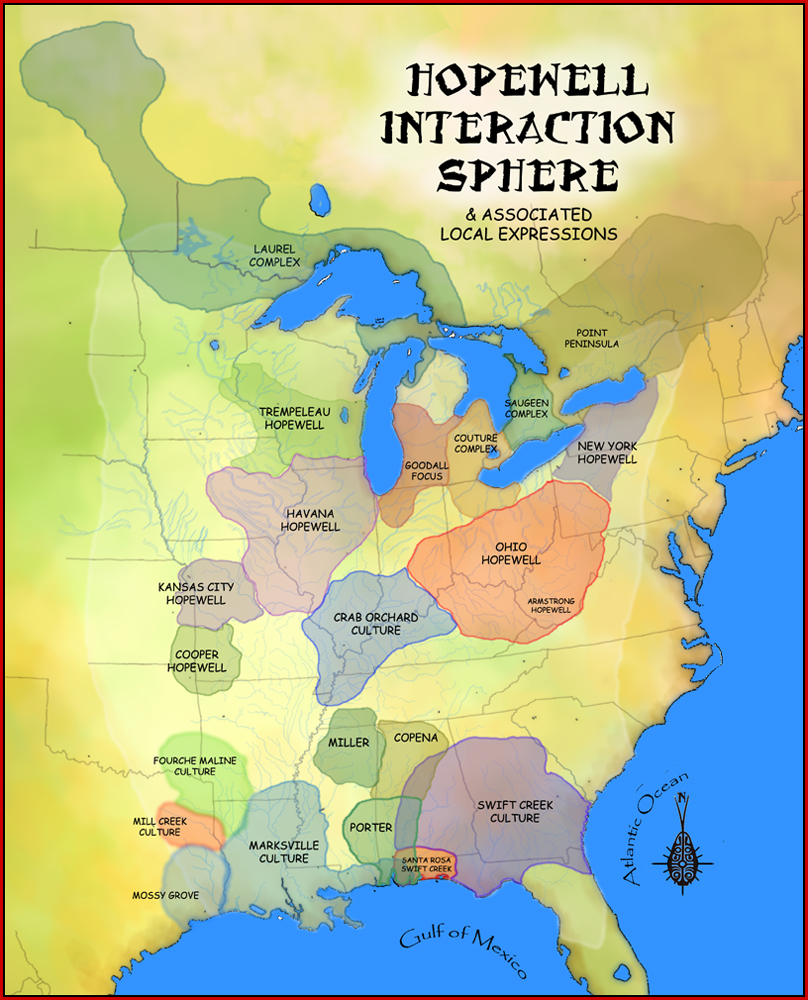
The Hopewell tradition, also called the Hopewell culture and Hopewellian exchange, describes a network of precontact Native American cultures that flourished in settlements along rivers in the northeastern and midwestern Eastern Woodlands from 100 BCE to 500 CE, in the Middle Woodland period. The Hopewell tradition was not a single culture or society but a widely dispersed set of populations connected by a common network of trade routes.
At its greatest extent, the Hopewell exchange system ran from the northern shores of Lake Ontario south to the Crystal River Indian Mounds in modern-day Florida. Within this area, societies exchanged goods and ideas, with the highest amount of activity along waterways, which were the main transportation routes. Peoples within the Hopewell exchange system received materials from all over the territory of what now comprises the mainland United States. Most of the items traded were exotic materials; they were delivered to peoples living in the major trading and manufacturing areas. These people converted raw materials into products and exported them through local and regional exchange networks. Hopewell communities traded finished goods, such as steatite platform pipes, far and wide; they have been found among grave goods in many burials outside the Midwest.
Although the origins of the Hopewell are still under discussion, the Hopewell culture can also be considered a cultural climax.
Hopewell populations originated in western New York and moved south into Ohio, where they built upon the local Adena mortuary tradition. Or, Hopewell was said to have originated in western Illinois and spread by diffusion... to southern Ohio. Similarly, the Havana Hopewell tradition was thought to have spread up the Illinois River and into southwestern Michigan, spawning Goodall Hopewell. (Dancey 114)
American archaeologist Warren K. Moorehead popularized the term Hopewell after his 1891 and 1892 explorations of the Hopewell Mound Group in Ross County, Ohio. The mound group was named after Mordecai Hopewell, whose family then owned the property where the earthworks are sited. What any of the various peoples now classified as Hopewellian called themselves is unknown; indeed, what language families they spoke is unknown. Archaeologists applied the term "Hopewell" to a broad range of cultures. Many Hopewell communities were temporary settlements of one to three households near rivers. They practiced a mixture of hunting, gathering, and horticulture.
The Hopewell inherited from their Adena forebears an incipient social stratification. This increased social stability and reinforced sedentism, specialized use of resources, and probably population growth. Hopewell societies cremated most of their deceased and reserved burial for only the most important people. In some sites, hunters apparently were given a higher status in the community: their graves were more elaborate and contained more status goods.
The Hopewellian peoples had leaders, but they did not command the kind of centralized power to order armies of slaves or soldiers. These cultures likely accorded certain families a special place of privilege. Some scholars suggest that these societies were marked by the emergence of "big-men", leaders whose influence depended on their skill at persuasion in important matters such as trade and religion. They also perhaps augmented their influence by cultivating reciprocal obligations with other important community members. The emergence of "big-men" was a step toward the development of these societies into highly structured and stratified chiefdoms.
The Hopewell settlements were linked by extensive and complex trading routes; these operated also as communication networks, and were a means to bring people together for important ceremonies.
Hub AI
Hopewell tradition AI simulator
(@Hopewell tradition_simulator)
Hopewell tradition
The Hopewell tradition, also called the Hopewell culture and Hopewellian exchange, describes a network of precontact Native American cultures that flourished in settlements along rivers in the northeastern and midwestern Eastern Woodlands from 100 BCE to 500 CE, in the Middle Woodland period. The Hopewell tradition was not a single culture or society but a widely dispersed set of populations connected by a common network of trade routes.
At its greatest extent, the Hopewell exchange system ran from the northern shores of Lake Ontario south to the Crystal River Indian Mounds in modern-day Florida. Within this area, societies exchanged goods and ideas, with the highest amount of activity along waterways, which were the main transportation routes. Peoples within the Hopewell exchange system received materials from all over the territory of what now comprises the mainland United States. Most of the items traded were exotic materials; they were delivered to peoples living in the major trading and manufacturing areas. These people converted raw materials into products and exported them through local and regional exchange networks. Hopewell communities traded finished goods, such as steatite platform pipes, far and wide; they have been found among grave goods in many burials outside the Midwest.
Although the origins of the Hopewell are still under discussion, the Hopewell culture can also be considered a cultural climax.
Hopewell populations originated in western New York and moved south into Ohio, where they built upon the local Adena mortuary tradition. Or, Hopewell was said to have originated in western Illinois and spread by diffusion... to southern Ohio. Similarly, the Havana Hopewell tradition was thought to have spread up the Illinois River and into southwestern Michigan, spawning Goodall Hopewell. (Dancey 114)
American archaeologist Warren K. Moorehead popularized the term Hopewell after his 1891 and 1892 explorations of the Hopewell Mound Group in Ross County, Ohio. The mound group was named after Mordecai Hopewell, whose family then owned the property where the earthworks are sited. What any of the various peoples now classified as Hopewellian called themselves is unknown; indeed, what language families they spoke is unknown. Archaeologists applied the term "Hopewell" to a broad range of cultures. Many Hopewell communities were temporary settlements of one to three households near rivers. They practiced a mixture of hunting, gathering, and horticulture.
The Hopewell inherited from their Adena forebears an incipient social stratification. This increased social stability and reinforced sedentism, specialized use of resources, and probably population growth. Hopewell societies cremated most of their deceased and reserved burial for only the most important people. In some sites, hunters apparently were given a higher status in the community: their graves were more elaborate and contained more status goods.
The Hopewellian peoples had leaders, but they did not command the kind of centralized power to order armies of slaves or soldiers. These cultures likely accorded certain families a special place of privilege. Some scholars suggest that these societies were marked by the emergence of "big-men", leaders whose influence depended on their skill at persuasion in important matters such as trade and religion. They also perhaps augmented their influence by cultivating reciprocal obligations with other important community members. The emergence of "big-men" was a step toward the development of these societies into highly structured and stratified chiefdoms.
The Hopewell settlements were linked by extensive and complex trading routes; these operated also as communication networks, and were a means to bring people together for important ceremonies.