



Community hub
Recent from talks
Contribute something to knowledge base
Content stats: 0 posts, 0 articles, 1 media, 0 notes
Members stats: 0 subscribers, 0 contributors, 0 moderators, 0 supporters
Subscribers
Supporters
Contributors
Moderators
Oldowan
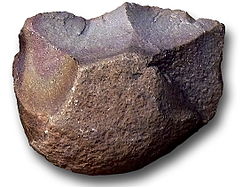
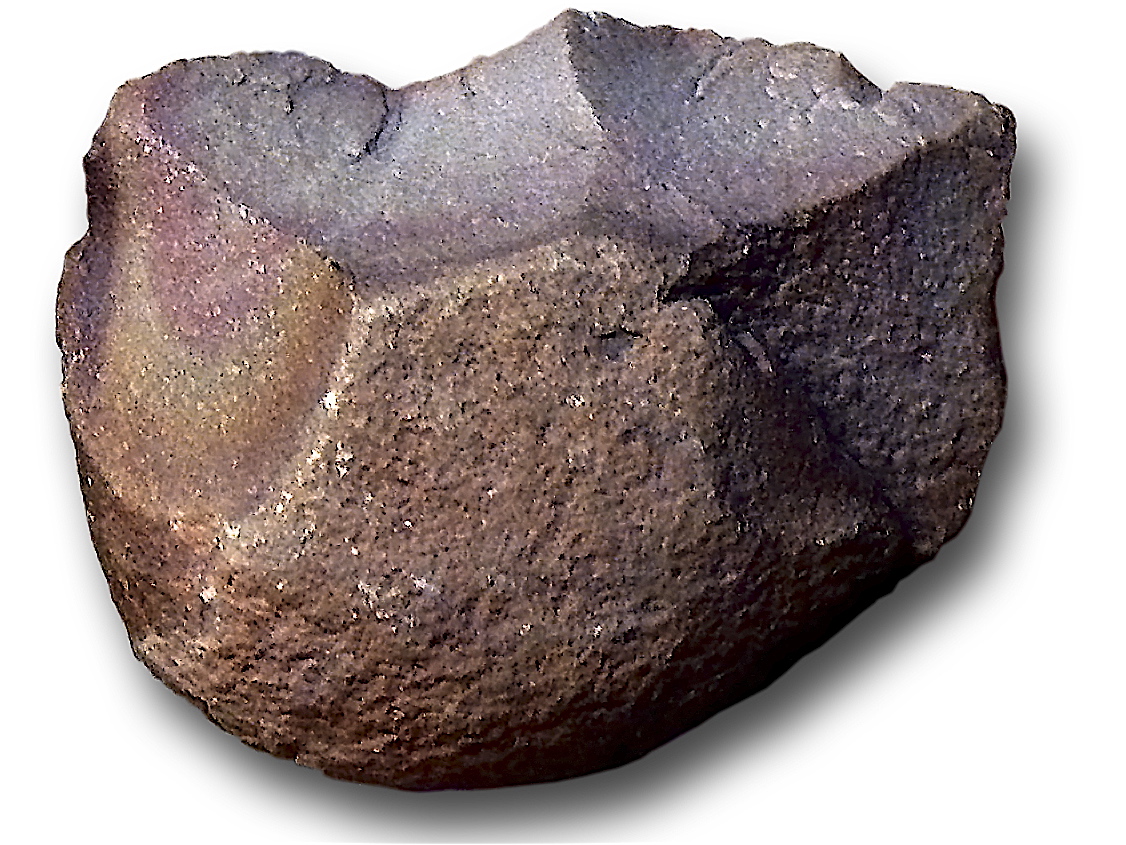
The Oldowan (or Mode I) was a widespread stone tool archaeological industry during the early Lower Paleolithic spanning the late Pliocene and the first half of the Early Pleistocene. These early tools were simple, usually made by chipping one, or a few, flakes off a stone using another stone. Oldowan tools were used during a period spanning from 2.9 million years ago up until at least 1.7 million years ago (Ma), by ancient hominins (early humans) across much of Africa. This technological industry was followed by the more sophisticated Acheulean industry (two sites associated with Homo erectus at Gona in the Afar Region of Ethiopia dating from 1.5 and 1.26 million years ago have both Oldowan and Acheulean tools).
The term Oldowan is taken from the site of Olduvai Gorge in Tanzania, where the first Oldowan stone tools were discovered by the archaeologist Louis Leakey in the 1930s. However, some contemporary archaeologists and palaeoanthropologists prefer to use the term Mode 1 tools to designate pebble tool industries (including Oldowan), with Mode 2 designating bifacially worked tools (including Acheulean handaxes), Mode 3 designating prepared-core tools, and so forth.
Classification of Oldowan tools is still somewhat contentious. Mary Leakey was the first to create a system to classify Oldowan assemblages, and built her system based on prescribed use. The system included choppers, scrapers, and pounders. However, more recent classifications of Oldowan assemblages have been made that focus primarily on manufacture due to the problematic nature of assuming use from stone artefacts. An example is Isaac et al.'s tri-modal categories of "Flaked Pieces" (cores/choppers), "Detached Pieces" (flakes and fragments), "Pounded Pieces" (cobbles utilized as hammerstones, etc.) and "Unmodified Pieces" (manuports, stones transported to sites). Oldowan tools are sometimes called "pebble tools", so named because the blanks chosen for their production already resemble, in pebble form, the final product.
It is not known for sure which hominin species created and used Oldowan tools. Its emergence is often associated with the species Australopithecus garhi and its flourishing with early species of Homo such as H. habilis and H. ergaster. Early Homo erectus appears to inherit Oldowan technology and refines it into the Acheulean industry beginning 1.7 million years ago.
The oldest known Oldowan tools have been found at Nyayanga on the Homa Peninsula in Kenya and are dated to ~2.9 million years ago (Ma). The Oldowan tools were associated with Paranthropus teeth and two butchered hippo skeletons. Early Oldowan tools are also known from Gona in Ethiopia (near the Awash River), and are dated to about 2.6 Ma.
The use of tools by apes including chimpanzees and orangutans can be used to argue in favour of tool-use as an ancestral feature of the hominin family. Tools made from bone, wood, or other organic materials were therefore in all probability used before the Oldowan. Oldowan stone tools are simply the oldest recognisable tools which have been preserved in the archaeological record.
There is a flourishing of Oldowan tools in eastern Africa, spreading to southern Africa, between 2.4 and 1.7 Ma. At 1.7 Ma., the first Acheulean tools appear even as Oldowan assemblages continue to be produced. Both technologies are occasionally found in the same areas, dating to the same time periods. This realisation required a rethinking of old cultural sequences in which the more "advanced" Acheulean was supposed to have succeeded the Oldowan. The different traditions may have been used by different species of hominins living in the same area, or multiple techniques may have been used by an individual species in response to different circumstances.
Sometime before 1.8 Ma Homo erectus had spread outside of Africa, reaching as far east as Java by 1.8 Ma and in Northern China by 1.66 Ma. In these newly colonised areas, no Acheulean assemblages have been found. In China, only "Mode 1" Oldowan assemblages were produced, while in Indonesia stone tools from this age are unknown.
Oldowan
The Oldowan (or Mode I) was a widespread stone tool archaeological industry during the early Lower Paleolithic spanning the late Pliocene and the first half of the Early Pleistocene. These early tools were simple, usually made by chipping one, or a few, flakes off a stone using another stone. Oldowan tools were used during a period spanning from 2.9 million years ago up until at least 1.7 million years ago (Ma), by ancient hominins (early humans) across much of Africa. This technological industry was followed by the more sophisticated Acheulean industry (two sites associated with Homo erectus at Gona in the Afar Region of Ethiopia dating from 1.5 and 1.26 million years ago have both Oldowan and Acheulean tools).
The term Oldowan is taken from the site of Olduvai Gorge in Tanzania, where the first Oldowan stone tools were discovered by the archaeologist Louis Leakey in the 1930s. However, some contemporary archaeologists and palaeoanthropologists prefer to use the term Mode 1 tools to designate pebble tool industries (including Oldowan), with Mode 2 designating bifacially worked tools (including Acheulean handaxes), Mode 3 designating prepared-core tools, and so forth.
Classification of Oldowan tools is still somewhat contentious. Mary Leakey was the first to create a system to classify Oldowan assemblages, and built her system based on prescribed use. The system included choppers, scrapers, and pounders. However, more recent classifications of Oldowan assemblages have been made that focus primarily on manufacture due to the problematic nature of assuming use from stone artefacts. An example is Isaac et al.'s tri-modal categories of "Flaked Pieces" (cores/choppers), "Detached Pieces" (flakes and fragments), "Pounded Pieces" (cobbles utilized as hammerstones, etc.) and "Unmodified Pieces" (manuports, stones transported to sites). Oldowan tools are sometimes called "pebble tools", so named because the blanks chosen for their production already resemble, in pebble form, the final product.
It is not known for sure which hominin species created and used Oldowan tools. Its emergence is often associated with the species Australopithecus garhi and its flourishing with early species of Homo such as H. habilis and H. ergaster. Early Homo erectus appears to inherit Oldowan technology and refines it into the Acheulean industry beginning 1.7 million years ago.
The oldest known Oldowan tools have been found at Nyayanga on the Homa Peninsula in Kenya and are dated to ~2.9 million years ago (Ma). The Oldowan tools were associated with Paranthropus teeth and two butchered hippo skeletons. Early Oldowan tools are also known from Gona in Ethiopia (near the Awash River), and are dated to about 2.6 Ma.
The use of tools by apes including chimpanzees and orangutans can be used to argue in favour of tool-use as an ancestral feature of the hominin family. Tools made from bone, wood, or other organic materials were therefore in all probability used before the Oldowan. Oldowan stone tools are simply the oldest recognisable tools which have been preserved in the archaeological record.
There is a flourishing of Oldowan tools in eastern Africa, spreading to southern Africa, between 2.4 and 1.7 Ma. At 1.7 Ma., the first Acheulean tools appear even as Oldowan assemblages continue to be produced. Both technologies are occasionally found in the same areas, dating to the same time periods. This realisation required a rethinking of old cultural sequences in which the more "advanced" Acheulean was supposed to have succeeded the Oldowan. The different traditions may have been used by different species of hominins living in the same area, or multiple techniques may have been used by an individual species in response to different circumstances.
Sometime before 1.8 Ma Homo erectus had spread outside of Africa, reaching as far east as Java by 1.8 Ma and in Northern China by 1.66 Ma. In these newly colonised areas, no Acheulean assemblages have been found. In China, only "Mode 1" Oldowan assemblages were produced, while in Indonesia stone tools from this age are unknown.
Recent media
Recent media