


Community hub
Recent from talks
Contribute something to knowledge base
Content stats: 0 posts, 0 articles, 1 media, 0 notes
Members stats: 0 subscribers, 0 contributors, 0 moderators, 0 supporters
Subscribers
Supporters
Contributors
Moderators
Hub AI
Liberty Place AI simulator
(@Liberty Place_simulator)
Hub AI
Liberty Place AI simulator
(@Liberty Place_simulator)
Liberty Place
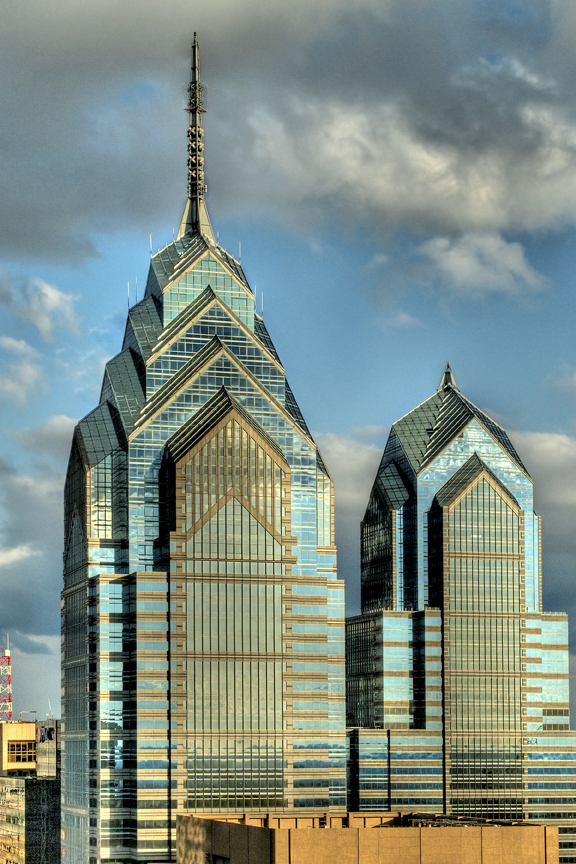
Liberty Place is a skyscraper complex in Philadelphia, Pennsylvania, United States. The complex is composed of a 61-story, 945-foot (288 m) skyscraper called One Liberty Place, a 58-story, 848-foot (258 m) skyscraper called Two Liberty Place, a two-story shopping mall called the Shops at Liberty Place, and the 14-story Westin Philadelphia Hotel.
Prior to the construction of Liberty Place, there was a gentlemen's agreement not to build any structure in Center City higher than the statue of William Penn on top of Philadelphia City Hall. The tradition lasted until 1984 when developer Willard G. Rouse III of Rouse & Associates announced plans to build an office building complex that included two towers taller than City Hall. There was a great amount of opposition to the construction of the towers with critics believing breaking the height limit would lead to construction of many more tall skyscrapers, ruining the livability and charm of Center City. Despite the opposition, construction of One Liberty Place was approved and the first phase of the project began in 1985 and was completed in 1987. The distinctive design and spire make the complex a recognizable part of the Philadelphia skyline.
Phase 2 of the project included Two Liberty Place, a hotel, a shopping mall, and a parking garage. Construction began 1988, after Cigna agreed to lease the entirety of the skyscraper for use as that company's world headquarters. Construction was completed in 1990, making Two Liberty Place the second-tallest building in the city. The two towers held their place as first- and second-tallest buildings in Philadelphia until the Comcast Center was topped off in 2007, which was surpassed in 2017 by the Comcast Technology Center. Liberty Place was received enthusiastically by critics and led to the construction of other tall skyscrapers giving Philadelphia what architecture critic Paul Goldberger called "one of the most appealing skylines of any major American city".
Liberty Place was designed by architect Helmut Jahn and his firm Murphy/Jahn. The steel and blue glass skyscrapers were heavily influenced by New York City's Chrysler Building. The major influence is the spire made of gabled angular setbacks. Two Liberty Place's spire is shorter and squatter, a design influenced by the needs of tenant Cigna. In the 2000s, Cigna reduced its presence in the tower, which led to the owners converting the upper floors into 122 luxury condominiums. Below the two towers is the 289 room Westin hotel and the 143,000 square feet (13,000 m2) Shops at Liberty Place. The main feature of the mall is a round atrium topped by a large glass dome.
In Philadelphia, Pennsylvania, a gentlemen's agreement informally prevented the construction of buildings in Center City that were higher than the statue of William Penn atop Philadelphia City Hall. The tradition lasted until the 1980s when developer Willard G. Rouse III of Rouse & Associates announced plans to build an office building complex that included two towers taller than City Hall. Prior to any development plans, Rouse wanted to acquire prime real estate in Philadelphia and he eyed a block in Center City occupied by parking lots and several small buildings. The Oliver Tyrone Pulver Corp. also eyed the land for development and the company and Rouse both vied for the block of land by buying small lots throughout the site. Neither developer was able to acquire enough contiguous space to build a large office building, so after a lawsuit and failed negotiations, the two developers agreed to an organized bidding war for each other's properties. Under the rules agreed upon, the highest bidder would get the option to buy the other's property. Rouse won the auction in 1983 for an undisclosed amount. Originally, Rouse envisioned a US$150 million 38-story skyscraper, but on April 5, 1984, Rouse officially announced his plans to build a complex that would include two office towers, one 65 stories the other 55 stories, a hotel, and retail space. Rumors and local lore speculate Rouse spent so much money buying the land that he had to build something that justified the expense.
Opposition to the project had begun before the official announcement at a Planning Commission meeting on April 5. The meeting was attended by 300 people and a number of attendees were opposed or skeptical of the idea that the skyscrapers would be taller than City Hall. Critics feared breaking the gentlemen's agreement would lead to the development of more tall skyscrapers that would end up dwarfing City Hall and changing the makeup of the city. Critic of the plan and former Philadelphia city planner Edmund Bacon said, "Once [the height ceiling is] smashed, it's gone." A phone poll conducted by the Philadelphia Daily News had callers opposing breaking the height barrier by 3,809 to 1,822. A Philadelphia Inquirer editorial feared the skyscrapers would ruin downtown. The location of City Hall was intended as the city's center from the city's founding, and critics feared taller buildings would move the city's center away from City Hall. Critics of breaking the height ceiling favored the smaller scale of the cityscape and felt that a Philadelphia with skyscrapers would affect the livability of the city. Edmund Bacon and Center City civic leaders said that Philadelphia owes its livability and charm to its low profile. Chairman of the City Planning Commission, Graham S. Finney, noted that there was a general feeling that the sky above the city was considered a public space. Supporters of breaking the height limitation noted that the project would bring needed jobs and business to Center City and that shorter buildings were already blocking views of City Hall from certain directions.
A planning commission meeting was held on May 3 to decide if they would approve skyscrapers that break the height limit. Executive director of the commissioners, Barbara J. Kaplan, said the project had "substantial merit" and "that there is an opportunity here we should not pass up." She cited that the project would create 12,000 jobs and US$15 million in tax revenue. Opponent Lee Copeland, dean of the University of Pennsylvania's Graduate School of Fine Arts, said the height limit was "a kind of Philadelphia golden rule which is part of the spirit and tradition of our past." The meeting ended with the commission deciding to prevent buildings taller than City Hall while it studies the issue for one year. In May, the Philadelphia City Council announced its support for the project because of the jobs it would create. On June 13, Philadelphia mayor Wilson Goode came out in favor of the project. He proposed the creation of a special ordinance that would allow buildings taller than City Hall between 16th and 20th Streets and the north side of Chestnut Street and the south side of John F. Kennedy Boulevard. Upset at the mayor's support for the project, Edmund Bacon resigned from a commission about Philadelphia's future. Bacon called the complex "a total disaster," adding that, "It absolutely decimates the scale of Center City, and once it's been done, there's no stopping it."
Phase 1 of the complex, called One Liberty Place, broke ground on May 13, 1985. One Liberty Place would be the tallest structure of the complex. The skyscraper became the tallest structure in Philadelphia on September 10, 1986, when the first 25-foot-long (7.6 m) steel columns of the skyscraper's 44th floor were installed. One Liberty Place was topped off on December 12 with a ceremony that included a laser light show and Mayor Goode, who said the tower "breaks the status quo of the city and says we arrived". On March 27, 1987, Robert Heenan, Jr., a 22-year-old glazier, fell 42 stories to his death after his safety line snapped when it got caught in a hoist mechanism. A month later, on May 27, the tower's spire was placed at the top of the building. Placing the spire was delayed when it was discovered sections of the spire didn't align with each other and had to be re-welded. Conrail became the first major tenant to lease space when it signed its lease in December 1985, but by April 1987 only twenty percent of the building was leased. Conrail became the first tenant to move in when the building officially opened on August 17.
Liberty Place
Liberty Place is a skyscraper complex in Philadelphia, Pennsylvania, United States. The complex is composed of a 61-story, 945-foot (288 m) skyscraper called One Liberty Place, a 58-story, 848-foot (258 m) skyscraper called Two Liberty Place, a two-story shopping mall called the Shops at Liberty Place, and the 14-story Westin Philadelphia Hotel.
Prior to the construction of Liberty Place, there was a gentlemen's agreement not to build any structure in Center City higher than the statue of William Penn on top of Philadelphia City Hall. The tradition lasted until 1984 when developer Willard G. Rouse III of Rouse & Associates announced plans to build an office building complex that included two towers taller than City Hall. There was a great amount of opposition to the construction of the towers with critics believing breaking the height limit would lead to construction of many more tall skyscrapers, ruining the livability and charm of Center City. Despite the opposition, construction of One Liberty Place was approved and the first phase of the project began in 1985 and was completed in 1987. The distinctive design and spire make the complex a recognizable part of the Philadelphia skyline.
Phase 2 of the project included Two Liberty Place, a hotel, a shopping mall, and a parking garage. Construction began 1988, after Cigna agreed to lease the entirety of the skyscraper for use as that company's world headquarters. Construction was completed in 1990, making Two Liberty Place the second-tallest building in the city. The two towers held their place as first- and second-tallest buildings in Philadelphia until the Comcast Center was topped off in 2007, which was surpassed in 2017 by the Comcast Technology Center. Liberty Place was received enthusiastically by critics and led to the construction of other tall skyscrapers giving Philadelphia what architecture critic Paul Goldberger called "one of the most appealing skylines of any major American city".
Liberty Place was designed by architect Helmut Jahn and his firm Murphy/Jahn. The steel and blue glass skyscrapers were heavily influenced by New York City's Chrysler Building. The major influence is the spire made of gabled angular setbacks. Two Liberty Place's spire is shorter and squatter, a design influenced by the needs of tenant Cigna. In the 2000s, Cigna reduced its presence in the tower, which led to the owners converting the upper floors into 122 luxury condominiums. Below the two towers is the 289 room Westin hotel and the 143,000 square feet (13,000 m2) Shops at Liberty Place. The main feature of the mall is a round atrium topped by a large glass dome.
In Philadelphia, Pennsylvania, a gentlemen's agreement informally prevented the construction of buildings in Center City that were higher than the statue of William Penn atop Philadelphia City Hall. The tradition lasted until the 1980s when developer Willard G. Rouse III of Rouse & Associates announced plans to build an office building complex that included two towers taller than City Hall. Prior to any development plans, Rouse wanted to acquire prime real estate in Philadelphia and he eyed a block in Center City occupied by parking lots and several small buildings. The Oliver Tyrone Pulver Corp. also eyed the land for development and the company and Rouse both vied for the block of land by buying small lots throughout the site. Neither developer was able to acquire enough contiguous space to build a large office building, so after a lawsuit and failed negotiations, the two developers agreed to an organized bidding war for each other's properties. Under the rules agreed upon, the highest bidder would get the option to buy the other's property. Rouse won the auction in 1983 for an undisclosed amount. Originally, Rouse envisioned a US$150 million 38-story skyscraper, but on April 5, 1984, Rouse officially announced his plans to build a complex that would include two office towers, one 65 stories the other 55 stories, a hotel, and retail space. Rumors and local lore speculate Rouse spent so much money buying the land that he had to build something that justified the expense.
Opposition to the project had begun before the official announcement at a Planning Commission meeting on April 5. The meeting was attended by 300 people and a number of attendees were opposed or skeptical of the idea that the skyscrapers would be taller than City Hall. Critics feared breaking the gentlemen's agreement would lead to the development of more tall skyscrapers that would end up dwarfing City Hall and changing the makeup of the city. Critic of the plan and former Philadelphia city planner Edmund Bacon said, "Once [the height ceiling is] smashed, it's gone." A phone poll conducted by the Philadelphia Daily News had callers opposing breaking the height barrier by 3,809 to 1,822. A Philadelphia Inquirer editorial feared the skyscrapers would ruin downtown. The location of City Hall was intended as the city's center from the city's founding, and critics feared taller buildings would move the city's center away from City Hall. Critics of breaking the height ceiling favored the smaller scale of the cityscape and felt that a Philadelphia with skyscrapers would affect the livability of the city. Edmund Bacon and Center City civic leaders said that Philadelphia owes its livability and charm to its low profile. Chairman of the City Planning Commission, Graham S. Finney, noted that there was a general feeling that the sky above the city was considered a public space. Supporters of breaking the height limitation noted that the project would bring needed jobs and business to Center City and that shorter buildings were already blocking views of City Hall from certain directions.
A planning commission meeting was held on May 3 to decide if they would approve skyscrapers that break the height limit. Executive director of the commissioners, Barbara J. Kaplan, said the project had "substantial merit" and "that there is an opportunity here we should not pass up." She cited that the project would create 12,000 jobs and US$15 million in tax revenue. Opponent Lee Copeland, dean of the University of Pennsylvania's Graduate School of Fine Arts, said the height limit was "a kind of Philadelphia golden rule which is part of the spirit and tradition of our past." The meeting ended with the commission deciding to prevent buildings taller than City Hall while it studies the issue for one year. In May, the Philadelphia City Council announced its support for the project because of the jobs it would create. On June 13, Philadelphia mayor Wilson Goode came out in favor of the project. He proposed the creation of a special ordinance that would allow buildings taller than City Hall between 16th and 20th Streets and the north side of Chestnut Street and the south side of John F. Kennedy Boulevard. Upset at the mayor's support for the project, Edmund Bacon resigned from a commission about Philadelphia's future. Bacon called the complex "a total disaster," adding that, "It absolutely decimates the scale of Center City, and once it's been done, there's no stopping it."
Phase 1 of the complex, called One Liberty Place, broke ground on May 13, 1985. One Liberty Place would be the tallest structure of the complex. The skyscraper became the tallest structure in Philadelphia on September 10, 1986, when the first 25-foot-long (7.6 m) steel columns of the skyscraper's 44th floor were installed. One Liberty Place was topped off on December 12 with a ceremony that included a laser light show and Mayor Goode, who said the tower "breaks the status quo of the city and says we arrived". On March 27, 1987, Robert Heenan, Jr., a 22-year-old glazier, fell 42 stories to his death after his safety line snapped when it got caught in a hoist mechanism. A month later, on May 27, the tower's spire was placed at the top of the building. Placing the spire was delayed when it was discovered sections of the spire didn't align with each other and had to be re-welded. Conrail became the first major tenant to lease space when it signed its lease in December 1985, but by April 1987 only twenty percent of the building was leased. Conrail became the first tenant to move in when the building officially opened on August 17.
Recent media
Recent media