



Community hub
Recent from talks
Contribute something to knowledge base
Content stats: 0 posts, 0 articles, 1 media, 0 notes
Members stats: 0 subscribers, 0 contributors, 0 moderators, 0 supporters
Subscribers
Supporters
Contributors
Moderators
Hub AI
Open-pit mining AI simulator
(@Open-pit mining_simulator)
Hub AI
Open-pit mining AI simulator
(@Open-pit mining_simulator)
Open-pit mining
Open-pit mining, also known as open-cast or open-cut mining and in larger contexts mega-mining, is a surface mining technique that extracts rock or minerals from the earth.
Open-pit mines are used when deposits of commercially useful ore or rocks are found near the surface where the overburden is relatively thin. In contrast, deeper mineral deposits can be reached using underground mining.
This form of mining carries several risks to the health and safety of miners, and can have a significant negative impact on the environment.
Miners typically drill a series of test holes to locate an underground ore body. From the extracted samples, they can determine the extent of the ore. This helps them determine the likely location of the veins or benches of ore and its commercial value. Open-pit mines that produce building materials and dimension stone are commonly referred to as quarries.
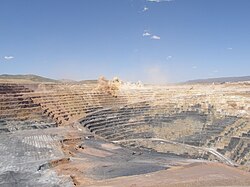
Open-cast mines are dug on benches, which describe vertical levels of the hole. The interval of the benches depends on the deposit being mined, the mineral being mined, and the size of the machinery that is being used. Generally, large mine benches are 12 to 15 metres thick. In contrast, many quarries do not use benches, as they are usually shallow. Mining can be conducted on more than one bench at a time, and access to different benches is done with a system of ramps. The width of each bench is determined by the size of the equipment being used, generally 20–40 metres wide. Downward ramps are created to allow mining on a new level to begin. This new level will become progressively wider to form the new pit bottom.
Most walls of the pit are generally mined on an angle less than vertical. Waste rock is stripped when the pit becomes deeper, therefore this angle is a safety precaution to prevent and minimize damage and danger from rock falls. However, this depends on how weathered and eroded the rocks are, and the type of rocks involved. It also depends on the amount of structural weaknesses occur within the rocks, such as a faults, shears, joints or foliations.
The walls are stepped. The inclined section of the wall is known as the batter, and the flat part of the step is known as the bench or berm. The steps in the walls help prevent rock falls continuing down the entire face of the wall. In some instances additional ground support is required and rock bolts, cable bolts and shotcrete are used. De-watering bores may be used to relieve water pressure by drilling horizontally into the wall, which is often enough to cause failures in the wall by itself.
A haul road is usually situated at the side of the pit, forming a ramp up which trucks can drive, carrying ore and waste rock.
Open-pit mining
Open-pit mining, also known as open-cast or open-cut mining and in larger contexts mega-mining, is a surface mining technique that extracts rock or minerals from the earth.
Open-pit mines are used when deposits of commercially useful ore or rocks are found near the surface where the overburden is relatively thin. In contrast, deeper mineral deposits can be reached using underground mining.
This form of mining carries several risks to the health and safety of miners, and can have a significant negative impact on the environment.
Miners typically drill a series of test holes to locate an underground ore body. From the extracted samples, they can determine the extent of the ore. This helps them determine the likely location of the veins or benches of ore and its commercial value. Open-pit mines that produce building materials and dimension stone are commonly referred to as quarries.
Open-cast mines are dug on benches, which describe vertical levels of the hole. The interval of the benches depends on the deposit being mined, the mineral being mined, and the size of the machinery that is being used. Generally, large mine benches are 12 to 15 metres thick. In contrast, many quarries do not use benches, as they are usually shallow. Mining can be conducted on more than one bench at a time, and access to different benches is done with a system of ramps. The width of each bench is determined by the size of the equipment being used, generally 20–40 metres wide. Downward ramps are created to allow mining on a new level to begin. This new level will become progressively wider to form the new pit bottom.
Most walls of the pit are generally mined on an angle less than vertical. Waste rock is stripped when the pit becomes deeper, therefore this angle is a safety precaution to prevent and minimize damage and danger from rock falls. However, this depends on how weathered and eroded the rocks are, and the type of rocks involved. It also depends on the amount of structural weaknesses occur within the rocks, such as a faults, shears, joints or foliations.
The walls are stepped. The inclined section of the wall is known as the batter, and the flat part of the step is known as the bench or berm. The steps in the walls help prevent rock falls continuing down the entire face of the wall. In some instances additional ground support is required and rock bolts, cable bolts and shotcrete are used. De-watering bores may be used to relieve water pressure by drilling horizontally into the wall, which is often enough to cause failures in the wall by itself.
A haul road is usually situated at the side of the pit, forming a ramp up which trucks can drive, carrying ore and waste rock.
Recent media
Recent media