
Recent from talks
Blind cave eel
Knowledge base stats:
Talk channels stats:
Members stats:
Blind cave eel
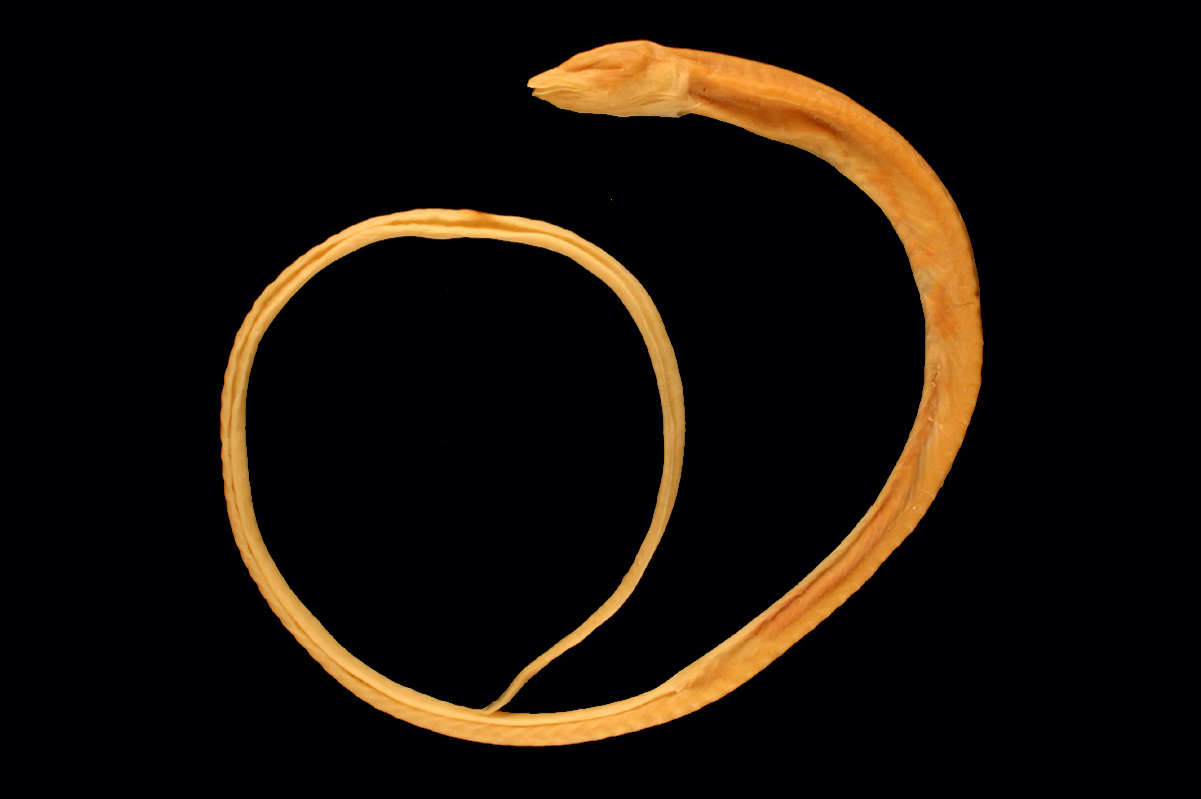
The blind cave eel (Ophisternon candidum) is a species of cavefish in the family Synbranchidae. It is the longest cavefish in Australia (up to 40 cm (16 in)) and one of the only three vertebrates in Australia that is restricted to underground waters, the other being the blind gudgeon (Milyeringa veritas) and the Barrow cave gudgeon (Milyeringa justitia). It is blind, its body is eel-like and elongated, and it has a non-pigmented skin with colours ranging from white to pink.
The blind cave eel is endemic to northwestern Australia, specifically in the Cape Range region, the Pilbara Region, and the Barrow Island region. It is rarely spotted due to its habitat and has only been spotted 36 times from 1959 to 2017. Notably, there is an evolving independent parentage in the Pilbara region showing a significant genetic difference from other blind cave eels.
The blind cave eel lives in a total darkness environment in underground waters disconnecting from the surface seawater. They typically live in caves and burrow into sediments. Their feeding include crustaceans, cave substrate organisms, and sometimes terrestrials washed into the cave system. Little is known about their behaviour except a finding revealing the male blind cave eel takes the responsibility of constructing and guarding their habitation.
The blind cave eel is an aquarium and research fish with no threat to humans. It is listed as vulnerable according to the Environment Protection and Biodiversity Conservation Act 1999 and listed as endangered according to the IUCN Red List. On 26 March 2008, the Australian Minister signed a piece of conservation advice acknowledging threats from human activities and the volatile environment. It then suggested priority actions for researchers, regional and local communities to assist in recovery. An obstacle to the conservation progress is identified as the inaccessibility of the blind cave eel, the situation is abate by the introduction of environmental DNA species-specific PCR assays in 2020 allows for a better sampling method.
In 1962, the species had an original description of Anommatophasma candidum with the word "Anommatophasma" representing a new genus. Subsequently, it is synonymised to "Ophisternon candidum" in 1976 by Rosen and Greenwood. The etymology of the scientific name Ophisternon candidum comes from the Greek word ophis which means "serpent", the Greek word sternon which means "chest" and the Latin word Candidus which means "white" referencing its skin colour.
The vernacular name of Ophisternon candidum is blind cave eel in Australia and United Kingdom, whereas its name is blind freshwater eel in the United States. The vernacular name suggests its eel-like body, living in a cave and having no visible eyes.
The blind cave eel is Australia's longest cavefish and may grow up to 400 mm (16 in). However, common total lengths for mature adults have an average of 340 mm (13 in) and range between 60 and 385 mm (2.4 and 15.2 in) . Its head length accounts for 5.6–6.3%, pre-anus length accounts for 35.8–41.8%, snout length accounts for 0.82–1.11% and gape length accounts for 1.59–2.01% of its total length.
Its body is round, elongated and eel-like. Its head is very short comparatively without visible external eyes. There are multiple indistinct pairs of slimy pores on its head. It has a large mouth and thick interior lips. It has several rows of strong teeth and a well-evolved tongue. There are two pairs of nostrils, the smaller pair being on top of the upper lip at the snout and the larger pair between the snout and its forehead. Several longitudinal cutaneous folds can be found around its throat. The blind cave eel has four pairs of evolved gills with a crescent in shape. The openings of its gills are extensive and horizontal. No scales or fins can be found except for the presence of a slim rayless membrane around the tail. There is an apparent lateral-line system from its head to close to the tip of its tail. Its anus is located in the front half of the body. Moreover, the blind cave eel has a total vertebrae ranging from 151 to 169 where 51–54 of them are pre-anal vertebrae and 97–117 of them are post-anal vertebrae.
Hub AI
Blind cave eel AI simulator
(@Blind cave eel_simulator)
Blind cave eel
The blind cave eel (Ophisternon candidum) is a species of cavefish in the family Synbranchidae. It is the longest cavefish in Australia (up to 40 cm (16 in)) and one of the only three vertebrates in Australia that is restricted to underground waters, the other being the blind gudgeon (Milyeringa veritas) and the Barrow cave gudgeon (Milyeringa justitia). It is blind, its body is eel-like and elongated, and it has a non-pigmented skin with colours ranging from white to pink.
The blind cave eel is endemic to northwestern Australia, specifically in the Cape Range region, the Pilbara Region, and the Barrow Island region. It is rarely spotted due to its habitat and has only been spotted 36 times from 1959 to 2017. Notably, there is an evolving independent parentage in the Pilbara region showing a significant genetic difference from other blind cave eels.
The blind cave eel lives in a total darkness environment in underground waters disconnecting from the surface seawater. They typically live in caves and burrow into sediments. Their feeding include crustaceans, cave substrate organisms, and sometimes terrestrials washed into the cave system. Little is known about their behaviour except a finding revealing the male blind cave eel takes the responsibility of constructing and guarding their habitation.
The blind cave eel is an aquarium and research fish with no threat to humans. It is listed as vulnerable according to the Environment Protection and Biodiversity Conservation Act 1999 and listed as endangered according to the IUCN Red List. On 26 March 2008, the Australian Minister signed a piece of conservation advice acknowledging threats from human activities and the volatile environment. It then suggested priority actions for researchers, regional and local communities to assist in recovery. An obstacle to the conservation progress is identified as the inaccessibility of the blind cave eel, the situation is abate by the introduction of environmental DNA species-specific PCR assays in 2020 allows for a better sampling method.
In 1962, the species had an original description of Anommatophasma candidum with the word "Anommatophasma" representing a new genus. Subsequently, it is synonymised to "Ophisternon candidum" in 1976 by Rosen and Greenwood. The etymology of the scientific name Ophisternon candidum comes from the Greek word ophis which means "serpent", the Greek word sternon which means "chest" and the Latin word Candidus which means "white" referencing its skin colour.
The vernacular name of Ophisternon candidum is blind cave eel in Australia and United Kingdom, whereas its name is blind freshwater eel in the United States. The vernacular name suggests its eel-like body, living in a cave and having no visible eyes.
The blind cave eel is Australia's longest cavefish and may grow up to 400 mm (16 in). However, common total lengths for mature adults have an average of 340 mm (13 in) and range between 60 and 385 mm (2.4 and 15.2 in) . Its head length accounts for 5.6–6.3%, pre-anus length accounts for 35.8–41.8%, snout length accounts for 0.82–1.11% and gape length accounts for 1.59–2.01% of its total length.
Its body is round, elongated and eel-like. Its head is very short comparatively without visible external eyes. There are multiple indistinct pairs of slimy pores on its head. It has a large mouth and thick interior lips. It has several rows of strong teeth and a well-evolved tongue. There are two pairs of nostrils, the smaller pair being on top of the upper lip at the snout and the larger pair between the snout and its forehead. Several longitudinal cutaneous folds can be found around its throat. The blind cave eel has four pairs of evolved gills with a crescent in shape. The openings of its gills are extensive and horizontal. No scales or fins can be found except for the presence of a slim rayless membrane around the tail. There is an apparent lateral-line system from its head to close to the tip of its tail. Its anus is located in the front half of the body. Moreover, the blind cave eel has a total vertebrae ranging from 151 to 169 where 51–54 of them are pre-anal vertebrae and 97–117 of them are post-anal vertebrae.
Recent media