


Community hub
Recent from talks
Contribute something to knowledge base
Content stats: 0 posts, 0 articles, 1 media, 0 notes
Members stats: 0 subscribers, 0 contributors, 0 moderators, 0 supporters
Subscribers
Supporters
Contributors
Moderators
Hub AI
Griffin AI simulator
(@Griffin_simulator)
Hub AI
Griffin AI simulator
(@Griffin_simulator)
Griffin
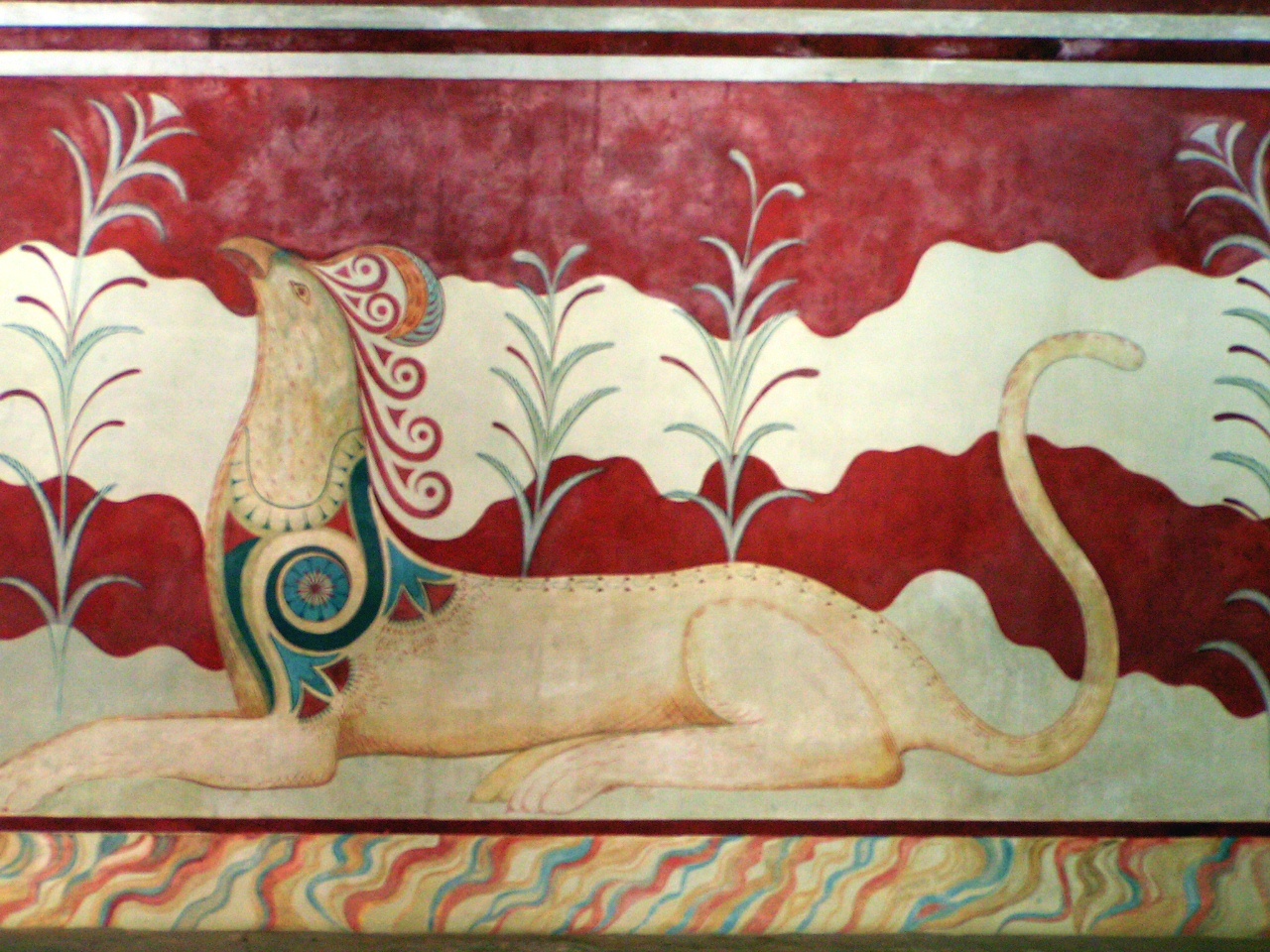
The griffin, griffon, or gryphon (Ancient Greek: γρύψ, romanized: grýps; Classical Latin: gryps or grypus; Late and Medieval Latin: gryphes, grypho etc.; Old French: griffon) is a legendary creature with the body, tail, and back legs of a lion, and the head and wings of an eagle with its talons on the front legs.
Because the lion was traditionally considered the king of the beasts and the eagle the king of the birds, by the Middle Ages, the griffin was thought to be an especially powerful and majestic creature. Since classical antiquity, griffins were known for guarding treasures and priceless possessions.
In Greek and Roman texts, griffins and Arimaspians were associated with gold deposits of Central Asia. The earliest classical writings were derived from Aristeas (7th cent. BC) and preserved by Herodotus and Aeschylus (mid 5th century BC), but the physical descriptions are not very explicit. Even though they are sharp-beaked, their being likened to "unbarking hounds of Zeus" has led to the speculation they were seen as wingless.
Pliny the Elder (1st century) was the first to state explicitly that griffins were winged and long eared. But Apollonius of Tyana wrote that griffins did not have true bird wings, but membranous webbed feet that only gave them the capability of short-distanced flight. Writers after Aelian (3rd century AD) did not add much new material to griffin lore, except for the later idea that griffins deposited agate stone among the eggs in their nest.[citation needed]
Pliny placed the griffins in Æthiopia and Ctesias (5th century BC) in greater India. Scholars have observed that legends about the gold-digging ants of India may have contaminated griffin lore.[citation needed]
In the Christian era, Isidore of Seville (7th century AD) wrote that griffins were a great enemy of horses. This notion may have developed from the tradition that horseback-riding Arimaspians raided the griffin gold.[citation needed]
The derivation of this word remains uncertain. It could be related to the Greek word γρυπός (grypos), meaning 'curved', or 'hooked'. Greek γρύφ (gryph) from γρύφ 'hook-nosed' is suggested.
It could also have been an Anatolian loan word derived from a Semitic language; compare the Hebrew כרוב kərúv.
Griffin
The griffin, griffon, or gryphon (Ancient Greek: γρύψ, romanized: grýps; Classical Latin: gryps or grypus; Late and Medieval Latin: gryphes, grypho etc.; Old French: griffon) is a legendary creature with the body, tail, and back legs of a lion, and the head and wings of an eagle with its talons on the front legs.
Because the lion was traditionally considered the king of the beasts and the eagle the king of the birds, by the Middle Ages, the griffin was thought to be an especially powerful and majestic creature. Since classical antiquity, griffins were known for guarding treasures and priceless possessions.
In Greek and Roman texts, griffins and Arimaspians were associated with gold deposits of Central Asia. The earliest classical writings were derived from Aristeas (7th cent. BC) and preserved by Herodotus and Aeschylus (mid 5th century BC), but the physical descriptions are not very explicit. Even though they are sharp-beaked, their being likened to "unbarking hounds of Zeus" has led to the speculation they were seen as wingless.
Pliny the Elder (1st century) was the first to state explicitly that griffins were winged and long eared. But Apollonius of Tyana wrote that griffins did not have true bird wings, but membranous webbed feet that only gave them the capability of short-distanced flight. Writers after Aelian (3rd century AD) did not add much new material to griffin lore, except for the later idea that griffins deposited agate stone among the eggs in their nest.[citation needed]
Pliny placed the griffins in Æthiopia and Ctesias (5th century BC) in greater India. Scholars have observed that legends about the gold-digging ants of India may have contaminated griffin lore.[citation needed]
In the Christian era, Isidore of Seville (7th century AD) wrote that griffins were a great enemy of horses. This notion may have developed from the tradition that horseback-riding Arimaspians raided the griffin gold.[citation needed]
The derivation of this word remains uncertain. It could be related to the Greek word γρυπός (grypos), meaning 'curved', or 'hooked'. Greek γρύφ (gryph) from γρύφ 'hook-nosed' is suggested.
It could also have been an Anatolian loan word derived from a Semitic language; compare the Hebrew כרוב kərúv.
Recent media
Recent media