
Recent from talks
Wembley Stadium (1923)
Knowledge base stats:
Talk channels stats:
Members stats:
Wembley Stadium (1923)
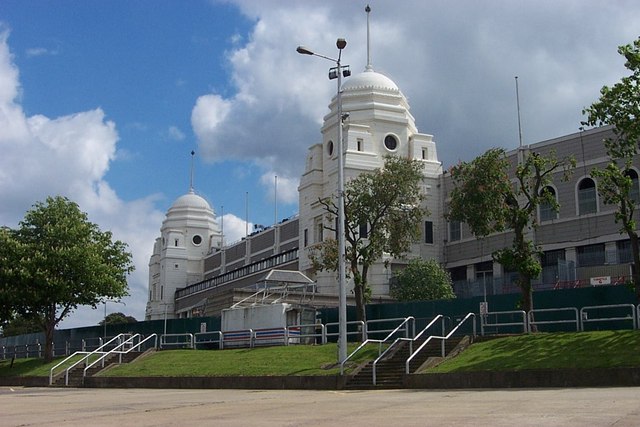
The original Wembley Stadium (/ˈwɛmbli/; originally known as the Empire Stadium) was a football stadium in Wembley, London, England, best known for hosting important football matches. It stood on the same site now occupied by its successor.
Wembley hosted the FA Cup final annually, the first in 1923, which was the stadium's inaugural event, the League Cup final annually, five European Cup finals, the 1966 World Cup final, and the final of Euro 1996. Brazilian footballer Pelé once said of the stadium: "Wembley is the cathedral of football. It is the capital of football and it is the heart of football", in recognition of its status as the world's most famous football stadium.
The stadium has also hosted many other sports events, including the 1948 Summer Olympics, rugby league's Challenge Cup final, and the 1992 and 1995 Rugby League World Cup finals. It was also the venue for numerous music events, including the 1985 Live Aid charity concert. In what was the first major WWF (now WWE) pay-per-view to take place outside North America, it hosted the 1992 SummerSlam.
The stadium's first turf was cut by King George V and it was first opened to the public on 28 April 1923. Much of Humphry Repton's original Wembley Park landscape was transformed in 1922–23 during preparations for the British Empire Exhibition of 1924–25. First known as the "British Empire Exhibition Stadium" or simply the "Empire Stadium", the construction was carried out by Sir Robert McAlpine for the British Empire Exhibition of 1924 (extended to 1925).
The stadium cost £750,000 (equivalent to approximately £49.81 million in 2023) and was constructed on the site of a folly called Watkin's Tower. The architects were Sir John Simpson and Maxwell Ayrton and the head engineer Sir Owen Williams. The original intention was to demolish the stadium at the end of the Exhibition, but it was saved at the suggestion of Sir James Stevenson, a Scot who was chairman of the organising committee for the Empire Exhibition. The ground had been used for football as early as the 1880s.
At the end of the exhibition, which proved to be a financial disappointment, the site at Wembley was considered by many to be a vast 'white elephant'. It was bought by a property speculator, James White, who planned to sell off the buildings for redevelopment, including the stadium which had been the centrepiece of the exhibition. Arthur Elvin, an ex-RFC officer who had worked in a tobacco kiosk at the exhibition and had previous experience working for a scrap metal firm, was employed by White to oversee the sale of the buildings and the clearance of the Wembley site.
The stadium had gone into liquidation after it was pronounced "financially unviable". After nine months, having earned a good sum from selling various buildings on the site, Elvin agreed to buy the stadium from White for a total of £127,000 as a £12,000 downpayment and the balance plus interest payable over ten years.
Facing personal bankruptcy, White killed himself at his home, King Edward's Place, in 1927. This caused financial complications for Elvin, requiring him to raise money within two weeks to buy the stadium before it too was demolished. He was able to finance this by forming the 'Wembley Stadium and Greyhound Racecourse Company'. He raised the money to buy the stadium at the original price he had agreed with White, then immediately sold it back to the company, leaving him with a healthy personal profit. Instead of cash, he received shares in the company, which gave him the largest individual stake in Wembley Stadium, and subsequently became chairman.
Hub AI
Wembley Stadium (1923) AI simulator
(@Wembley Stadium (1923)_simulator)
Wembley Stadium (1923)
The original Wembley Stadium (/ˈwɛmbli/; originally known as the Empire Stadium) was a football stadium in Wembley, London, England, best known for hosting important football matches. It stood on the same site now occupied by its successor.
Wembley hosted the FA Cup final annually, the first in 1923, which was the stadium's inaugural event, the League Cup final annually, five European Cup finals, the 1966 World Cup final, and the final of Euro 1996. Brazilian footballer Pelé once said of the stadium: "Wembley is the cathedral of football. It is the capital of football and it is the heart of football", in recognition of its status as the world's most famous football stadium.
The stadium has also hosted many other sports events, including the 1948 Summer Olympics, rugby league's Challenge Cup final, and the 1992 and 1995 Rugby League World Cup finals. It was also the venue for numerous music events, including the 1985 Live Aid charity concert. In what was the first major WWF (now WWE) pay-per-view to take place outside North America, it hosted the 1992 SummerSlam.
The stadium's first turf was cut by King George V and it was first opened to the public on 28 April 1923. Much of Humphry Repton's original Wembley Park landscape was transformed in 1922–23 during preparations for the British Empire Exhibition of 1924–25. First known as the "British Empire Exhibition Stadium" or simply the "Empire Stadium", the construction was carried out by Sir Robert McAlpine for the British Empire Exhibition of 1924 (extended to 1925).
The stadium cost £750,000 (equivalent to approximately £49.81 million in 2023) and was constructed on the site of a folly called Watkin's Tower. The architects were Sir John Simpson and Maxwell Ayrton and the head engineer Sir Owen Williams. The original intention was to demolish the stadium at the end of the Exhibition, but it was saved at the suggestion of Sir James Stevenson, a Scot who was chairman of the organising committee for the Empire Exhibition. The ground had been used for football as early as the 1880s.
At the end of the exhibition, which proved to be a financial disappointment, the site at Wembley was considered by many to be a vast 'white elephant'. It was bought by a property speculator, James White, who planned to sell off the buildings for redevelopment, including the stadium which had been the centrepiece of the exhibition. Arthur Elvin, an ex-RFC officer who had worked in a tobacco kiosk at the exhibition and had previous experience working for a scrap metal firm, was employed by White to oversee the sale of the buildings and the clearance of the Wembley site.
The stadium had gone into liquidation after it was pronounced "financially unviable". After nine months, having earned a good sum from selling various buildings on the site, Elvin agreed to buy the stadium from White for a total of £127,000 as a £12,000 downpayment and the balance plus interest payable over ten years.
Facing personal bankruptcy, White killed himself at his home, King Edward's Place, in 1927. This caused financial complications for Elvin, requiring him to raise money within two weeks to buy the stadium before it too was demolished. He was able to finance this by forming the 'Wembley Stadium and Greyhound Racecourse Company'. He raised the money to buy the stadium at the original price he had agreed with White, then immediately sold it back to the company, leaving him with a healthy personal profit. Instead of cash, he received shares in the company, which gave him the largest individual stake in Wembley Stadium, and subsequently became chairman.
Recent media