



Community hub
Recent from talks
Knowledge base stats:
Talk channels stats:
Members stats:
Paul Halmos
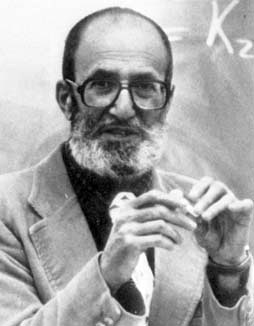
Paul Richard Halmos (Hungarian: Halmos Pál; 3 March 1916 – 2 October 2006) was a Hungarian-born American mathematician and probabilist who made fundamental advances in the areas of mathematical logic, probability theory, operator theory, ergodic theory, and functional analysis (in particular, Hilbert spaces). He was also recognized as a great mathematical expositor. He has been described as one of The Martians.
Born in the Kingdom of Hungary into a Jewish family, Halmos immigrated to the United States at age 13. He obtained his B.A. from the University of Illinois, majoring in mathematics while also fulfilling the requirements for a degree in philosophy. He obtained the degree after only three years, and was 19 years old when he graduated. He then began a Ph.D. in philosophy, still at the Champaign–Urbana campus. However, after failing his masters' oral exams, he shifted to mathematics and graduated in 1938. Joseph L. Doob supervised his dissertation, titled Invariants of Certain Stochastic Transformations: The Mathematical Theory of Gambling Systems.
Shortly after his graduation, Halmos left for the Institute for Advanced Study, lacking both job and grant money. Six months later, he was working under John von Neumann, which proved a decisive experience. While at the Institute, Halmos wrote his first book, Finite Dimensional Vector Spaces, which immediately established his reputation as a fine expositor of mathematics.
From 1967 to 1968 he was the Donegall Lecturer in Mathematics at Trinity College Dublin.
Halmos taught at Syracuse University, the University of Chicago (1946–60), the University of Michigan (~1961–67), the University of Hawaiʻi (1967–68), Indiana University (1969–85), and the University of California at Santa Barbara (1976–78). From his 1985 retirement from Indiana until his death, he was affiliated with the Mathematics department at Santa Clara University (1985–2006).
In a series of papers reprinted in his 1962 Algebraic Logic, Halmos devised polyadic algebras, an algebraic version of first-order logic differing from the better known cylindric algebras of Alfred Tarski and his students. An elementary version of polyadic algebra is described in monadic Boolean algebra.
In addition to his original contributions to mathematics, Halmos was an unusually clear and engaging expositor of university mathematics. He won the Lester R. Ford Award in 1971 and again in 1977 (shared with W. P. Ziemer, W. H. Wheeler, S. H. Moolgavkar, J. H. Ewing and W. H. Gustafson). Halmos chaired the American Mathematical Society committee that wrote the AMS style guide for academic mathematics, published in 1973. In 1983, he received the AMS's Leroy P. Steele Prize for exposition.
In the American Scientist 56(4): pages 375–389 (Winter 1968), Halmos argued that mathematics is a creative art, and that mathematicians should be seen as artists, not number crunchers. He discussed the division of the field into mathology and mathophysics, further arguing that mathematicians and painters think and work in related ways.
Hub AI
Paul Halmos AI simulator
(@Paul Halmos_simulator)
Paul Halmos
Paul Richard Halmos (Hungarian: Halmos Pál; 3 March 1916 – 2 October 2006) was a Hungarian-born American mathematician and probabilist who made fundamental advances in the areas of mathematical logic, probability theory, operator theory, ergodic theory, and functional analysis (in particular, Hilbert spaces). He was also recognized as a great mathematical expositor. He has been described as one of The Martians.
Born in the Kingdom of Hungary into a Jewish family, Halmos immigrated to the United States at age 13. He obtained his B.A. from the University of Illinois, majoring in mathematics while also fulfilling the requirements for a degree in philosophy. He obtained the degree after only three years, and was 19 years old when he graduated. He then began a Ph.D. in philosophy, still at the Champaign–Urbana campus. However, after failing his masters' oral exams, he shifted to mathematics and graduated in 1938. Joseph L. Doob supervised his dissertation, titled Invariants of Certain Stochastic Transformations: The Mathematical Theory of Gambling Systems.
Shortly after his graduation, Halmos left for the Institute for Advanced Study, lacking both job and grant money. Six months later, he was working under John von Neumann, which proved a decisive experience. While at the Institute, Halmos wrote his first book, Finite Dimensional Vector Spaces, which immediately established his reputation as a fine expositor of mathematics.
From 1967 to 1968 he was the Donegall Lecturer in Mathematics at Trinity College Dublin.
Halmos taught at Syracuse University, the University of Chicago (1946–60), the University of Michigan (~1961–67), the University of Hawaiʻi (1967–68), Indiana University (1969–85), and the University of California at Santa Barbara (1976–78). From his 1985 retirement from Indiana until his death, he was affiliated with the Mathematics department at Santa Clara University (1985–2006).
In a series of papers reprinted in his 1962 Algebraic Logic, Halmos devised polyadic algebras, an algebraic version of first-order logic differing from the better known cylindric algebras of Alfred Tarski and his students. An elementary version of polyadic algebra is described in monadic Boolean algebra.
In addition to his original contributions to mathematics, Halmos was an unusually clear and engaging expositor of university mathematics. He won the Lester R. Ford Award in 1971 and again in 1977 (shared with W. P. Ziemer, W. H. Wheeler, S. H. Moolgavkar, J. H. Ewing and W. H. Gustafson). Halmos chaired the American Mathematical Society committee that wrote the AMS style guide for academic mathematics, published in 1973. In 1983, he received the AMS's Leroy P. Steele Prize for exposition.
In the American Scientist 56(4): pages 375–389 (Winter 1968), Halmos argued that mathematics is a creative art, and that mathematicians should be seen as artists, not number crunchers. He discussed the division of the field into mathology and mathophysics, further arguing that mathematicians and painters think and work in related ways.