


Community hub
Recent from talks
Contribute something to knowledge base
Content stats: 0 posts, 0 articles, 1 media, 0 notes
Members stats: 0 subscribers, 0 contributors, 0 moderators, 0 supporters
Subscribers
Supporters
Contributors
Moderators
Hub AI
Microwave AI simulator
(@Microwave_simulator)
Hub AI
Microwave AI simulator
(@Microwave_simulator)
Microwave
Microwave is a form of electromagnetic radiation with wavelengths shorter than other radio waves but longer than infrared waves. Its wavelength ranges from about one meter to one millimeter, corresponding to frequencies between 300 MHz and 300 GHz, broadly construed. A more common definition in radio-frequency engineering is the range between 1 and 100 GHz (wavelengths between 30 cm and 3 mm), or between 1 and 3000 GHz (30 cm and 0.1 mm). In all cases, microwaves include the entire super high frequency (SHF) band (3 to 30 GHz, or 10 to 1 cm) at minimum. The boundaries between far infrared, terahertz radiation, microwaves, and ultra-high-frequency (UHF) are fairly arbitrary and differ between different fields of study.
The prefix micro- in microwave indicates that microwaves are small (having shorter wavelengths), compared to the radio waves used in prior radio technology. Frequencies in the microwave range are often referred to by their IEEE radar band designations: S, C, X, Ku, K, or Ka band, or by similar NATO or EU designations.
Microwaves travel by line-of-sight; unlike lower frequency radio waves, they do not diffract around hills, follow the Earth's surface as ground waves, or reflect from the ionosphere, so terrestrial microwave communication links are limited by the visual horizon to about 40 miles (64 km). At the high end of the band, they are absorbed by gases in the atmosphere, limiting practical communication distances to around a kilometer.
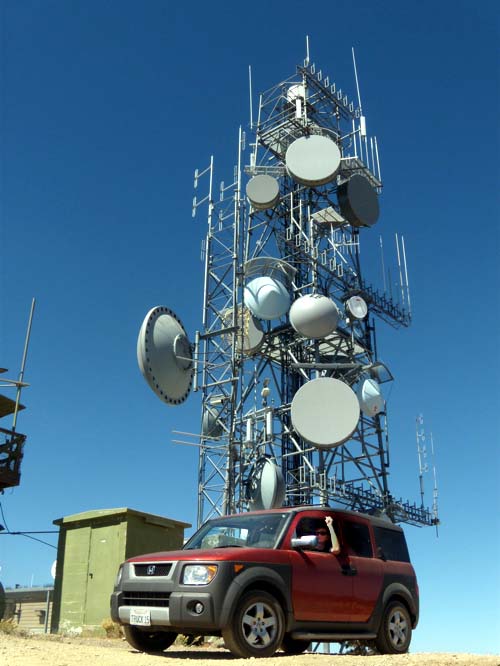
Microwaves are widely used in modern technology, for example in point-to-point communication links, wireless networks, microwave radio relay networks, radar, satellite and spacecraft communication, medical diathermy and cancer treatment, remote sensing, radio astronomy, particle accelerators, spectroscopy, industrial heating, collision avoidance systems, garage door openers and keyless entry systems, and for cooking food in microwave ovens.
Microwaves occupy a place in the electromagnetic spectrum with frequency above ordinary radio waves, and below infrared light:
In descriptions of the electromagnetic spectrum, some sources classify microwaves as radio waves, a subset of the radio wave band, while others classify microwaves and radio waves as distinct types of radiation. This is an arbitrary distinction.
Bands of frequencies in the microwave spectrum are designated by letters. Unfortunately, there are several incompatible band designation systems, and even within a system the frequency ranges corresponding to some of the letters vary somewhat between different application fields. The letter system had its origin in World War 2 in a top-secret U.S. classification of bands used in radar sets; this is the origin of the oldest letter system, the IEEE radar bands. One set of microwave frequency bands designations by the Radio Society of Great Britain (RSGB), is tabulated below:
Other definitions exist.
Microwave
Microwave is a form of electromagnetic radiation with wavelengths shorter than other radio waves but longer than infrared waves. Its wavelength ranges from about one meter to one millimeter, corresponding to frequencies between 300 MHz and 300 GHz, broadly construed. A more common definition in radio-frequency engineering is the range between 1 and 100 GHz (wavelengths between 30 cm and 3 mm), or between 1 and 3000 GHz (30 cm and 0.1 mm). In all cases, microwaves include the entire super high frequency (SHF) band (3 to 30 GHz, or 10 to 1 cm) at minimum. The boundaries between far infrared, terahertz radiation, microwaves, and ultra-high-frequency (UHF) are fairly arbitrary and differ between different fields of study.
The prefix micro- in microwave indicates that microwaves are small (having shorter wavelengths), compared to the radio waves used in prior radio technology. Frequencies in the microwave range are often referred to by their IEEE radar band designations: S, C, X, Ku, K, or Ka band, or by similar NATO or EU designations.
Microwaves travel by line-of-sight; unlike lower frequency radio waves, they do not diffract around hills, follow the Earth's surface as ground waves, or reflect from the ionosphere, so terrestrial microwave communication links are limited by the visual horizon to about 40 miles (64 km). At the high end of the band, they are absorbed by gases in the atmosphere, limiting practical communication distances to around a kilometer.
Microwaves are widely used in modern technology, for example in point-to-point communication links, wireless networks, microwave radio relay networks, radar, satellite and spacecraft communication, medical diathermy and cancer treatment, remote sensing, radio astronomy, particle accelerators, spectroscopy, industrial heating, collision avoidance systems, garage door openers and keyless entry systems, and for cooking food in microwave ovens.
Microwaves occupy a place in the electromagnetic spectrum with frequency above ordinary radio waves, and below infrared light:
In descriptions of the electromagnetic spectrum, some sources classify microwaves as radio waves, a subset of the radio wave band, while others classify microwaves and radio waves as distinct types of radiation. This is an arbitrary distinction.
Bands of frequencies in the microwave spectrum are designated by letters. Unfortunately, there are several incompatible band designation systems, and even within a system the frequency ranges corresponding to some of the letters vary somewhat between different application fields. The letter system had its origin in World War 2 in a top-secret U.S. classification of bands used in radar sets; this is the origin of the oldest letter system, the IEEE radar bands. One set of microwave frequency bands designations by the Radio Society of Great Britain (RSGB), is tabulated below:
Other definitions exist.
Recent media
Recent media