




Community hub
Recent from talks
Contribute something to knowledge base
Content stats: 0 posts, 0 articles, 1 media, 0 notes
Members stats: 0 subscribers, 0 contributors, 0 moderators, 0 supporters
Subscribers
Supporters
Contributors
Moderators
Palazzo Falson
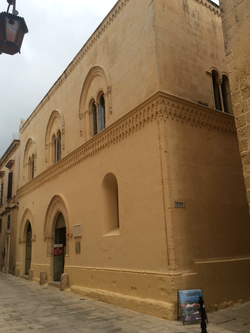
Palazzo Falson, formerly known as Palazzo Cumbo-Navarra, Casa dei Castelletti, and the Norman House, is a medieval townhouse in Mdina, Malta. It was built as a family residence by the Maltese nobility, and is named after the Falson family. It is presently open to the public as a house-museum with seventeen rooms of historic domestic belongings and a number of antique collections.
The building is believed to have been built around 1495, probably incorporating parts of a 13th-century building. This makes it the second oldest building in Mdina, after the ground floor of Palazzo Santa Sofia. During the rule of the Order of St. John, the building might have received Philippe Villiers de L'Isle-Adam, the first Grand Master in Malta. The building was further enlarged in the mid-16th century. Its architect is unknown, but the distinctive upper floor windows might be the work of Jacobo Dimeg.
Palazzo Falson was acquired by Olof Frederick Gollcher in the 20th century, and he restored and altered parts of the building. It is now owned by a foundation established by Gollcher, and since 2007 it has been open to the public as the Palazzo Falson Historic House Museum, which is managed by the Fondazzjoni Patrimonju Malti, a Maltese heritage foundation. It displays permanent collections which originally belonged to Gollcher, and occasionally other temporary exhibits from private collections.
The building was included on the Antiquities List of 1925. It has been a Grade 1 scheduled property since 1992, and is on the list of the National Inventory of the Cultural Property of the Maltese Islands.
The Falsone family was one of the prominent families of medieval Mdina, and its members were often involved in the city's municipal affairs. The earliest recorded reference to the family dates back to 1299.
The site of Palazzo Falson was originally occupied by a building known as La Rocca. By the 13th century, a single-story house had been built, and eventually a synagogue existed on the site. According to Quentin Hughes, the ground floor of the present building was built in around 1495, probably incorporating parts of the synagogue. Changes to the façade, including a shift in the orientation of the building as well as the addition of a double serrated string course and the hood mould framing the main doorway were completed at this point. These features are typical of the Siculo-Norman style, prevalent in the period.
According to tradition, soon after the arrival of the Order of St. John in Malta, Grand Master Philippe Villiers de L'Isle-Adam visited the palace for a banquet after a ceremony in which he took possession of Mdina on 13 November 1530. L'Isle-Adam's visit to the Falsone residence in Mdina is documented by Giovanni Francesco Abela in his 1647 book Della Descrittione di Malta, and until recently, the residence in question was assumed to be Palazzo Falson. However, there is some uncertainty as who owned the palace at the time. Documents suggest that the building originally belonged to the Cumbo family, and that the main branch of the Falsone family never owned the palace. On the other hand, some sources claim that in the 16th century the building was owned by Ambrosio de Falsone, Head of the Town Council, and in 1524 it was inherited by his cousin, Vice-Admiral Michele Falsone. The latter is said to have made further changes to the building including the addition of mullioned windows on the second floor. These windows are sometimes known in Italian and Maltese architecture as bifora. The decorative windows were probably designed by the local architect Jacobo Dimeg (1464-1527). The palace's piano nobile is believed to have been added in the mid-16th century.
The building eventually passed to Matteo Falson, who was the Master of the Rod. He fled to Sicily in 1574 after being persecuted by the Inquisition for his Lutheran views. The palace was seized by the Inquisition and it eventually passed to the Cumbo-Navarra family.
Palazzo Falson
Palazzo Falson, formerly known as Palazzo Cumbo-Navarra, Casa dei Castelletti, and the Norman House, is a medieval townhouse in Mdina, Malta. It was built as a family residence by the Maltese nobility, and is named after the Falson family. It is presently open to the public as a house-museum with seventeen rooms of historic domestic belongings and a number of antique collections.
The building is believed to have been built around 1495, probably incorporating parts of a 13th-century building. This makes it the second oldest building in Mdina, after the ground floor of Palazzo Santa Sofia. During the rule of the Order of St. John, the building might have received Philippe Villiers de L'Isle-Adam, the first Grand Master in Malta. The building was further enlarged in the mid-16th century. Its architect is unknown, but the distinctive upper floor windows might be the work of Jacobo Dimeg.
Palazzo Falson was acquired by Olof Frederick Gollcher in the 20th century, and he restored and altered parts of the building. It is now owned by a foundation established by Gollcher, and since 2007 it has been open to the public as the Palazzo Falson Historic House Museum, which is managed by the Fondazzjoni Patrimonju Malti, a Maltese heritage foundation. It displays permanent collections which originally belonged to Gollcher, and occasionally other temporary exhibits from private collections.
The building was included on the Antiquities List of 1925. It has been a Grade 1 scheduled property since 1992, and is on the list of the National Inventory of the Cultural Property of the Maltese Islands.
The Falsone family was one of the prominent families of medieval Mdina, and its members were often involved in the city's municipal affairs. The earliest recorded reference to the family dates back to 1299.
The site of Palazzo Falson was originally occupied by a building known as La Rocca. By the 13th century, a single-story house had been built, and eventually a synagogue existed on the site. According to Quentin Hughes, the ground floor of the present building was built in around 1495, probably incorporating parts of the synagogue. Changes to the façade, including a shift in the orientation of the building as well as the addition of a double serrated string course and the hood mould framing the main doorway were completed at this point. These features are typical of the Siculo-Norman style, prevalent in the period.
According to tradition, soon after the arrival of the Order of St. John in Malta, Grand Master Philippe Villiers de L'Isle-Adam visited the palace for a banquet after a ceremony in which he took possession of Mdina on 13 November 1530. L'Isle-Adam's visit to the Falsone residence in Mdina is documented by Giovanni Francesco Abela in his 1647 book Della Descrittione di Malta, and until recently, the residence in question was assumed to be Palazzo Falson. However, there is some uncertainty as who owned the palace at the time. Documents suggest that the building originally belonged to the Cumbo family, and that the main branch of the Falsone family never owned the palace. On the other hand, some sources claim that in the 16th century the building was owned by Ambrosio de Falsone, Head of the Town Council, and in 1524 it was inherited by his cousin, Vice-Admiral Michele Falsone. The latter is said to have made further changes to the building including the addition of mullioned windows on the second floor. These windows are sometimes known in Italian and Maltese architecture as bifora. The decorative windows were probably designed by the local architect Jacobo Dimeg (1464-1527). The palace's piano nobile is believed to have been added in the mid-16th century.
The building eventually passed to Matteo Falson, who was the Master of the Rod. He fled to Sicily in 1574 after being persecuted by the Inquisition for his Lutheran views. The palace was seized by the Inquisition and it eventually passed to the Cumbo-Navarra family.
Recent media
Recent media